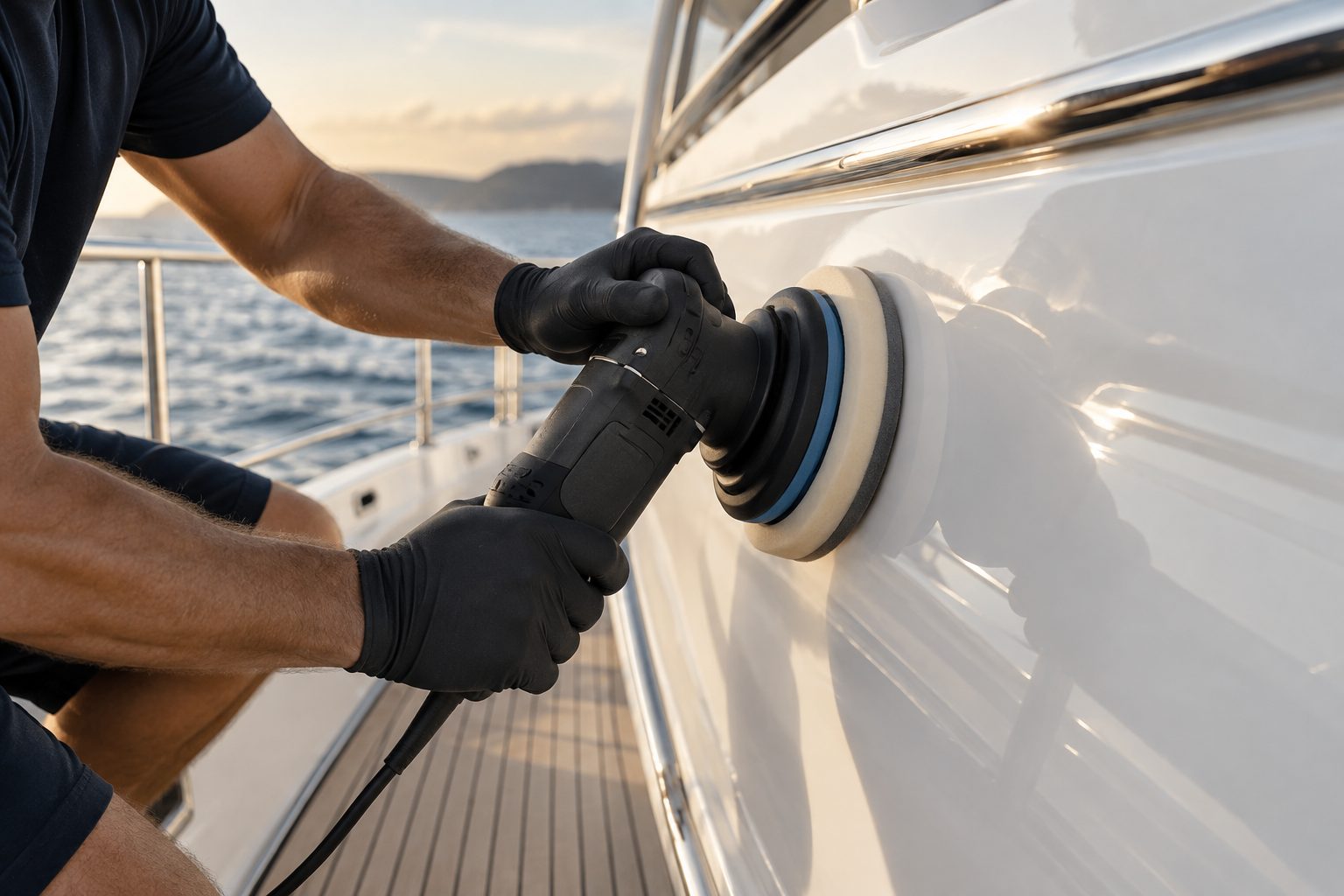
What protection layers are for
Bare gelcoat and paint are exposed to ultraviolet light, salt, water, pollution, bird droppings and the abrasion of regular washing. A protective layer sits over the finish and takes much of that wear instead. It gives the surface a smoother, slicker feel, helps water bead and sheet off, and makes dirt and salt release more easily when you wash.
Protection does not repair a damaged surface and does not make it immune to wear. It is a sacrificial or semi-permanent shield that slows the aging of the finish underneath. It also changes how the boat looks, from the warm glow of wax to the sharp, glassy look of a coating.
All three types can work well when applied to a properly prepared surface. Problems usually arise from mismatched expectations, poor preparation, or skipping upkeep. Understanding the differences helps avoid disappointment.
Marine wax
Wax is the traditional choice. It is usually based on natural waxes such as carnauba, sometimes blended with polymers. It adds warm depth and gloss, fills microscopic roughness and leaves a protective film. It is typically easy to apply, forgiving of technique and pleasant to work with, which is why many owners apply it themselves.
The tradeoff is durability. Wax sits on the surface rather than bonding to it, and in marine conditions heat, sun, salt and washing break it down relatively quickly compared with other options. It needs to be reapplied more often to keep protection in place. Strong soaps and harsh cleaners shorten its life further.
Wax suits owners who enjoy the ritual, who want a warm look and who are happy to renew regularly. It also suits older finishes where a gentle approach is wanted. It is less suited to a boat that is hard to reach often or sits in a punishing environment with little attention.
- Warm, deep gloss and easy application.
- Forgiving of technique, good for owners who do it themselves.
- Shortest durability of the three, needs regular renewal.
- Wears faster with harsh soaps, strong sun and frequent washing.
- Good for owners who like regular upkeep.
Synthetic sealants
Marine sealants are polymer products designed to bond more tightly to the finish than wax and to resist heat and wash. They form a harder, more uniform film and tend to hold up longer in sun and salt. They produce a sharper, more reflective look than wax, which some owners prefer and some find less warm.
Preparation matters more than with wax. The surface should be clean, with old wax, oils and polish residue removed so the sealant can bond. Many sealants cure over hours, and humidity, temperature and sun at the time of application affect the result. Instructions differ by product, so follow the label.
Sealants sit in the middle: more durable than wax, less demanding than a coating. They suit owners who want longer protection without the preparation and commitment of a ceramic coating, and who are willing to reapply periodically. Our service page on boat sealant application describes how this is handled dockside.
Ceramic coatings
Ceramic coatings are liquid products that cure into a hard, thin, chemically bonded layer on the surface. They are designed to resist ultraviolet light, salt, chemicals and staining, and to create a slick surface that sheds water and dirt. They tend to produce a very glossy, glass-like look and make washing noticeably easier.
They are also the most demanding. The surface has to be thoroughly cleaned and corrected first, because the coating seals in whatever is under it, including oxidation, swirls and stains. Application needs care and the right conditions, since coatings cure on contact and mistakes are difficult to undo. Removing a coating usually means abrasive correction.
Coatings are not scratch proof and do not remove the need for upkeep. They resist some wear but can still be marred, and they need proper washing and periodic upkeep products to perform. Claims of lifetime protection should be treated with caution. For more detail, see our ceramic coating service page and maintenance notes.
- Hard, bonded layer, intended to be the most durable.
- Very glossy look, easier washing.
- Needs thorough correction and preparation first.
- Difficult to remove or correct if applied poorly.
- Still needs proper washing and periodic maintenance.
Side by side, in qualitative terms
Numbers about durability are often marketing. How long a product lasts depends on the surface, preparation, how much sun and salt the boat sees, where it is kept, how often it is washed and with what. That is why the table below uses relative terms instead of figures. Use it to compare the general character of each option.
No row in this table is a promise about your particular boat. A well prepared sealant can outlast a poorly prepared coating. A coating on a boat that is never washed properly can look worse than a regularly renewed wax. Conditions and care matter as much as the product.
| Factor | Wax | Sealant | Ceramic coating |
|---|---|---|---|
| Relative durability | Shortest | Moderate | Longest of the three |
| Look | Warm, deep | Sharp, reflective | Glassy, very slick |
| Preparation needed | Light to moderate | Moderate | Extensive correction |
| Forgiveness if applied poorly | High, easy to redo | Moderate | Low, hard to undo |
| Ease of later washing | Helpful | Good | Very good |
| Upkeep | Frequent renewal | Periodic renewal | Proper washing and maintenance products |
| Best for | Owners who enjoy regular care | Balance of effort and durability | Boats worth a full correction and long-term plan |
Preparation is where results are decided
Whichever product you choose, preparation determines the outcome. The surface should be washed, decontaminated and, where needed, corrected. Oxidation, old wax, stains, rust and fuel residue all interfere with bonding or are sealed in as they are. A protective layer applied over a poor surface preserves the poor surface.
For wax, prep may be a wash and a cleaner wax. For sealants, prep usually includes a cleaning step to remove old products and oils. For coatings, prep is often the largest part of the job, including compounding and polishing to the level the finish can safely tolerate, followed by a panel wipe to remove polishing oils before application.
Prep also depends on the finish. On gelcoat, correction can be more thorough. On paint, correction must be gentle because the layer is thin. See our guide to gelcoat and painted hull care for why that matters.
- Wash thoroughly and decontaminate the surface.
- Treat stains and rust that would be locked under protection.
- Correct oxidation and defects as the finish allows.
- Remove polish residue so the product can bond.
- Apply the chosen protection in suitable weather and let it cure.
Repair, correction and removal
Sooner or later, protection needs renewing or removing. Wax can be washed away or stripped with a cleaner and reapplied. Sealants can be removed with the right cleaner or a light polish before a new layer goes on. Coatings are the hardest, because they are designed to stay. Removing or correcting a coating generally means abrasive polishing, which also removes some finish.
Scratches and damage affect the choice. Wax and sealant do not hide significant scratches and do not repair them. A coating over a scratched surface keeps the scratch. If you expect minor damage, such as dock rash and line marks, consider how easy it is to correct under your chosen protection.
If you plan to sell the boat, repaint it or switch products, think about future steps. A coating that was well applied can add appeal, but it can also complicate refinishing. Talk to your detailer about what comes next before you decide.
- Wax: strip and reapply when worn.
- Sealant: clean or lightly polish, then reapply.
- Coating: removal usually involves abrasive correction.
- Scratches are not repaired by any protection layer.
- Think ahead to resale, refinishing or a change of product.
Upkeep after application
Protection lasts longer when it is washed properly. Use marine-safe, pH-balanced soap, a soft mitt and plenty of fresh water. Avoid strong degreasers, acids and abrasives that strip or dull the layer. Rinse after saltwater use and remove bird droppings and fuel promptly.
Some coatings and sealants come with recommended maintenance products, such as boosters or toppers, that refresh the surface layer and restore water behavior. Ask what applies to the product used on your boat and follow it. Wax needs the most frequent renewal, and you can watch for water that stops beading as a rough indicator that it is time.
Keep an eye on high-wear areas: gunwales, rub rails, the transom, the waterline and anywhere that gets rubbed by lines and fenders. Protection wears first there. Spot refresh those areas as needed.
Talking about cost without numbers
Costs vary a great deal with vessel size, condition, finish, access and how much correction is needed, which is why no honest figure can be given on a web page. The same product can be a modest job on a small, well kept boat and a large project on a big, neglected one. Prep is often the largest share of the effort.
At Best Yacht Cleaning, quotes are given by phone only. You describe the vessel, the finish and what you see, and we explain what would be involved. Larger or more complicated jobs need an on-site visit first. There is a service call charge, and it is explained on the phone before anyone is dispatched.
When comparing providers, compare what is included, not only the headline. Ask about prep, products, number of steps, upkeep and what happens if the finish needs more work than expected. A clear scope makes comparison fair.
Where each option goes wrong
Every protection option has a typical failure story. With wax, it is usually neglect: a layer applied once and then left to wear away while salt and sun work on the bare finish underneath. The boat looks fine for a few weeks, then slowly dulls, and the owner concludes that wax does not work when the real issue was the renewal interval.
With sealants, the common failure is poor bonding. The surface was not cleaned of old wax or polish oils, or the product was applied in direct sun and cured unevenly. The result looks patchy, beads water in some places and not others, and wears off in streaks. Almost always it traces back to preparation and application conditions.
With coatings, the failure that hurts most is sealing in a flawed surface. Swirls, oxidation or stains that were not corrected become permanent features under a hard layer. A second common failure is expecting a coating to replace washing. Salt film and droppings left on a coated surface still bond and mark it, and a neglected coating loses the slick behavior it was bought for.
Knowing these patterns helps you ask the right questions of any provider. How will the surface be prepared? What happens to old products? What are the conditions for application? How should the boat be washed afterward? Clear answers to those four questions predict results better than any brand name.
- Wax fails from neglect and missed renewals.
- Sealants fail from poor cleaning and poor application conditions.
- Coatings fail from skipped correction and neglected washing.
- Ask how prep, conditions and aftercare will be handled.
- Good answers to those questions matter more than any brand.
Choosing among the three
Choose wax if you like hands-on care, want a warm look and are happy to renew often. Choose a sealant if you want a longer interval without the full commitment of a coating, and your finish is in decent shape. Consider a ceramic coating if the finish is worth a full correction, the boat is used and exposed enough to benefit, and you will maintain it properly.
Consider also how the boat is used and where it lives. A boat in a lift under a cover faces different wear from one in an open slip beside an inlet. A charter boat has different needs from a family weekender. See our guide on whether a ceramic coating is worth it if you are weighing the biggest step.
If you are undecided, call and describe the boat and how you use it. We will talk through the options honestly, including cases where the simpler choice is the better one.
Questions people ask
Which lasts longest, wax, sealant or ceramic coating?
In general wax wears fastest, sealant lasts longer and ceramic coating is intended to last longest. Actual results depend on preparation, sun and salt exposure, slip location, washing habits and the specific product. No protection is permanent, so ask about upkeep when you choose.
Can I put a coating over wax?
Not directly. Wax, oils and old polish residue interfere with bonding, so the surface needs to be cleaned and prepared before a coating or sealant is applied. A detailer will strip and decontaminate the surface first. Coating over leftover wax is a common cause of poor results.
Do coatings stop scratches?
No. A coating offers some resistance to wear and makes cleaning easier, but it can still be scratched or marred, and it does not repair existing damage. Any scratches present when the coating is applied stay under it, which is why correction comes first.
Is wax a bad choice for boats?
Not at all. Wax gives warm gloss, is forgiving and suits owners who enjoy regular care. It just needs renewal more often than the other options, particularly in strong sun and salt. It is a fine choice when its upkeep fits your routine.
Why can't you give prices on the website?
Cost depends on vessel size, finish, condition, access and how much preparation is needed, so a fair figure requires details. Quotes are given by phone only. Complicated jobs need an on-site visit first, and a service call charge is explained on the phone before dispatch.
How do I maintain protection after it is applied?
Wash with a marine-safe soap and soft mitt, rinse after saltwater use, remove droppings and fuel quickly and avoid harsh cleaners. Ask about any recommended maintenance products for your specific layer. Watch for water no longer beading as a sign it may be time to refresh.
Describe the situation by phone and we will tell you what the job involves. Quotes are given by phone. Jobs that cannot be quoted without seeing them need a technician on site, and the service call charge is explained on the phone before anyone is dispatched.
(954) 719-3572Related pages
Practical differences you notice during ordinary use
Specifications and marketing language only go so far. What matters is how each protection layer behaves on your boat across the months. Wax tends to give a warm, soft look and feels slick under the hand, but it softens in heat and needs more frequent renewal. Sealants usually feel a little firmer and hold up better to repeated washing. Coatings often leave a harder, glassier surface that sheds water and dirt readily, though they do not make the boat immune to scratches or stains. The scope and any quote are explained before work begins, and you are welcome to ask for changes before we start.
Think about the weekends. If you enjoy a pre-trip wax session with a cold drink, wax can be a pleasant ritual and not a chore. If you would rather spend that time on the water, a longer-lasting layer makes sense. If your boat sits at an open dock under strong sun, a more durable layer may justify its higher preparation effort. If it sits in a covered slip and moves rarely, a lighter approach may serve just as well. Keep personal valuables, loose electronics and documents off the surfaces being cleaned so nothing is damaged or misplaced.
Also consider how you wash. Strong soaps and rough brushes wear down any protective layer, so a gentle routine with the right products makes whichever option you choose last longer. Rinsing after every outing matters more than most owners expect. Talk with a technician about your habits and your slip, and let the conversation guide the choice. We avoid promising specific lifespans, because the honest answer always depends on conditions and care. Hurricane season and summer storms can change plans quickly, so a flexible attitude helps everyone involved and keeps people safe.