What sets dive and work boats apart
A dive boat has a simple job: carry people and gear to a site, support them in the water, and bring them back safely. A work boat may carry survey equipment, tools, supplies or crew. Both are used heavily, often daily, and both take more abuse in a week than a pleasure boat takes in a season.
Dive boats in South Florida work the reefs, wrecks and drift sites off Miami, Fort Lauderdale, the Palm Beaches and the Keys. They carry tanks, regulators, weights, fins, wetsuits and cameras, and they rinse gear aboard in tanks or buckets. Salt water, neoprene, sunscreen, snack residue and sometimes engine fumes combine to create a distinctive cleaning challenge.
Work boats have their own mix: tool storage, rope and chain, oil and fuel residue, ladders, winches and equipment that scrape the deck. They are judged by reliability, not gloss, and the cleaning is mostly about keeping surfaces safe, finding problems early and slowing wear.
The cleaning approach for both is practical. It focuses on sanitation, slip resistance, corrosion control and the removal of smells and residue. Cosmetic polish comes second, and often matters less. For other vessel notes, see charter yacht detailing.
Rinse tanks, camera tables and the gear zone
The gear area is the busiest part of a dive boat. It usually includes a rinse tank or barrel, a camera table, rack storage for tanks, benches with gear stowage below, and a place to hang wetsuits. The rinse tank is where salt, sunscreen, silicone grease and neoprene fragments collect.
A good cleaning starts by emptying and scrubbing rinse tanks so slime and film do not build up. The tank is rinsed several times with fresh water. Cleaning products are chosen with care, since residue can irritate skin and corrode camera housings or regulators. Plain, well-rinsed approaches are better than strong chemicals here.
Camera tables and gear benches are wiped, rinsed and checked for sharp edges or loose fittings that can damage expensive equipment. Rubber mats and foam liners are lifted, cleaned and dried, because moisture trapped beneath them grows mildew and bad smells.
Tank racks and tank holders should be cleaned and checked for corrosion. A rack that has rusted through or a strap that has weakened is a safety matter, and the right step is for the operator or a service shop to repair it. A cleaner notes and reports the issue but does not repair dive equipment.
A detailer does not clean, test or service regulators, tanks, BCDs or other life-support equipment. That belongs to a certified dive equipment technician. We clean the boat, not the gear that keeps divers alive.
Wetsuit odors and the smell that never leaves
Anyone who has spent time on a busy dive boat knows the smell of neoprene, damp fabric and salt water mixed together. It soaks into benches, carpet, locker liners and even foam. Once it settles, regular washing does not remove it.
Neoprene odor comes from bacteria growing in moisture trapped in the material and in the places where wet suits lie. The remedy is to remove moisture and organic residue from the surfaces, not to mask the odor. A detailer scrubs benches and lockers with cleaners that break down organic matter, rinses well and dries thoroughly. Hatches are opened when the boat sits so air moves through.
Carpets and fabric on dive boats should be avoided where possible, because they hold moisture and smells. Where they exist, they are cleaned with extraction methods, and persistent smells may call for replacement. Our page on odor removal describes how we hunt for the source rather than cover it.
Heads on dive boats see heavy use. Cleaning and sanitizing them is part of any serious detail. See head and galley sanitizing for scope. A head that smells strongly even after cleaning may have a plumbing problem, which a marine mechanic should check.
A few habits help between cleanings: hang suits to dry in open air, store gear in ventilated lockers, rinse everything with fresh water, and leave hatches cracked when the boat is idle.
Decks, non-skid and slip safety
Wet decks, dive gear and people carrying heavy tanks are a dangerous mix. Slip resistance on a dive boat is a safety issue first and an appearance issue second.
Non-skid textures fill with grime, sunscreen, bait, fuel residue and algae, which flattens their grip. A stiff brush and a cleaner suited to the surface lift that residue so the texture works again. If the non-skid has worn smooth, cleaning cannot restore it, and the answer is a recoating or overlay by a repair professional. A cleaner can show you where grip has failed.
Dive platforms, ladders and entry points are the most critical. Algae on a ladder rung or a slick swim platform step can cause falls. These areas are scrubbed, rinsed and checked for loose fasteners, cracked steps or corroded brackets. See swim platform cleaning and non-skid deck cleaning for details.
Rubber mats, anti-fatigue pads and deck matting should be lifted and cleaned beneath. Trapped water leaves stains and encourages growth. Mats that curl at the edges can trip people, and a cleaner will point out any that need replacement.
Avoid waxy deck products on walking surfaces. Anything that makes the deck shine can also make it slick. If someone offers a polish for non-skid, ask whether it reduces traction.
Salt, corrosion and the metal on working boats
Working boats spend long hours in salt air and spray. Aluminum, stainless and galvanized steel all suffer. Without regular rinsing, the result is white corrosion bloom on aluminum, rust bleed and tea staining on stainless, and flaking on painted steel.
A cleaning routine for a dive boat or work boat starts with a thorough freshwater rinse of every metal surface, then a wash with mild soap, followed by a protectant on exposed bright work where it suits. Handrails, ladders, davits, gates, tank racks, cleats and fasteners are all included. The aim is to slow corrosion, find early signs and keep hardware moving.
Corrosion that has progressed beyond the surface is a repair issue. Pitted aluminum, thinned stainless and rusted structural parts are not fixed by polishing. We will tell you when something looks like it needs a welder, a fabricator or a rigger. Safety-critical pieces such as davits, A-frames, winch mounts and ladder brackets should be inspected by a qualified professional.
Dissimilar metals in contact can corrode quickly in salt water. If you see bubbling paint, white powder around a stainless bolt in aluminum or rust streaks from a fastener, there may be galvanic action at work. A cleaner removes the visible stain and flags the source.
See our pages on stainless hardware cleaning and rust around stanchions for related detail.
Hull, topsides and the grime of daily use
Dive boats and work boats collect dock marks, fender smudges, rope abrasion, exhaust soot and the constant film of salt and sunscreen. They are often tied up in busy marinas where other vessels and fuel docks add to the mess.
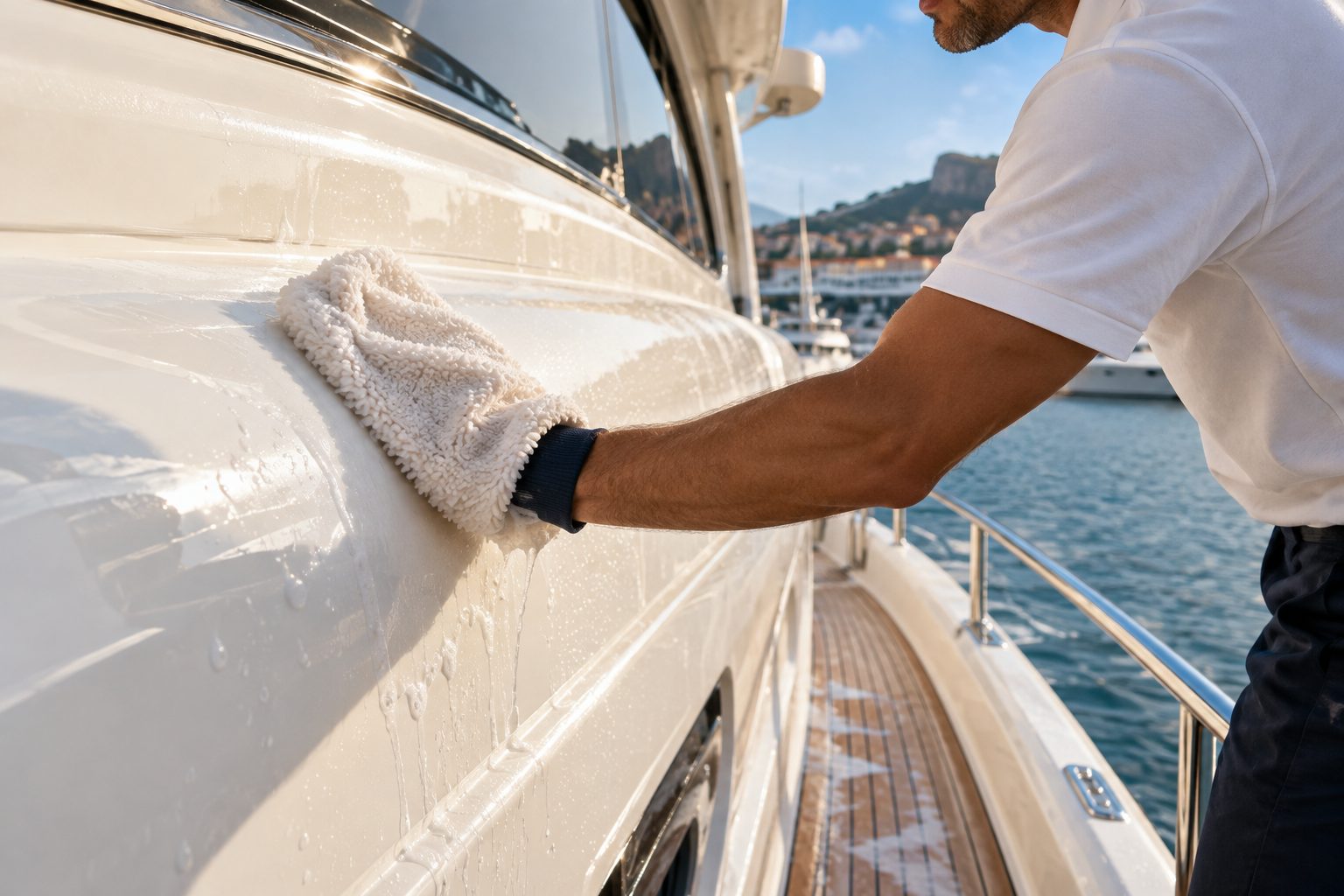
A wash and, where it suits, a polish and protective layer keep gelcoat or paint in better shape and make future cleaning easier. On working boats, the decision about how far to go is practical. A full correction may not make sense on a hull that will take new scrapes next week. A thorough wash and a protective layer often give the best return.
Exhaust soot on transoms, sterns and engine-room vents is common on boats that run engines for long hours. Our page on exhaust soot stains explains how it is removed and what keeps it from returning quickly.
Hull cleaning above the waterline is part of the work, and below it, growth and fouling belong to a diver or haul-out service. See hull cleaning above the waterline for the boundary. Bottom paint, zincs, propellers and through-hulls are not detailing tasks.
Aluminum hulls get their own approach. Painted aluminum is cleaned like any painted surface. Raw aluminum is cleaned with products made for it, and strong alkaline or acid cleaners are avoided because they can stain or pit the metal.
Fuel, oil and the working parts
Work boats and dive boats carry fuel and oil, and spills, drips and residue are part of life. Decks near fuel fills, engine hatches and generators often show dark stains. Bilges collect oily water.
A cleaning crew can degrease visible deck areas, wipe engine-room surfaces and clean accessible bilge areas. The goal is to remove residue so that new leaks stand out. Oil absorbent pads, proper disposal and care with runoff are part of responsible practice. See our guide to environmental practices in yacht detailing for how that is handled.
A cleaner does not repair engines, tighten fittings, change filters or service fuel systems. If we see an active leak, a loose hose or an unusual smell of fuel, we will tell you so a marine mechanic can inspect it. A fuel smell on a working boat is a safety issue and should be taken seriously before the boat goes out.
Some operators keep logs of safety and cleaning tasks. If you do, let us know what your operation requires, and we can note what was done and what was found. We do not certify equipment or sign off on safety inspections.
Scheduling around a working boat
A dive boat or a work boat earns its living on the water. Time at the dock is time not earning. That makes scheduling the biggest practical issue.
The best windows are early mornings before departure, afternoons between trips, rest days and weather days. Some operators prefer a deeper cleaning on a scheduled off day each month and light cleaning between trips. We can discuss what fits your operation, though scheduling is confirmed on the phone and no arrival windows are promised.
Marina rules apply. Dive operations often sit at commercial docks or busy marinas with restrictions on contractors, runoff and noise. Check with the dockmaster and tell us what you know. Our page on dockside detailing and marina rules covers the usual points.
If you operate several boats, see our page on fleet and club boat care for how multiple hulls are scheduled and kept consistent.
What to have ready and how the call goes
Before you call, gather the basics: the type and length of the boat, the hull material, where it is kept, and how it is used. Tell us about the gear areas, the rinse system, the smell problems and any safety concerns you know of.
Tell us about your schedule. Do you have a day off during the week? Are there quiet periods during the season? When does the boat need to be ready? The more we know, the easier it is to plan.
Quotes are given by phone only. Straightforward jobs can often be quoted on the call. Larger or more complicated jobs may need an on-site visit, and there is a service call charge, which we explain before anyone is dispatched. Our website does not post prices.
If your boat is working hard and showing it, call and tell us what is going on. We will talk through the cleaning plan and be plain about what is cleaning and what is repair.
Questions people ask
Do you clean dive gear like regulators and BCDs?
No. We clean the boat, not life-support equipment. Regulators, tanks, BCDs and similar gear should be serviced and tested by a certified dive equipment technician. We clean racks, benches, rinse tanks and storage areas, and we will tell you if a rack, strap or holder looks corroded or weak so you can have it repaired.
Can you get the wetsuit smell out of my boat?
Often, yes, but it depends on how deep the smell has gone. The approach is to remove moisture and organic residue from benches, lockers and mats, rinse well and dry thoroughly. Foam and carpet that have soaked up odor for a long time may not respond fully and could need replacement. We look for the source rather than masking it.
Will cleaning make my deck less slippery?
It can. Grime, sunscreen and algae flatten non-skid texture, and a proper scrub lifts that residue so the grip works again. Worn-smooth non-skid cannot be restored by cleaning and needs recoating by a repair professional. We avoid waxy products on walking surfaces because they can make a deck slick.
What about corrosion on ladders, davits and racks?
We clean and protect the surface and flag corrosion that looks beyond cosmetic. Pitted aluminum, thinned stainless and rusted structural parts need a welder, fabricator or rigger. Safety-critical items such as davits, A-frames, ladders and winch mounts should be inspected by a qualified professional, not only cleaned.
Can you work around our trip schedule?
We will try to fit your operation, such as early mornings, gaps between trips or off days, but we do not promise arrival windows. Scheduling is confirmed on the phone. Tell us about your calendar and your marina's rules when you call, and we will explain what is realistic.
How do I get a quote for a dive or work boat?
Quotes are given only by phone. Describe the boat, its use, condition and location. Simple jobs can often be quoted on the call, while larger or more complicated jobs may need an on-site visit. A service call charge applies for visits and is explained before anyone is sent.
Describe the situation by phone and we will tell you what the job involves. Quotes are given by phone. Jobs that cannot be quoted without seeing them need a technician on site, and the service call charge is explained on the phone before anyone is dispatched.
(954) 719-3572Related pages
Walking the boat the way a divemaster does
A dive boat is organized around a sequence: gear on, divers in, divers out, gear off. When we plan a cleaning visit, we try to follow that same path from the stern ladder forward, because the layout of the work area tells us where the mess collects. Wet footprints, saltwater that has dried into white lines, and sand tracked into every seam usually start at the entry point and fade toward the bow. Cleaning in the same order the boat is used means we are not walking dirt back over finished areas, and it helps us spot spots the crew has stopped noticing.
We also look at what the crew treats as normal. A bench that is always damp, a locker that never quite dries, or a hose that is permanently tangled around a rail usually points to a habit that can be improved without any equipment at all. We mention these observations plainly and leave the decision to you. Some operators want a deep clean and a few suggestions, while others want only the surfaces handled and nothing said about how the boat runs. Either approach is fine as long as it is agreed before the work starts.
Safety gear and dive equipment are never moved without being asked. Regulators, tanks, lights and first aid kits belong to the crew, and we work around them or ask them to be lifted clear. If something does need to move, we note where it was and put it back in the same place. That small courtesy saves a lot of confusion on the next trip, when a captain or divemaster reaches for a piece of kit in the dark and expects it exactly where it has always been.
Mixed crews, shared lockers and the small things that get lost
Many dive operations have several people who touch the boat in a week: captains, mates, instructors, and rotating staff. That shared use means personal items drift into odd places. Fins, masks, towels, phone chargers, sunscreen and half empty water bottles collect in corners and under seats. Before we begin, we ask that anything personal be collected or at least pointed out, because we do not want to throw away a mask that belongs to someone, or soak a wallet left in a pocket. A short pass with a bin bag by the crew beforehand makes our work faster and the result better.
Shared lockers deserve special thought. Damp wetsuits, booties and gloves can sit in a closed space for a long time, and the smell they create sometimes spreads into nearby cushions and carpeting. We can wipe and ventilate the empty locker, but we do not rearrange personal belongings or decide what should be discarded. If a locker has become a problem, we point it out and suggest it be emptied, so the crew can sort what stays and what goes. The cleaner and drier the space, the easier it is to keep that way afterward.
At the end of a visit, we walk the boat with whoever is in charge and show what was done, what was left, and anything we noticed along the way. If gear was moved, we confirm it is back. If a surface needs a closer look from someone else, such as a loose fitting or a cracked step, we say so clearly. Handing back a boat that is clean and also understood, rather than just clean, is a better outcome for a vessel that works every week and cannot afford to lose track of its equipment.