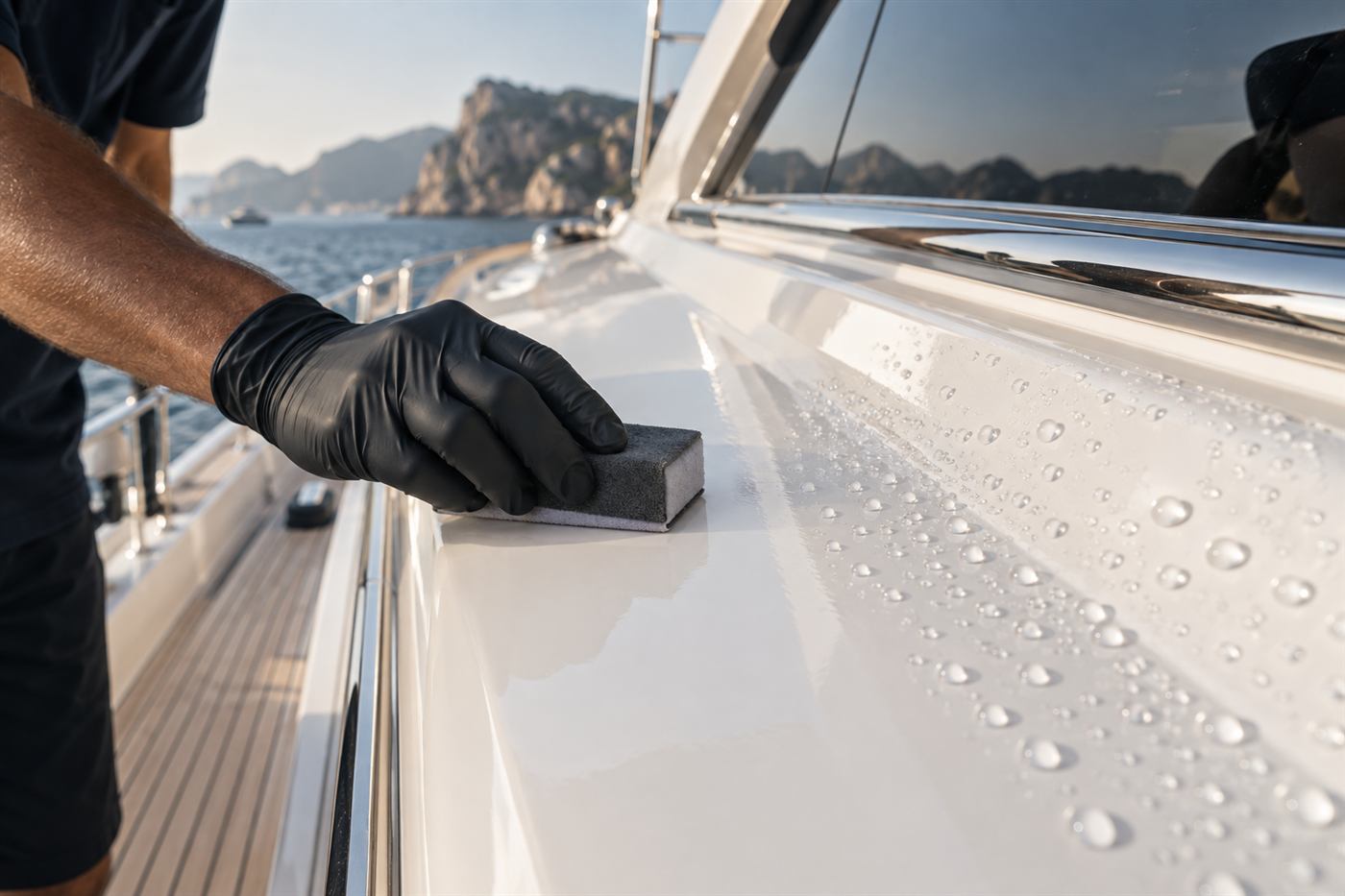
What support means on a large yacht
A large yacht usually has a professional crew. The captain, mate, engineer, stewardess or chief stew and deckhands each have their own responsibilities, and the vessel runs on a daily routine. Detailing support on such a boat is not meant to replace the crew. It is meant to add skilled hands, equipment and time for work that is too large, too demanding or too time-consuming for the crew to do alongside their regular duties.
That framing matters because it changes how the work is organized. On a smaller boat, the owner is the decision maker and the schedule is flexible. On a large yacht, decisions pass through the captain, who answers for the safety and condition of the vessel. A detailer who understands this respects the chain of command, asks before touching anything, and works to the captain's rules instead of imposing a routine.
The vessels in this category vary widely. Some are large motor yachts that an owner runs with a small crew. Others are charter vessels, managed vessels or boats that sit at a yard between seasons with a caretaker. Each has different needs, and the first step is understanding which one you are.
Scope clarity before anything starts
Large yachts can swallow a vague request. When someone says, "detail the boat," the question is which parts, to what standard, on which decks and in what order. A written scope avoids misunderstanding and keeps a team focused. Surface by surface, it lists what will be done: exterior washing, gelcoat polishing, stainless polishing, teak care, canvas cleaning, interior cleaning, glass and hardware.
A good scope also lists what is excluded. Mechanical systems, paint repair, woodwork repair and upholstery repair are separate trades and are not part of detailing. Mentioning exclusions early prevents disappointment. If you expect a surface to be restored and it is beyond what polish can do, the scope should say so and propose a referral.
Condition is part of scope. A technician cannot price or plan well without understanding the finish. Is it gelcoat or painted? What is the age and the condition? Are there previous repairs? Are there unusual coatings? On the phone, share what you know, such as photographs or details from a recent survey, and be honest about problem areas. An on-site walk-through is often the right step for a large vessel, and the service call charge for it is explained over the phone before dispatch.
- List each deck and area to be included, from the bow to the stern and from the engine room to the flybridge.
- Note finishes that need specific products, such as painted topsides or varnished brightwork.
- State any areas that are off limits, such as the bridge, the master suite or equipment spaces.
- Name who on the crew approves changes to the plan while the work is under way.
Team coordination
A big vessel needs more than one person, and several people on a single boat need a plan. A common method is to divide work by area or by trade. One person handles exterior washing and drying, another polishes stainless, another handles the interior. Sequencing is crucial: you wash from the top down, finish the upper decks before the lower decks and avoid having one team's runoff land on another's freshly polished work.
Communication on board is simple but essential. A contact person on the crew should be named who can answer questions, unlock spaces and approve changes. Radio or phone contact helps when a technician is on a remote deck and a decision comes up. A short meeting at the beginning and end of each day, to review progress and next steps, keeps everyone aligned.
Coordination also includes other trades on the boat. A yard might have painters, mechanics, electricians and canvas workers. Detailing is often done late in a sequence because dust, overspray and sanding residue undo clean work. Learn the schedule of other contractors and arrange detailing accordingly. See the page on post haul-out detailing for how work after a yard period is typically sequenced.
Scheduling around crews and guests
Crew routines drive the calendar. Many yachts begin the day with a wash-down and finish with guest service in the evening. A detailing team that arrives in the middle of that has to choose its spaces carefully. Noise, wet decks and chemical odors do not mix with an owner's breakfast or a charter guest's arrival. Agree ahead of time on quiet periods, areas available at specific hours and the schedule for any machinery that creates noise, such as polishers and pressure equipment.
Seasons matter in South Florida. Winter is the high season, with owners and charter guests aboard and the pressure to have the boat ready. Summer brings heat and afternoon storms. Hurricane season introduces planning for storms and cleanup. The guides on winter high-season prep and the South Florida boating season calendar help explain when to book.
No arrival time or duration is promised here, because the weather, the marina and the vessel's own schedule all change plans. Instead, the schedule is set on the phone and revisited as the work proceeds. Flexibility from both sides keeps a large job moving.
Access, equipment and working at height
Large yachts have decks and surfaces that are high above the dock. Reaching them safely requires staging, platforms, ladders or lifts, and in some cases a boom or a barge alongside. Work at height carries risk, and anyone working above a few feet needs suitable fall protection and a plan for tools, water and cleaning products. These are matters for the captain and the technicians to agree on before anyone climbs.
Equipment includes more than brushes. Electric polishers, wet vacuums, extension poles, hoses with adequate length and pressure, and a clean source of fresh water all matter. Fresh water supply is a regular topic. Many marinas limit water use or require a specific type of hose connection, and yacht tanks hold limited water. Make sure it is clear who provides water and how.
Surfaces on large yachts are diverse and costly to repair. Exotic woods, stone, leather, unusual fabrics, glass of unusual sizes and expensive electronics are not unusual. Each needs its own approach, and a detailer will ask the crew about care instructions before starting. If something is not understood, it should be left alone until the right method is confirmed.
Marina rules, insurance and documentation
Marinas that host large yachts are used to contractors, and many have formal procedures. You may be asked for proof of insurance, a list of workers, a description of products and a plan for containing runoff. Some marinas restrict certain work, such as sanding or painting, and some require prior notice. The page on dockside detailing and marina rules explains common themes, and the captain or yacht manager typically handles the details.
Environmental practices are an expectation, not an extra. Wastewater, soap and polishing residue must be handled in line with marina policy and local rules. Using appropriate products, containing runoff and cleaning up after each session are part of the job. See yacht detailing environmental practices for more.
Documentation is helpful. A short written record of what was done, which areas were treated and any issues noticed gives the crew something to refer to next time. A technician who spots a developing problem, such as corrosion at a fitting or a crack in a sealant line, should report it to the captain rather than quietly working around it.
Exterior, interior and metalwork on a larger scale
On a large yacht, each area is a project. The hull sides alone are a vast surface to wash, polish and protect, and a consistent finish needs a consistent method. Technicians work in sections, keep wet edges moving and avoid letting products dry on a hot surface. Upper decks collect salt and sun, and they are usually washed more often than the hull sides. Teak, where present, needs cleaning and care that matches the owner's preference for appearance, as covered in teak deck care.
Metalwork is a large item on bigger yachts. Stainless rails, window frames, ladders, hardware and fittings are everywhere, and corrosion shows quickly in marine air. A routine for stainless polishing and cleaning keeps tea staining and pitting under control. Aluminum and chrome need separate care.
Interiors on large yachts are usually the crew's domain, and detailing support is mostly deep cleaning that goes beyond daily routines: carpets, upholstery, headliners, vents, tight corners and hidden areas. Coordinating with the chief stew prevents mix-ups about which products are safe on delicate finishes.
Quality control on a big job
On a large yacht, quality control cannot be left to the end. Small differences in method add up across hundreds of feet of rail and acres of deck, and a mismatch between one section and the next is visible in raking light. The best approach is to agree on a reference area at the start. A single panel of hull side or a section of rail is polished to the agreed standard, the captain or owner looks at it, and the rest of the work is matched to it.
Lighting matters. Work is inspected in different light, in sun, in shade and, where possible, at an angle that shows swirls and haze. Technicians wipe a section clean and look again before moving on, because residue from polish and sealant can hide defects until it is removed. Checking as you go prevents having to redo a large area later.
A short punch list at the end of each phase helps. The crew walks the vessel with the lead technician, notes anything missed or unclear and agrees on how it will be corrected. This habit builds trust and avoids disagreements about what was in scope. If a surface turns out to be beyond what detailing can achieve, it is documented and discussed instead of quietly ignored.
- Agree on a reference panel before the full surface is started.
- Inspect in more than one kind of light.
- Keep a running list of items to revisit.
- Walk the vessel with the crew at the end of each phase.
When a large yacht benefits from outside help
Many captains have a trusted routine and use outside support at specific times. Before a charter season, after a yard period, ahead of a boat show, before a sale or after a storm, the work expands beyond what the crew can manage. At those times, outside help is more efficient than stretching the crew thin. Pages such as boat show prep and pre-sale detailing describe typical scenarios.
Large yacht support also fits vessels that sit unattended for periods. A caretaker may check the boat, but cannot run a full detail. A periodic visit to wash, wipe down interiors and check for mildew keeps the vessel in better condition for the next use. Management companies sometimes arrange this, as described on the yacht management company detailing page.
If you are weighing whether outside support makes sense, describe your situation on the phone. The honest answer is sometimes that your crew can handle it, and sometimes that a one-time push will help.
What to have ready and how to start
Before you call, gather some basics: approximate length, type and age of the vessel, where it is docked, the main areas of concern, who the point of contact is and whether any other contractors will be on board. If you have a recent survey, a list of finishes or photographs of problem areas, those help. Mention any marina requirements and any dates that cannot move.
Quotes are given only by phone. For a large vessel, an on-site visit is common before a firm plan is set, because size and complexity make a call-only estimate unreliable. There is a service call charge for that visit, and it is explained on the phone before anyone is dispatched. A clear scope, agreed in writing between you and the person doing the work, protects both sides.
Large yacht support is built on communication and respect for the crew. When you are ready, call and describe your vessel and what you need done.
Questions people ask
Do you replace the yacht's crew?
No. Detailing support adds skilled hands and equipment for work the crew does not have time or tools to do. The captain remains in charge, and work is planned around the crew's routines, the owner's use of the vessel and the rules of the marina.
Why does a large yacht usually need an on-site visit first?
Because size, materials and condition vary so much that a phone description often cannot capture them. A walk-through lets the scope be written accurately. The service call charge for the visit is explained on the phone before anyone is dispatched, and quotes are given only by phone.
How do you handle work at height on tall decks?
With staging, lifts, ladders or other suitable access agreed in advance with the captain, and with appropriate fall protection for anyone working above ground level. Work at height is planned, not improvised, and it is not started if conditions or equipment are not right.
Can detailing be done while guests or crew are aboard?
Sometimes, with planning. Noisy or wet work is best scheduled when the owner or guests are away, while quieter tasks can run alongside the crew's routine. Agree on quiet periods and off-limit areas with the captain at the start.
Will you follow our marina's contractor requirements?
Yes, as far as they apply to the work. Marinas often ask for insurance documentation, notice of work and containment of runoff. The captain or yacht manager typically handles the paperwork, and the technicians follow the rules on the water and at the dock.
What happens if you find a problem during the detail?
It is reported to the captain or the contact person. Examples include corrosion at a fitting, a failing sealant line or a leak stain. Detailing does not cover repairs, but flagging a developing issue helps the crew and the owner decide what to do.
Describe the situation by phone and we will tell you what the job involves. Quotes are given by phone. Jobs that cannot be quoted without seeing them need a technician on site, and the service call charge is explained on the phone before anyone is dispatched.
(954) 719-3572Related pages
Handing over a daily log between crew and outside team
On a large yacht, the permanent crew knows the boat deeply, and an outside team arrives with fresh eyes but little history. A daily log bridges that gap. At the start of each day we meet with the chief stewardess, mate or bosun to confirm the plan, ask what has changed and learn which areas are sensitive. At the end of the day we write a short summary of what was done, what was found and what remains. That record helps everyone stay aligned. Small details like this tend to decide how the finished work looks.
The log is also useful for noticing patterns. If we see repeated staining in one place, a leak that shows up after rain or a fitting that keeps coming loose, we write it down and mention it to the crew. They may already know, or they may be glad to have a second set of eyes. Either way, the entry creates a trail that can be shared with managers, owners or contractors. We stay factual and avoid guesses about causes, leaving diagnosis to the people responsible for maintenance.
Keeping the log simple makes it more likely to be used. A single page with dates, areas, tasks and notes is enough. We share it in whatever format the crew prefers, whether paper, message or email, and we respect any rules about guest areas and private spaces. When the job is done, the log becomes a record of the scope and a reference for future visits. It supports clear communication and makes handoffs smoother when crew members rotate or a new captain comes aboard. Tell us what matters most to you and we will build the day around it.