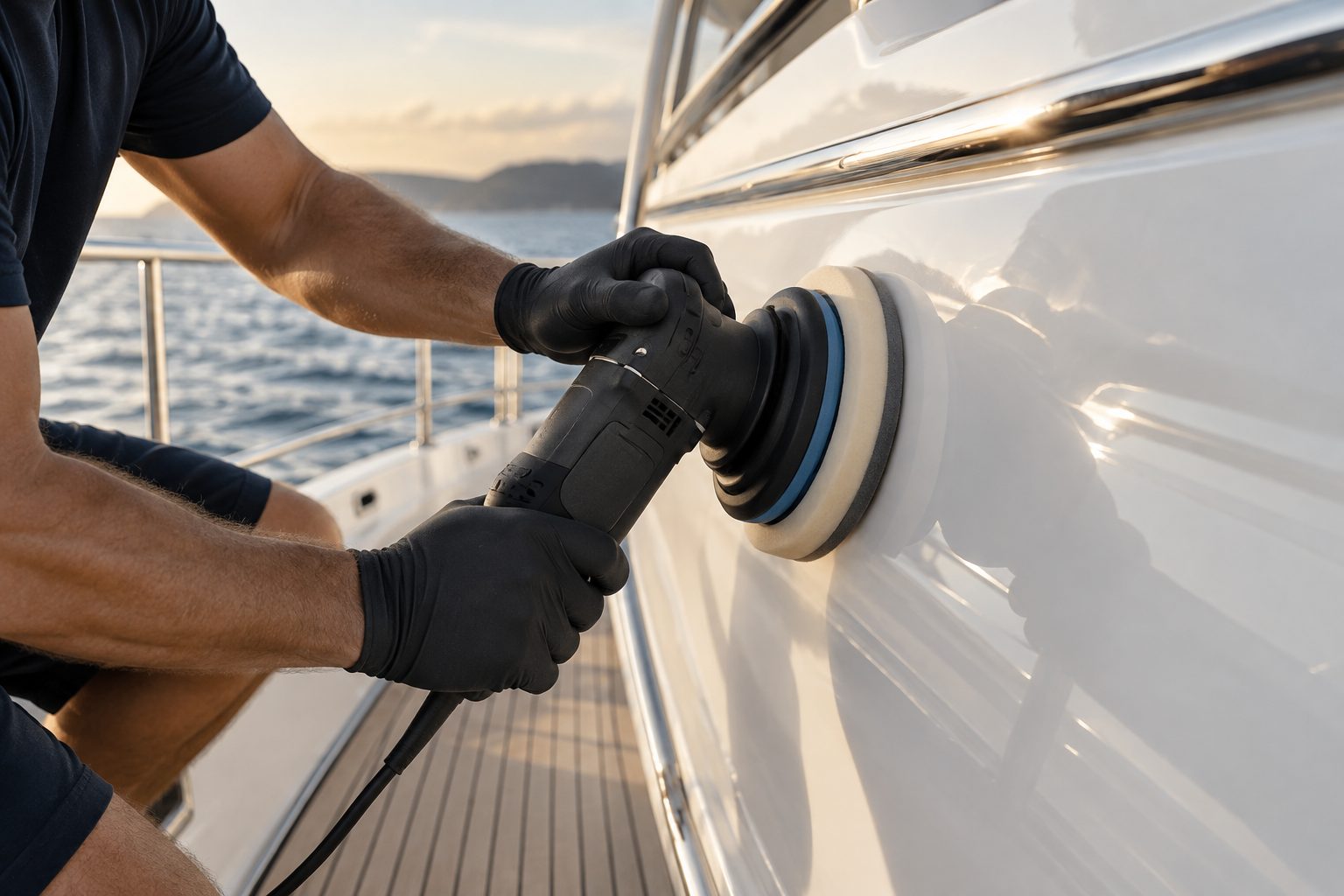
Searching for yacht detailing near me at Delray Beach? Best Yacht sends a real detailer dockside with before-and-after photos on every job. See our yacht detailing near me page for full marina coverage.
Intracoastal docks a short hop from the inlet, regular salt and traffic wear that benefits from a set maintenance schedule.
Exterior wash-down, compound and polish, ceramic coating, bright work, interior detail, and teak and deck care, scheduled dockside. Call (954) 719-3572.
How a dockside job runs
Assess the vessel
Size, gelcoat condition and scope confirmed before a price is quoted.
Flat price agreed
Quoted before we schedule, not adjusted dockside.
Work the vessel dockside
At Delray Beach, coordinated around your schedule.
Walk-through and sign-off
Reviewed with you before we consider the job done.
Delray Beach ZIP codes we serve
Delray Beach is governed by the City of Delray Beach. For marina permits or dockage rules, that's the relevant authority, we handle the detailing, not the marina.
A smaller, quieter stretch of the Intracoastal.
Delray Beach sits between Boca Raton and the larger marina cluster around Boynton Beach and West Palm Beach further north, a smaller, more residential coastal city where the Intracoastal Waterway runs behind a modest barrier of beachfront homes and low-rise condominiums rather than the dense high-rise skyline seen further south in Sunny Isles or Miami Beach. The scale here is genuinely different, docks tend to be smaller, the marina facilities more modest, and the overall pace of the waterfront noticeably calmer than the busier commercial marinas in Fort Lauderdale.
That said, calm doesn't mean sheltered from the elements. Delray's Intracoastal docks sit close enough to the Boynton Inlet just north and the Boca Raton Inlet just south that tidal flow and periodic current are a real part of daily conditions here, more so than in a fully enclosed canal community. Salt content in the water and air is fully marine, and a boat docked here for any length of time faces the same fundamental oxidation and corrosion pressures as anywhere else on this coast, just without quite the same wave action and open-water chop that define the more exposed marinas further north.
Sailboats are a genuinely common sight along Delray's stretch of the Intracoastal, favoring the calmer water and the more modest dock fees typical of a smaller coastal city compared with Fort Lauderdale's larger commercial marinas. A sailboat's rigging, standing and running, and its finer hull lines mean a somewhat different detailing approach than a broad-beamed motor yacht, more attention to stainless standing rigging, turnbuckles and chainplates, areas where crevice corrosion has a particular talent for hiding.
Cruisers, sailboats and the mid-size fleet.
The typical vessel we service in Delray Beach runs smaller and more moderate than the marquee superyachts found at Bahia Mar or Palm Beach, mid-size cruisers, sailboats and smaller sportfishing boats that make up the backbone of a genuine leisure boating community rather than a showcase marina built around the largest vessels afloat. That's not a limitation, it's simply a different kind of work, and a mid-size cruiser or sailboat deserves the same careful, honest assessment as a hundred-foot motor yacht, scaled appropriately to the vessel's actual size and needs.
Because many owners here are hands-on with their own boats, doing basic wash-downs themselves between professional visits, we often get called specifically for the harder jobs, gelcoat correction that's beyond what a bucket and sponge can fix, ceramic coating application that needs proper surface prep and controlled cure conditions, or bright work on rigging fittings that takes real technique to do safely without scratching stainless or damaging a turnbuckle's threads. Understanding which parts of a boat's maintenance an owner is comfortable handling themselves, and which parts genuinely benefit from a professional pass, is part of scoping a job correctly here.
Rigging, brightwork and a different hull shape.
A sailboat's standing rigging, the wire or rod stays and shrouds holding the mast upright, along with turnbuckles, chainplates and the fittings connecting rigging to the hull, represents some of the highest-consequence bright work on the entire vessel, since a corroded or failed fitting here isn't just a cosmetic problem, it's a genuine safety issue. We treat rigging-adjacent stainless with particular care during a bright work pass, checking for the early signs of crevice corrosion or stress cracking that a purely cosmetic polish would miss entirely, and flagging anything that looks like it needs a rigger's attention rather than just a detailer's.
Sailboat hulls also tend to have a different gelcoat profile than a motor yacht, often a narrower waterline beam and a deeper keel, and oxidation patterns can concentrate differently as a result, particularly around the boot stripe and anywhere the hull sees more consistent immersion depth changes from heel and trim underway. Compounding and polishing a sailboat hull respects these differences rather than applying a motor yacht's flat, broad-surface technique to a shape that behaves differently under a buffer.
Do you work on sailboats specifically, not just motor yachts?
Yes, sailboats are a regular part of our work in Delray Beach, including rigging-adjacent bright work and hull correction suited to a sailboat's specific shape.
Can you check my rigging fittings for corrosion during a bright work visit?
We'll flag anything that looks concerning during a polish, though any structural rigging assessment beyond visible corrosion should also involve a qualified rigger.
I do my own basic wash-downs. Can you handle just the harder jobs?
Yes, plenty of Delray Beach owners split maintenance this way, and we're glad to step in specifically for correction, coating or bright work that needs professional technique.
A quieter dock scene with its own rhythm.
Delray Beach sees the same broad seasonal pattern as the rest of this coast, more boat activity in winter as seasonal residents return, quieter summer months with occasional intense storm activity. Because the marina and dock facilities here are more modest in scale than Fort Lauderdale's larger commercial operations, availability and access tend to be more straightforward, less competition for dock space, less gate bureaucracy, and generally an easier conversation about scheduling a visit around whenever the boat happens to be at the dock.
For owners who split time between a sailboat kept here and other boating destinations further afield, coordinating a maintenance visit around cruising plans, before a passage south for the winter, or after returning from a season spent elsewhere, is a common request, and we're happy to plan around a boat's actual travel calendar rather than a fixed recurring date that might miss the vessel entirely if it's away when scheduled.
A middle ground between sheltered canal and open marina.
Delray's docks sit in a genuine middle ground of exposure, more open than a deep residential canal, less exposed than a marina facing straight into the Atlantic. This middle-ground exposure means a maintenance schedule here often lands between the tighter intervals we'd recommend for an open marina like Bahia Mar and the more relaxed pace workable in a sheltered canal community like parts of Lighthouse Point. A wash-down every couple of weeks, with attention to bright work and glass at every visit, tends to keep a Delray Beach vessel looking properly cared for without over-servicing a boat that isn't taking the heaviest exposure on this coast.
Whatever the vessel, sailboat, mid-size cruiser or smaller sportfishing boat, the same underlying approach applies at every Delray Beach dock we visit, an honest assessment matched to the boat's actual exposure and use, not a generic package borrowed from a busier marina further south. Call (954) 719-3572 to talk through your specific dock and vessel here.
Working a compact interior the right way.
A sailboat or smaller cruiser's cabin presents a different interior detailing challenge than a large motor yacht's multi-stateroom layout, tighter spaces, more built-in storage and joinery to work around, and often teak or other hardwood cabinetry that needs specific, gentle products rather than anything generic. We approach a compact interior with the same thoroughness as a larger vessel's salon, just adapted to the reality of a settee that converts to a berth, a nav station tucked into a corner, and a head compartment that shares space with a shower rather than occupying its own dedicated room.
Humidity management matters just as much in a small, tightly sealed cabin as it does in a larger yacht's below-deck spaces, arguably more, since a smaller enclosed volume can reach uncomfortable, mildew-friendly humidity levels faster than a larger, more ventilated interior. Boats that sit closed up between uses, common for sailboats kept for weekend or seasonal cruising rather than daily use, benefit from periodic interior attention specifically aimed at catching early mildew and must odor before it becomes an entrenched problem that's much harder to fully clear out.
Matching scope to a realistic maintenance budget.
Not every Delray Beach vessel is a showcase yacht with an unlimited maintenance budget, and we recognize that many owners here are managing a boat's upkeep against a genuine household budget rather than treating detailing as an incidental expense. Being upfront about what a boat actually needs versus what would simply be nice to have lets an owner make an informed decision about where to spend, prioritizing, for instance, a gelcoat correction that protects the hull's long-term value over a purely cosmetic interior refresh that can wait another season.
This kind of honest conversation about priorities is part of every assessment we do here, and it's especially relevant for owners maintaining a boat as a long-term asset on a realistic schedule rather than chasing a showroom finish every single visit. A well-maintained, honestly assessed boat holds its value and its appearance far better over years than one that gets sporadic, unfocused attention whenever it happens to look bad enough to call someone.
Can you help prioritize what to spend on first if budget is a factor?
Yes, we'll walk through what protects the boat's long-term condition versus what's purely cosmetic, so you can make an informed call about where to focus first.
Do smaller cabins need different products than a large yacht's interior?
Often yes, particularly around built-in wood joinery and tighter, less-ventilated spaces, and we adjust our approach and products accordingly.
Boynton and Boca Raton, and what they mean for this stretch.
Delray Beach sits almost exactly between the Boynton Inlet to the north and the Boca Raton Inlet to the south, and vessels based here often use one or the other regularly depending on which marina or ramp they're closer to and which route offers better conditions on a given day. Both inlets bring the same basic dynamic to this stretch of the Intracoastal, periodic tidal current stronger than in a fully enclosed canal, and enough open-water influence that boats making regular runs out to the reef or the Gulf Stream pick up more salt exposure than a boat that never leaves the dock. Knowing which inlet a specific vessel favors sometimes informs how we think about wash frequency, particularly for boats that run offshore on a fairly regular cadence.
Both inlets are also known for current and chop that can turn genuinely rough on an outgoing tide against an onshore wind, a condition local boaters are well aware of and plan around for their own passages. That same chop occasionally affects docks closest to either inlet, adding a bit more wave action and spray at the slip than docks set further back along a quieter stretch of the Intracoastal, one more small variable that factors into how tightly a specific boat's wash schedule should run.
Boats near Delray's Atlantic Avenue corridor.
Some of the docks we service sit within a short distance of Delray Beach's well-known downtown corridor along Atlantic Avenue, a walkable, restaurant- and shop-lined stretch that draws visitors year-round. Boats docked near this area sometimes see more foot traffic and general activity near the water than a purely residential canal further from downtown, which is worth knowing when scheduling a visit that involves equipment, hoses or gear staged near a public walkway. We're mindful of working cleanly and keeping gear tidy in these more visible, higher-traffic locations, the same courtesy we'd extend to any shared public space.
This downtown proximity also means a slightly different mix of vessel activity, more short daytrip use tied to a day out downtown, alongside the longer-term liveaboard and cruising sailboats that make up much of Delray's boating population. A boat used this way, frequent short trips rather than extended cruising, tends to accumulate salt and general grime steadily rather than in the heavier bursts a longer offshore passage produces, which usually means a straightforward, regular wash-down interval serves it well without needing the tighter schedule a hard-running sportfish boat further south would need.
What Delray Beach owners tend to ask.
Do you service boats near the downtown Atlantic Avenue docks?
Yes, and we're careful to keep equipment and work areas tidy given the higher foot traffic in that part of the waterfront.
Does using the Boynton or Boca Raton Inlet regularly change my maintenance needs?
It can. Boats running out to open water more often through either inlet generally pick up more salt exposure and benefit from a slightly tighter wash interval than a boat that stays purely in the Intracoastal.
My boat is a cruising sailboat that's away for months at a time. How does scheduling work?
We plan around your actual cruising calendar rather than a fixed date, so service happens before departure or after return, whichever fits your travel plans.
Delray Beach's calmer, more residential character doesn't mean less exposure, just a different balance of it, real tidal influence from two nearby inlets, genuine sun and salt pressure on every hull, and a boating community that spans everything from a modest daysailer to a serious offshore cruiser. Whatever the vessel, the same commitment to honest assessment and properly scoped work applies at every dock along this stretch.
Owners new to keeping a boat in Delray Beach, whether moving from a different part of this coast or new to boating entirely, are welcome to ask basic questions about what a reasonable maintenance rhythm looks like for this specific stretch of water. We'd rather spend a few extra minutes on a first call explaining what to expect than have an owner guess at a schedule that doesn't actually match the local conditions, and that conversation costs nothing beyond the time it takes to have it properly.
From a first wash-down to a full seasonal maintenance program, the goal at every Delray Beach address is the same one we bring to any dock on this coast, a vessel that looks and holds up like it's genuinely cared for, assessed honestly and serviced on a schedule that fits how the boat is actually used and where it actually sits. A short phone call describing your dock, your vessel and roughly how long it's been since the last real detailing pass is usually enough to put together an accurate first scope, whether that turns into a single visit or the start of a longer standing relationship at your slip, and we're glad to answer questions about pacing and pricing before anything is booked. That first conversation, more than anything printed on this page, is what actually shapes a maintenance plan that fits your specific boat, your specific dock, and how you actually use the water here in Delray Beach, whether that's a quiet weekend at the dock, a regular offshore run through one of the nearby inlets, or a long cruising season spent mostly somewhere else entirely, coming back to a dock here only a handful of times a year between passages. However the boat spends its time, the same standard applies whenever it's actually at the dock and ready for a visit, honest work, matched to the vessel, at the pace that actually fits it.
Need detailing at Delray Beach?
Describe the situation by phone and we will tell you what the job involves. Quotes are given by phone. Jobs that cannot be quoted without seeing them need a technician on site, and the service call charge is explained on the phone before anyone is dispatched.
(954) 719-3572