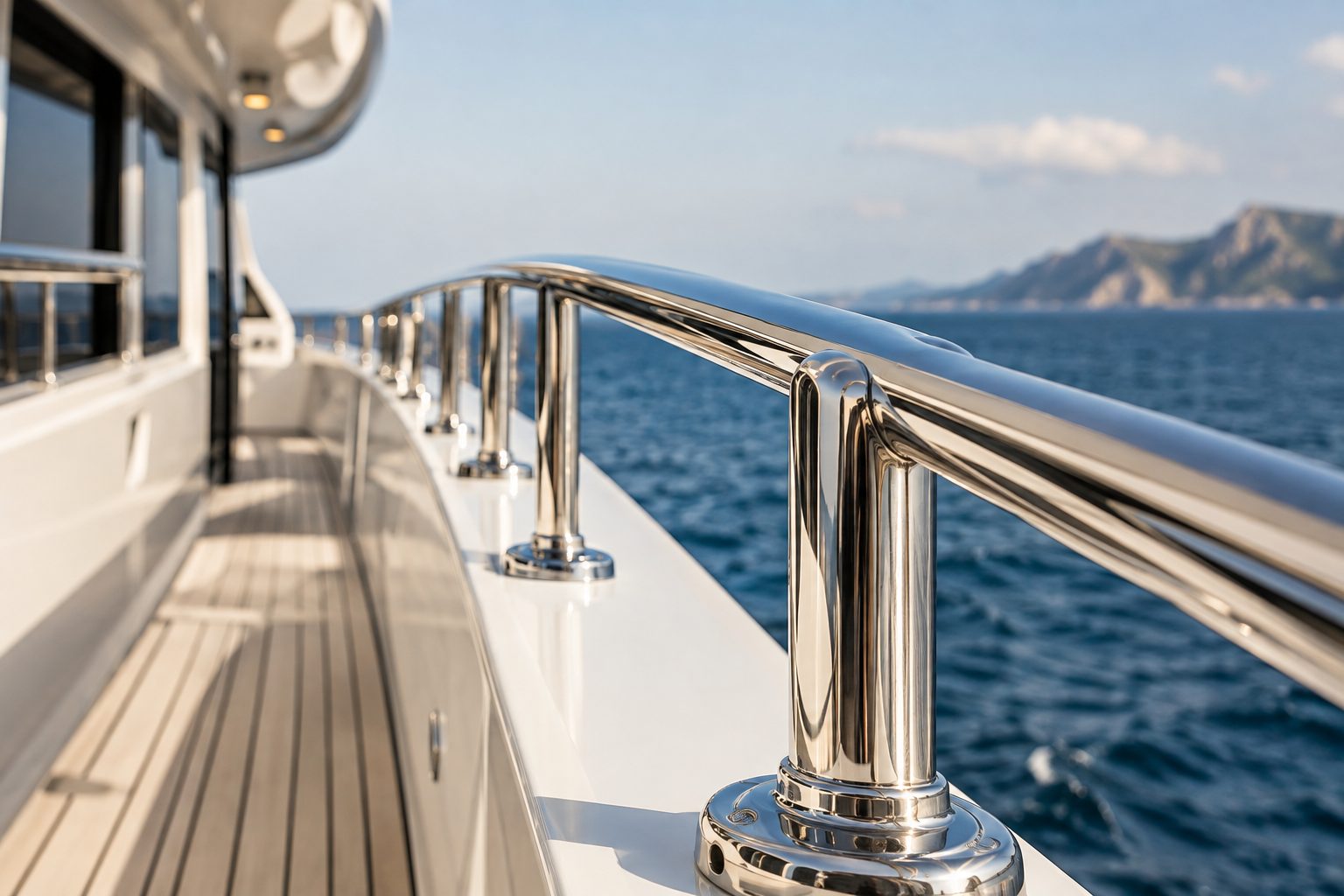
Two metals, two different surfaces
Chrome plating on a boat is a thin layer of chromium, deposited over a base such as brass, zinc alloy or steel, often with nickel or copper underneath. The bright, hard chromium layer is only a small fraction of the thickness of the part. When it is intact, it resists tarnish and wipes clean. When it is breached by a scratch, a pit or wear, moisture gets to the metal beneath, and corrosion starts under the plating and spreads sideways.
Anodized aluminum is a different story. Anodizing is an electrochemical process that thickens the natural oxide layer on aluminum, making it harder and more corrosion resistant, and allowing it to be dyed. Window frames, hatch frames, outriggers, railings, ladder parts and some trim on yachts are anodized. The finish is part of the metal, but it is still very thin, and abrasive polishing can wear through it.
Bare, unanodized aluminum, such as some tower and deck structure, forms a dull gray oxide on its own, and may be painted or powder coated. That is a separate topic, and the right care depends on whether the surface is anodized, painted, coated or raw. If you do not know which you have, tell us and we will assess it.
Because the protective layers are so thin, the principle for both chrome and anodized aluminum is to clean first, polish only when necessary and to the minimum degree, and then protect. Compare this approach with the one we use for stainless on our stainless steel polishing page, where metal can be abraded more freely.
Chrome pitting and how it develops
Chrome pitting begins with a break in the plating. It might be a stone chip, a scratch from a tool, a thin spot at an edge or a defect from manufacturing. Salt water gets through to the layer below, and that layer corrodes. The corrosion product is bulkier than the original metal, so it lifts the chrome above it, producing blisters and flakes. The visible result is small dark or white spots, then rough, flaking patches.
Once chrome has started to pit, it cannot be truly repaired by polishing. Polishing removes some surface contamination and can brighten the intact areas, but it cannot restore missing plating. Over-aggressive polishing can speed up the failure by thinning the chrome around the pits. The real fixes are replating, which is a shop process, or replacement of the part.
That said, early chrome care can slow progress. Rinsing salt off promptly, wiping dry, removing contamination before it etches and protecting the surface with a suitable product all reduce the chance that small breaks spread. Chrome that is kept clean and protected from the start can last a very long time.
We tell owners honestly what is salvageable. A faucet handle or hinge with light haze may clean up well. A rail or fitting with widespread flaking will not, and we would rather say so than polish it for a short-lived improvement. Our page on pitted chrome and stainless describes the symptoms in more detail.
Aluminum corrosion bloom
Aluminum corrodes differently from steel. Instead of rust, it forms a white or gray powdery deposit, often described as bloom, and in severe cases pits and rough, crusty patches. The oxide layer on aluminum is protective, but in salt water it is attacked, particularly around fasteners, joints and places where moisture sits. Contact with dissimilar metals, such as stainless fasteners, can speed this up through galvanic action.
Anodized aluminum resists this much better than bare metal, but the anodizing can be scratched, worn or damaged by harsh chemicals. Once the surface is compromised, bloom appears as white spots or streaks, often starting at fastener holes and edges. It can also stain gelcoat and paint as it runs.
Mild bloom can often be removed with the right cleaner and gentle agitation. Acid-based cleaners that work well on stainless can damage aluminum, so product choice matters greatly. Strong alkaline cleaners can also attack aluminum and leave dark staining. We use aluminum-safe cleaners, test in a small area and rinse thoroughly.
Deep corrosion, pitting that has penetrated the metal and cracking are beyond cosmetic care. Corroded structural aluminum, such as tower legs, outrigger bases or hatch frames, needs assessment by a qualified fabricator or rigger. Our role is to clean and protect what is cosmetically recoverable and to flag what needs another trade.
Protect or polish: how we decide
The central question on these metals is whether polishing is worth doing. For chrome in good condition, the answer is often no. A gentle clean and a protective layer is better than any abrasive step. For chrome with surface haze but no plating loss, a very fine polish can restore clarity. For chrome with breaks in the plating, polishing is cosmetic at best.
For anodized aluminum, polishing usually means removing the anodized layer, which is not what you want. A gentle cleaning with a non-abrasive aluminum-safe product and a light protective coating preserves the finish. If the anodizing has already worn through and the metal is dull, a controlled polish can bring back brightness, but the protection must then be maintained, since the bare metal will oxidize again.
Raw polished aluminum, such as some bright-finished hardware, is different. It can be polished to a high shine, but it will dull again quickly unless it is sealed. Owners should know that high maintenance is part of that finish, and we explain what to expect before starting.
In each case we make the decision on the spot, based on a test area and what we see. We do not apply one routine to every metal part. For general guidance, read our bright work and metals page, which sets out how the different metals on a yacht are grouped and treated.
| Surface | Typical approach | What to avoid |
|---|---|---|
| Intact chrome | Gentle clean, protectant | Abrasive polish, harsh acids |
| Chrome with haze | Fine polish after test spot | Heavy pressure and heat |
| Pitted chrome | Clean and protect; replate or replace | Expecting polish to restore plating |
| Anodized aluminum | Non-abrasive aluminum-safe clean, light protectant | Abrasives, strong acid or alkaline cleaners |
| Bare aluminum | Clean, polish if wanted, seal | Leaving unsealed in salt air |
What the work involves at the slip
A visit for chrome and aluminum starts with an inspection of every piece, looking at plating condition, anodizing wear, corrosion and fasteners. We take photographs, note which parts are in good order and which are damaged, and explain the plan. Parts that are loose, cracked or severely corroded are noted for a trade professional.
Cleaning begins with a fresh water rinse and mild soap to remove salt and grime. Where there is staining or oxidation, a targeted cleaner suited to the metal is applied and agitated with soft tools. Masking is used to protect adjacent gelcoat, paint, teak and canvas from cleaner and polish. Rinsing is thorough, because residual cleaner continues to attack metal after the work is done.
Where polishing is appropriate, we use fine abrasives and soft pads, working small areas at low speed with frequent checks. The goal is to restore clarity without cutting through plating or anodizing. After polishing, residue is removed and the metal is inspected, sometimes with a magnifier, to check for any damage.
Protection finishes the work. Depending on the metal, that may be a thin wax-like protectant, a sealant formulated for metal or a clear coating. We apply it sparingly, buff it off cleanly and keep it off adjacent surfaces. We also note any parts that should be rechecked soon, so small problems do not grow into big ones.
- Inspect every part and photograph its condition.
- Rinse and wash to remove salt and grime.
- Mask nearby surfaces that cleaners could harm.
- Clean with a product matched to the metal.
- Polish lightly only where it is appropriate.
- Rinse, dry and apply a thin protective layer.
- Record what needs attention from another trade.
Where chrome and aluminum show up on a yacht
Chrome is common on older motor yachts and cruisers: bow rails, cleats, navigation light housings, window frames, galley and head fixtures, ladders and decorative trim. Inside the vessel, it is in faucets, towel bars, shower fittings and cabinet hardware. Exterior chrome faces the harshest conditions and is often the first to fail.
Anodized aluminum is common on sportfish boats, center consoles and modern cruisers. Look at hardtop frames, T-tops, outrigger poles, rod holders, windshield frames, rails, pedestal seats and many hatch and door frames. These parts spend their lives in salt spray and sun, and anodizing fades, chalks or turns patchy with age.
Window and hatch frames deserve a separate comment. They sit next to glass and gaskets and often hold standing water in their tracks and corners. Corrosion bloom builds there out of sight, and it can stain the surrounding gelcoat. A thorough clean of the tracks and drains matters as much as polishing the visible frame. Our marine window and glass cleaning page covers how glass and frames are handled together.
Tower and outrigger hardware is out of reach for many owners, and working at height has its own risks. We work only from safe positions at the slip, and if access to elevated parts requires equipment or qualifications beyond our scope, we tell you.
Caring for these metals between visits
The simplest habit is a fresh water rinse after exposure to salt, with a gentle wipe of chrome and aluminum parts. Salt left to dry on these surfaces draws moisture and starts corrosion. A regular rinse and wipe makes a larger difference than any product.
Avoid abrasive pads, steel wool and household scouring powders, which scratch plating and anodizing. Avoid harsh chemical cleaners such as oven cleaner, toilet bowl cleaner or strong acids, which are sometimes suggested online and can strip finishes or cause burns. Use a pH neutral marine soap for routine cleaning and a product made for the metal in question when you need more.
A thin coat of protectant on chrome and aluminum helps salt and water sheet off. Apply sparingly and buff well. Greasy, thick coats attract dust and sunscreen and look worse. Fabric or cushions that touch freshly treated metal can pick up residue, so allow time before use.
Keep an eye on fasteners and joints. White powder at a screw, a small bubble under chrome or a stain running from a corner is an early warning. Cleaning it when it first appears is far easier than waiting. Our stainless hardware guide includes a short routine that applies to other metals too.
Limits, honesty and what to ask
Polishing improves the look of metal that is basically sound. It does not rebuild plating, regrow anodizing or reverse corrosion that has penetrated the metal. When a part has gone past cosmetic repair, we say so. Replacement, replating, recoating or refinishing are jobs for the right trade, and we can help you decide whether they are worth pursuing before you spend on them.
We do not make claims about how long a polished or protected finish will last. Salt, sun, handling and the environment decide that. What we can promise in plain terms is careful work, a clear explanation and an honest record of what was done and what was found.
When comparing providers, ask how they decide whether to polish, what they use on anodized parts, how they protect nearby surfaces and what they do when they find structural corrosion. An answer that is a single product for all metals should raise questions. Our guide on what to ask before hiring a detailer has more.
If you would like to talk through the metal on your vessel, call. We will ask about the boat, the finish and where it is kept. Quotes are given by phone, larger jobs need an on-site visit, and there is a service call charge that is explained on the phone before any technician is dispatched.
Questions people ask
Can pitted chrome be fixed by polishing?
No. Pits and flaking mean the plating has been breached and corrosion has started underneath. Polishing can brighten intact areas and remove surface contamination, but it cannot restore missing chrome, and aggressive polishing can thin what is left. Replating or replacing the part is the real fix, and early care can slow how fast damage spreads.
Is it safe to polish anodized aluminum?
Usually only lightly. Anodizing is a thin hardened layer, and abrasive polishing can wear through it, leaving bare metal that oxidizes quickly. Gentle cleaning with an aluminum-safe, non-abrasive product and a thin protectant is normally the better route. If the anodizing has already failed, a controlled polish and sealing may be reasonable.
What is the white powder on my aluminum frames?
It is aluminum oxide and related salts, often called corrosion bloom. It forms when salt and moisture attack the metal, especially near fasteners and joints. Mild bloom can be cleaned off with the right product. Deep pitting or structural damage needs a qualified fabricator, and we will tell you if we see signs of it.
Can I use the same cleaner on chrome, stainless and aluminum?
Not safely. Some acid-based products suited to stainless can damage aluminum and stain it, and strong alkaline cleaners can also attack aluminum. Chrome plating can be harmed by abrasives. We choose products by metal and test first, and we mask nearby surfaces so cleaner does not run onto gelcoat, paint or teak.
How do I keep chrome and aluminum from corroding?
Rinse with fresh water after salt exposure, wipe dry when you can and clean off salt and sunscreen promptly. Avoid abrasive pads and harsh chemicals. A thin protective product helps water and salt shed. Watch fasteners and joints for early signs, since cleaning a small spot is far easier than treating a spread.
How do I get a quote for chrome and aluminum polishing?
Quotes are given by phone only. We ask what metals are involved, how much there is, their condition and where the vessel is kept. Larger or more complicated jobs need an on-site visit. There is a service call charge, and it is explained on the phone before any technician is dispatched.
Describe the situation by phone and we will tell you what the job involves. Quotes are given by phone. Jobs that cannot be quoted without seeing them need a technician on site, and the service call charge is explained on the phone before anyone is dispatched.
(954) 719-3572Related pages
What happens to bright metal when it is neglected
Chrome and anodized aluminum both look sturdy, but neglect shows quickly in a marine setting. On chrome, the first sign is usually a light film that dulls the shine, followed by tiny spots where moisture has found a weak point in the plating. On aluminum, a gray or white powdery bloom begins to form where the protective layer is thin or damaged. Left alone, these changes spread slowly, and the metal becomes rougher and harder to restore. Catching the early signs while the surface is still mostly smooth makes cleaning easier and keeps more of the original finish intact.
Salt air, shared dock water and warm humid weather all speed up the process, and so does contact with other metals. A stainless screw in an aluminum frame can create a corrosion point, and a rubber gasket that holds moisture against the surface can do the same. Technicians look at these junctions closely, since the visible spot of corrosion is often just the end of a problem that starts underneath a fitting. Understanding where the moisture gathers helps explain why the same two or three places keep showing trouble on a given boat.
When the damage has advanced, the conversation turns honest. Pitting in chrome cannot be polished away, because the pits are missing metal, and aggressive buffing can make the damage worse by removing what plating remains. Aluminum that has deeply oxidized may be cleaned and brightened, but the texture can stay changed. The technician explains what can be improved, what can only be stabilized and when replacement is the more sensible path. The scope and any quote are explained before work begins, so nothing is a surprise.