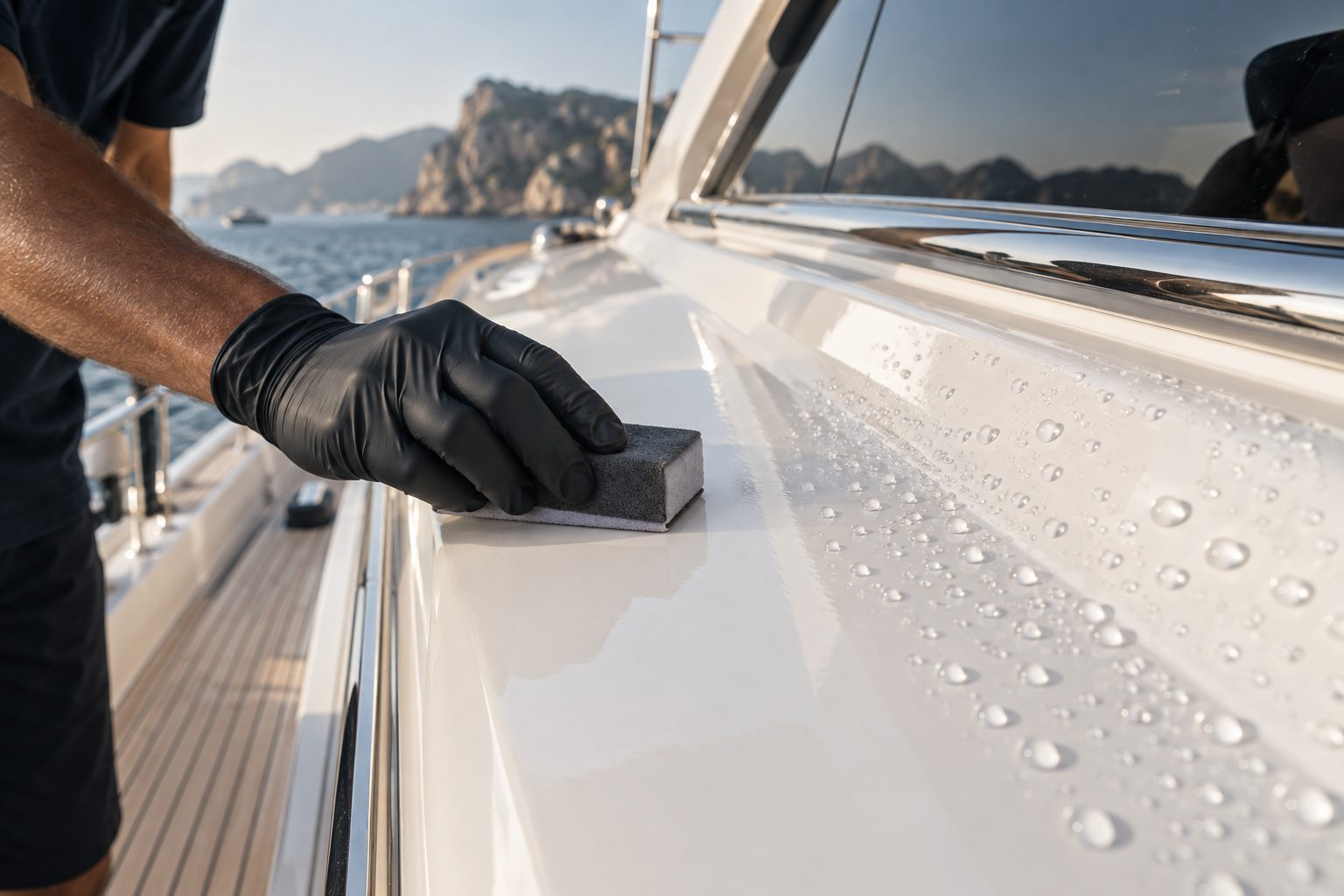
What above the waterline really means
On a yacht, the waterline is the line where the hull meets the water when the boat sits at its normal load. Everything above that line is the topsides: the painted or gelcoated sides, the bow flare, the transom, the sheer line near the deck, the rub rail and the hull graphics. Everything below it is the bottom, and the bottom belongs to a different trade with different tools, different safety needs and different products.
Above-waterline hull cleaning is the work done on those visible sides. It is the most photographed part of any boat, and it is also the part that collects the most visible grime in South Florida: salt film, rain streaks, exhaust soot, dock-line scuffs, tannin runoff from mangrove-lined canals, and the thin gray haze that settles on a hull sitting still at a slip for a few weeks.
The reason this page exists is scope clarity. Owners and captains often call and say they need the hull cleaned, and the word hull means different things to different people. To one person it means the sides. To another it means the bottom with barnacles and slime. To a third it means the entire boat. When everyone agrees at the start that the job is above the waterline, the visit goes smoothly, the right people are scheduled, and nobody is surprised at the end.
What a topsides cleaning visit usually covers
A typical visit starts with a fresh-water rinse to lift loose salt and dust, because rubbing a dry, gritty hull is how swirl marks are made. After the rinse, a marine-safe boat soap is applied in sections and worked with soft mitts or soft brushes. The technician moves from the top of the hull down toward the waterline, so dirty runoff does not streak over a section that is already clean.
The topsides are then rinsed again, and stubborn spots are addressed one at a time rather than with a harsh product sprayed across the whole hull. That matters because gelcoat and marine paint react differently to chemicals, and a product that lifts a stain on one surface can dull another. The hull is dried by hand or with soft towels to prevent water spots, which are common in Florida where the water is hard and the sun dries droplets in minutes.
Depending on what you have asked for, the visit may also include the transom, the swim platform edge, the boot stripe, the rub rail and the hull-side hardware such as hawse pipes, cleats and fender hooks. The scope is agreed on the phone before the visit, so what the technician does at the slip matches what you expected.
- Fresh-water rinse before any contact with the surface
- Soap wash of the topsides, top to bottom, in sections
- Spot treatment of individual stains with the gentlest product that works
- Hand drying to reduce water spots
- Boot stripe edge, rub rail and transom included when requested
- Notes to the owner or captain about anything that needs a different service
What is not included, and who handles it
Anything below the waterline is outside this service. That includes the removal of slime, grass, barnacles and other marine growth from the bottom, polishing or scrubbing of the running gear, cleaning of the props, shafts and rudders, and any work on the anti-fouling paint. Those jobs are done by divers working in the water or by yard crews when the boat is hauled out, and they need equipment and training that a dockside detailing visit does not involve.
Anti-fouling bottom paint also has its own rules. It is designed to release biocide slowly to discourage growth, and scrubbing it the wrong way can shorten its life or release more of that material into the water than intended. Marinas often have written policies about who may clean bottoms in the slip and how. A detailer who works the topsides from the dock is not stepping on that territory, which is one reason the two jobs are kept separate.
If you are unsure whether your boat needs a diver, look at the waterline itself. A band of green or brown growth that begins right at the water and continues down is a bottom issue. A band that sits above the water, on the gelcoat, is a topsides issue. If the answer is both, two different visits will usually be needed, and it is perfectly normal to book them back to back.
The waterline edge and the boot stripe
The strip of paint or gelcoat right at the waterline, often called the boot stripe or boot top, takes the most abuse on any hull. It is wet, then dry, then wet again with every wake and every change in load. A dark ring of waterline staining here is common and can be caused by oils from the water surface, tannin from canals, algae film, or the faint residue of marine growth just below the line.
Cleaning this edge takes patience. The technician works it at a comfortable position, often from a tender or a floating dock, because a swim platform is rarely at the right angle. The goal is to remove the dirt without cutting into the paint line or driving cleaner under the stripe. A soft brush and a gentle cleaner usually come first. If a stain persists, a stronger step may be needed, and that is where a separate waterline stain removal visit makes sense. You can read more about it on the waterline stain removal page.
It also helps to know that the waterline moves. A boat loaded with fuel, water, tackle and guests sits lower than one at the dock with half a tank. A stain that looks like it is at the waterline today may be well above it next month. A good technician will ask about typical loading so the cleaning reaches the true working range of the boot stripe.
Tricky stains along the topsides
Most topsides dirt comes off with soap and a soft pad. A few types of stain do not, and it saves frustration to know them in advance. Exhaust soot leaves a gray or black fan on the transom and the quarters, and diesel soot in particular is oily and spreads if it is rubbed dry. Rust bleeds from stanchion bases, cleats and fasteners and leaves orange tails that can sink into porous gelcoat. Tannin stains from mangrove water leave a tea color near the waterline.
Then there are dock-line scuffs, which are black or green marks where a rope or fender has rubbed. Some of these are dirt sitting on the surface and come off in seconds. Others are a transfer of rubber or dye, and they need a little more time. Yellowing on white gelcoat is another category: it can be a surface stain or a sign of the gelcoat itself aging, and the right approach depends on which it is.
In each of these cases the technician starts with the least risky method and moves up only if needed. The aim is to avoid thinning the gelcoat or scratching the paint. If a stain refuses to move after gentle steps, the honest answer is often that it needs a compound or a polish rather than another round of cleaner, and the next step will be discussed with you before anything is done. The pages on yellow gelcoat stains and black streaks on the hull go deeper on the two most common ones.
Cleaning is not the same as polishing or protecting
A wash removes what sits on the surface. It does not remove oxidation, which is the chalky layer that forms when sun breaks down the top of the gelcoat. It does not remove scratches. It does not leave behind any lasting shine or water-beading layer. Owners are sometimes disappointed after a wash because the hull is clean but still dull, and the reason is that dullness lives in the gelcoat itself, not on top of it.
If your hull looks flat or chalky even right after a wash, the next conversation is about gelcoat oxidation removal or a compound and polish. If the hull is in good shape and you want to keep it that way, a sealant or coating step after cleaning makes later washes easier. None of these are required, and many owners simply keep up a regular wash schedule.
What matters is understanding where one service ends and another begins. A cleaning-only visit has a clear and limited promise: the topsides will be cleaner when the technician leaves than when he arrived. Anything beyond that is a separate decision, and it is yours to make once you have seen the result of the first step.
Access: how the work gets done from the slip
Access shapes the job. A boat in a wet slip with a floating dock alongside is the easiest case: the technician walks the dock and reaches most of the topsides at a comfortable height. A boat on a fixed pier with a tall freeboard may need a ladder, a small tender or a floating work platform to reach the upper sections of the hull. A boat in a slip with pilings on both sides and little clearance may only allow one side to be reached from the dock, and the other side may be done from a tender or on a later turn of the boat.
A large motor yacht has a lot of hull to cover. The side of a big flybridge yacht is a tall wall, and cleaning it safely takes more than one person working from a lift, a pole or a boat. Sailboats and sportfish have their own constraints, such as flared bows or tuna towers that restrict access. The technician will ask about the slip and the boat before the visit so the right gear arrives with them.
Please let the office know about low bridges, tight fairways, restricted marina hours and gate access at the time of booking. Many marinas require vendors to check in, carry insurance paperwork and follow rules about runoff and hose use. The dockside detailing marina rules guide explains what is typically expected, and the technician will follow the marina's rules on the day.
Products, water and environmental care
Hull cleaning happens right next to the water, so what goes on the surface can end up in the marina basin. Reputable detailers choose marine-safe, readily biodegradable soaps for routine washing and keep stronger products for spot use, applied with a rag or pad instead of sprayed broadly. Wash water that runs off the hull in small amounts of mild soap is generally accepted at most marinas, but some marinas have stricter rules, and the technician will follow them.
Fresh water is used for rinsing because salt water leaves residue and does not dissolve soap well. Hard water leaves spots, so drying by hand matters. Where a marina allows it, the technician may use the boat's own water or a filtered supply to reduce mineral spotting, but that depends on what is available at the slip.
Pressure washers are used with care or not at all on topsides. High pressure can force water behind hull graphics, drive water into window seals, and in the wrong hands mark soft gelcoat or old paint. The avoiding pressure washer damage guide covers the reasoning in more detail. A rinse with a normal hose and a good soft brush does the job on the vast majority of hulls.
How often the topsides need cleaning
There is no single schedule that suits every boat. A yacht in constant use, exposed to salt spray and exhaust, will get dirty quickly. A boat that sits at a covered slip and runs occasionally will stay cleaner for longer. In South Florida, heat, humidity, afternoon rain and frequent boating all push toward more frequent cleaning than a cooler, drier region would need.
A simple test is to run a hand over a clean-looking part of the hull. If it feels gritty, the surface has a film of salt and dust that will scratch the finish if you wipe it dry. If you see rain streaks, black runs from the rail, or a gray haze that dulls the color, the hull is ready for a wash. Owners who keep a regular schedule often find each visit shorter and the finish in better condition, because stains do not have time to set.
Some owners choose a recurring plan with a fixed rhythm that matches how they use the boat. The recurring maintenance plans page explains how those are arranged. The how often to wash a yacht guide offers a way to think through the question for your own vessel and season.
What to have ready before the visit
A little preparation makes the visit faster and the result better. Tell the office the boat's name, length, type and slip location, and mention anything the technician should know, such as a recent repaint, known soft spots in the finish, hull graphics that are peeling, or a hull with a delicate matte finish. A matte or satin hull needs a very different approach from glossy gelcoat, and it is much easier to prevent a mistake than to fix one.
If the boat is occupied, let the crew or captain know when the work will begin so lines, fenders and gear are in a position that does not block access. Move loose items off the swim platform and the side decks, and take in any fenders that can come in, though the technician can also work around them. If the boat is going out that day, say so, and the timing can be arranged around your departure.
Finally, think about what you want from the visit. Do you want a quick refresh before guests come aboard? A careful wash before a polish? A cleaned boot stripe before a survey? Each of those has a slightly different scope, and saying it plainly at the start prevents misunderstandings. When you are ready, call and describe the boat and the marina. Quotes are given by phone, and for anything complicated an on-site look comes first. There is a service call charge for that visit, and it is explained on the phone before anyone is dispatched.
Questions people ask
Does above-waterline cleaning include the bottom of the boat?
No. Above-waterline cleaning covers the topsides, the transom, the boot stripe edge and the rub rail. Bottom growth such as slime, grass and barnacles is handled by a diver or by a yard crew when the boat is hauled out. If you are not sure which one you need, describe what you see at the waterline when you call and the office will help sort it out.
Can a technician clean the hull while the boat stays in the slip?
In most cases yes. The work is designed to be done dockside, using a floating dock, a ladder or a small tender to reach the upper hull. Some slips with tight clearance only allow one side to be done at a time, and the technician will tell you if the other side needs a different approach or a later visit.
Will washing the hull remove oxidation or yellowing?
A wash removes dirt, salt and film from the surface. Oxidation and true yellowing live in the gelcoat itself, so they usually need a compound or polish, not just soap. A good technician will tell you which one you are looking at once the hull is clean, and the next step is always your decision.
Is pressure washing safe for a yacht hull?
It can be harmful if used carelessly. High pressure can force water behind graphics and seals and can mark soft or aged finishes. Most hulls are better served by a normal hose, soft brushes and the right soap. If pressure is used at all, it is kept low and at a distance and never aimed at seams, windows or decals.
What if my hull has a matte or satin finish?
Tell the office when you call. Matte and satin finishes should never be polished or treated with abrasive products, because that creates shiny patches. The wash is done with a very gentle soap and soft tools, and products are chosen specifically for that finish. It is much easier to avoid a mistake than to repair one.
How do I get a quote for hull cleaning?
Quotes are given only by phone. Describe the boat, its length and type, the marina and what you want cleaned. For straightforward jobs the phone call may be enough. For complicated work, an on-site visit comes first. There is a service call charge, and it is explained on the phone before anyone is dispatched to your slip.
Describe the situation by phone and we will tell you what the job involves. Quotes are given by phone. Jobs that cannot be quoted without seeing them need a technician on site, and the service call charge is explained on the phone before anyone is dispatched.
(954) 719-3572