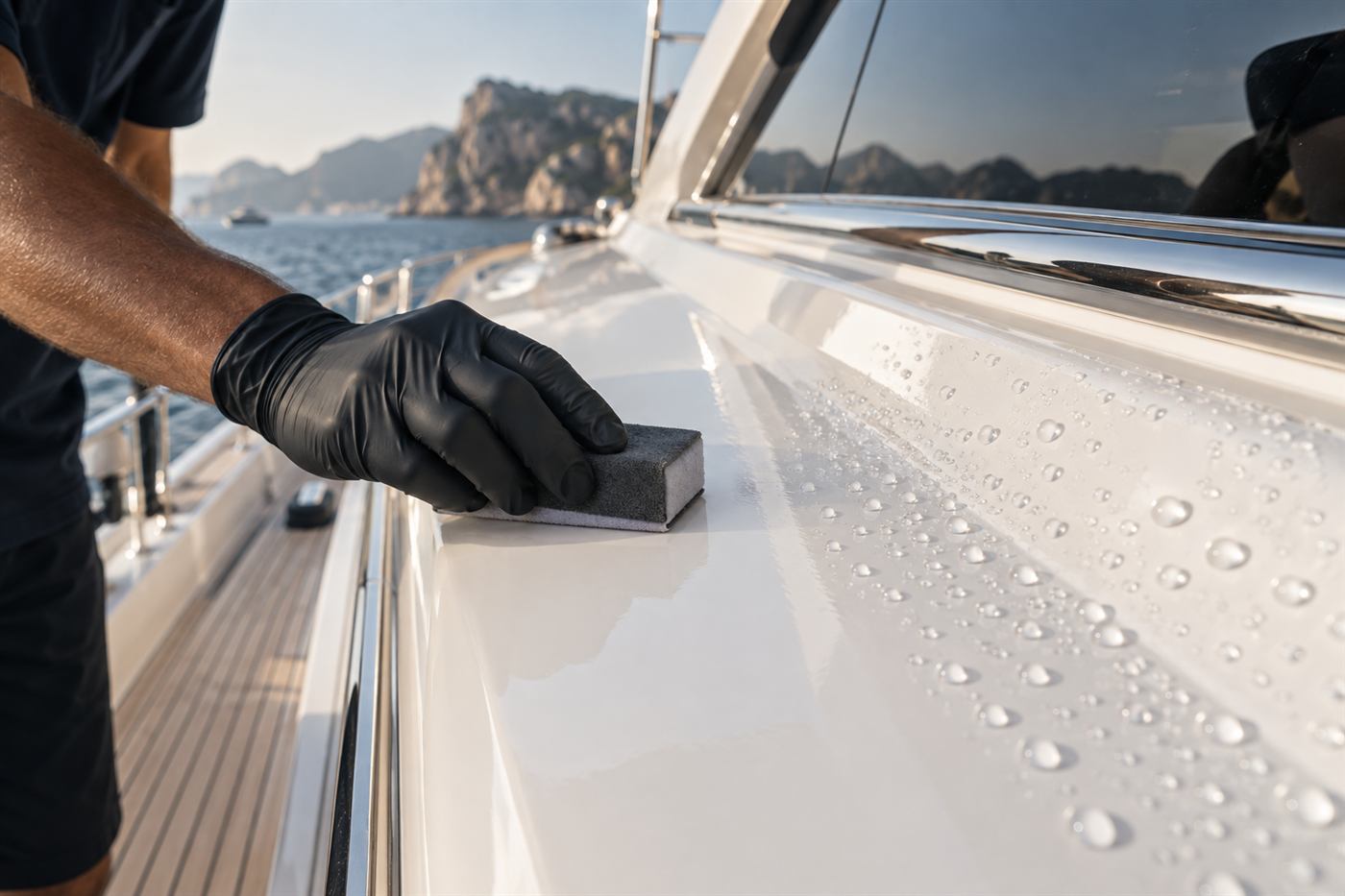
Salt, sand and airborne grime removed with marine-safe soaps and soft media on every wash. The rinse-and-dry at the end is what actually stops water spotting, most wash services skip it.
Serving marinas and private docks across Fort Lauderdale, Miami-Dade and Palm Beach County. Call (954) 719-3572.
What the job actually involves
Rinse the salt film
A fresh-water rinse first, before any soap touches the hull.
Wash with marine-safe soap
Soft media, top to bottom, hull and superstructure.
Detail the hard-to-reach areas
Rails, cleats, and the areas a hose alone won't clean.
Rinse and dry
The step that actually prevents water spotting on gelcoat and glass.
Marine-safe means more than a label.
Household detergents and generic car-wash soaps are formulated for different surfaces than marine gelcoat and often contain stripping agents that pull existing wax or sealant off a hull along with the dirt. A genuine marine-safe soap is pH-balanced specifically to lift salt and organic grime without degrading whatever protection is already on the surface, and it's formulated with an awareness that runoff from a wash eventually reaches the same water the boat sits in. We use products chosen for both of these reasons, protecting the existing finish and respecting the marina environment the wash happens in.
Soft media matters just as much as the soap itself. A wash mitt or sponge that's picked up grit from a previous pass, or one made from a coarse material to begin with, introduces fine scratches into gelcoat with every stroke, invisible individually but cumulative over dozens of washes into a genuinely dulled, swirl-marked surface. We use dedicated, clean wash media for every visit and separate tools for the hull versus anything that's touched the ground or a dirty surface, a small discipline that prevents a huge amount of avoidable damage over a boat's lifetime.
Removing loose grit before anything touches the surface.
Starting with a fresh-water rinse before any soap or media touches the hull isn't a cosmetic step, it's a genuine damage-prevention measure. Salt crystals and airborne grit sitting on a dry gelcoat surface are exactly the abrasive particles that cause fine scratching when a wash mitt drags across them under pressure. A thorough pre-rinse dissolves and washes away as much of this loose material as possible before any contact begins, meaning the actual washing motion that follows works against a cleaner surface with far less abrasive material still present to grind in.
This sequence matters more in South Florida than almost anywhere else, given how much salt aerosol settles onto a boat's surfaces even between uses. A boat that's sat at the dock for a week accumulates a genuine salt film that needs this proper rinse-first approach rather than a quick soap-and-scrub that skips straight to washing.
Why not just use a standard car soap since it's cheaper?
Standard car soaps aren't formulated for marine gelcoat or for runoff into marina water, and many strip existing wax or sealant unintentionally, which shortens how long that protection lasts.
Does soft media really make a difference over a standard sponge?
Yes, a coarse or contaminated sponge introduces fine scratches with every wash, cumulative damage that shows up as dulled, swirl-marked gelcoat over time.
The step most wash services skip entirely.
Water spotting is mineral deposit left behind as droplets evaporate under direct sun, and it's genuinely more visible and more stubborn on dark hulls and glass than on white gelcoat, though it affects every surface to some degree. A wash that ends with a rinse and no active drying step leaves this evaporation process to happen on its own, and the result is a hull that looks clean immediately after washing but develops a hazy, spotted appearance within an hour as the water dries in place. We finish every wash-down with an active dry pass using clean microfiber towels, working systematically across the hull, superstructure and glass so evaporation never gets the chance to leave its mark.
This final step is also where hard-to-reach areas, rails, cleats, hatch seams and other spots a simple hose spray misses, get real attention rather than being left damp and forgotten. Standing water in these crevices is exactly where the early stages of stainless corrosion and mildew both start, so a thorough dry pass here protects more than just the visual finish.
Matching frequency to your specific dock and use.
As described throughout our marina coverage pages, the right wash interval depends heavily on where a specific vessel sits, an open, ocean-facing slip needs considerably more frequent attention than a sheltered residential canal, and a boat that runs offshore regularly accumulates salt faster than one that mostly sits at the dock. Most owners keeping a boat at a South Florida marina full time do well with a wash every one to two weeks, adjusted up or down based on the specific conditions their slip actually faces.
Skipping washes to save cost in the short term routinely costs more later, since a hull that goes months without proper attention accumulates the kind of embedded salt damage and oxidation that requires a full compound and polish to correct, a considerably more expensive and time-consuming service than the maintenance washing that would have prevented it.
How do you handle hard-to-reach areas like rails and cleats?
These get specific attention during the dry pass, since standing water in crevices is exactly where corrosion and mildew start, not just a quick wipe of the easily visible surfaces.
What happens if I skip wash-downs for a few months?
Embedded salt damage and oxidation typically progress to the point where a full compound and polish becomes necessary, a more expensive service than the maintenance washing that would have prevented it.
Adjusting technique to the vessel in front of us.
A sailboat's rigging, mast base and standing rigging fittings need careful attention during a wash-down that a motor yacht simply doesn't have, water and salt collect at deck-level fittings where rigging passes through, and a thorough wash checks these spots specifically rather than treating a sailboat like a motor yacht with a mast bolted on. Center consoles and open boats, with more exposed deck hardware and less enclosed superstructure, wash differently again, more attention to leaning posts, T-tops and rod holders, less to enclosed cabin exteriors.
Tenders and smaller runabouts kept on davits behind a larger yacht get the same careful wash-down as the main vessel during a comprehensive visit, since they're just as exposed to salt and sun as anything else afloat and are easy for an owner to overlook simply because attention naturally focuses on the larger boat nearby.
Beyond just the hull sides.
A complete exterior wash-down covers considerably more surface than the obvious hull sides that catch the eye from the dock. Superstructure, flybridge, hardtop and any enclosed bridge areas all need the same attention, along with glass and isinglass enclosures that show water spotting more visibly than gelcoat does. Swim platforms and boarding areas, which take constant foot traffic and direct water exposure, need particular attention to non-slip surfaces without polishing away the texture that provides safe footing.
Ground tackle, anchor and windlass areas, often overlooked because they're functional rather than decorative, accumulate mud, salt and general grime that a thorough wash addresses along with the rest of the vessel, since neglected ground tackle both looks poor and risks accelerated corrosion on hardware that needs to function reliably.
Do you wash sailboats differently than motor yachts?
Yes, with particular attention to rigging-adjacent deck fittings where water and salt collect, areas a motor yacht simply doesn't have.
Are tenders included in a wash-down visit for a larger yacht?
Yes, we wash any vessel present at the dock during a comprehensive visit, tender included, since it's exposed to the same environment as the main boat.
Washing within a marina's own rules.
Many marinas along this coast maintain specific rules about wash water runoff, requiring biodegradable products and, in some cases, controlled water reclaim rather than an open hose left running freely over the side. We work within whatever specific rules apply at each marina we service, confirming requirements before a first visit rather than assuming a single blanket approach fits every facility. This isn't just a compliance matter, marina water is shared water, and responsible wash practices protect the same environment every vessel at that marina depends on.
Using genuinely marine-safe, biodegradable soap formulations as standard practice, rather than only when a specific marina requires it, is part of how we approach every wash regardless of location, a habit that protects water quality consistently rather than only when someone's checking.
Do you follow marina-specific runoff rules?
Yes, we confirm each marina's specific requirements before scheduling and use biodegradable, marine-safe products as standard practice everywhere we work.
What to expect from a first visit.
A first wash-down visit typically starts with a quick look at the vessel to confirm size and general condition, since this affects time estimation even for a routine service, followed by the sequence described above, rinse, wash, detail hard-to-reach areas, rinse and dry. For a boat that's gone an extended stretch without proper attention, we're upfront if what's actually needed has progressed beyond a standard wash into genuine correction territory, rather than performing a wash that won't meaningfully improve a hull that's already oxidized.
Recurring scheduling tends to be the most efficient arrangement for owners keeping a boat at the same dock long-term, removing the need to call fresh each time and letting a crew that already knows the vessel's specific quirks work efficiently every visit. Call and describe your vessel and dock, and we'll put together an accurate first scope.
Why the same interval doesn't fit every month.
South Florida's wet season, roughly June through October, brings frequent afternoon downpours that rinse some salt off passively, but also leave their own residue once evaporated, since rainwater mixing with settled salt and airborne particulate spots glass and gelcoat just as surely as a skipped wash would. The dry season winter months bring lower humidity swings and often stronger, more consistent breeze, which increases salt aerosol deposition even without a drop of rain falling. We adjust wash frequency seasonally for owners on a recurring schedule rather than applying a fixed interval blindly across the whole calendar year.
Storm season adds another consideration entirely, a vessel that goes into a storm with a fresh wash and clean, dry canvas is simply better positioned to come through cleanup with less staining and less standing salt residue baked into the finish by the time an owner can return to the boat.
Being honest about the limits of a maintenance service.
A wash-down is a maintenance service, not a correction service, and we're upfront when a hull's condition has progressed beyond what washing alone can meaningfully improve. Genuine oxidation, deep scratching, or gelcoat damage from impact all need the compound and polish service described elsewhere on this site, and applying wash-level effort to a problem that needs correction wastes an owner's money on a service that won't produce the improvement they're hoping for.
Similarly, we don't use aggressive chemical strippers or acid-based cleaners during a standard wash-down, since these products, while sometimes effective at cutting through heavy grime quickly, also strip existing wax and sealant and can etch gelcoat with repeated use. Anything beyond standard marine-safe soap and soft media gets flagged and discussed with the owner first rather than applied without explanation.
What if my boat needs more than a standard wash can provide?
We'll tell you directly and explain what a compound and polish service would involve instead, rather than performing a wash that won't meaningfully improve the underlying condition.
Do you ever use stronger chemicals for particularly dirty boats?
Not without discussing it with you first, since stronger products can strip existing protection or etch gelcoat with repeated use, and we're upfront about that tradeoff before using anything beyond standard marine-safe soap.
Working within the rules every marina expects.
Whatever your vessel, wherever it's docked along this coast, a proper wash-down remains the single most important, most foundational service on this list, the maintenance that prevents the need for everything more expensive further down the line. Reach out and describe your boat, and we'll put together an honest, accurate scope.
Why the right gear matters as much as the right hands.
Beyond soap and soft media, a proper wash-down relies on the right water pressure and delivery, gentle enough to avoid forcing water past seals and gaskets it shouldn't reach, but thorough enough to actually rinse salt out of crevices rather than just displacing it across the surface. Long-handled soft brushes reach flybridge and hardtop areas without requiring a crew member to stand precariously on wet, potentially slippery surfaces, and dedicated microfiber towels, kept clean and used specifically for drying rather than general shop use, prevent the same contamination risk described for wash media.
We maintain and replace this equipment regularly rather than running tools past the point where they're still doing their job properly, since a worn-out wash mitt or a towel that's picked up grit from improper storage defeats the whole purpose of using soft media and careful technique in the first place.
Do you bring your own equipment and supplies to every visit?
Yes, we maintain our own equipment specifically to avoid the contamination and wear issues that come from reusing tools past their useful life.
A wash-down might be the simplest service on this list to describe, but doing it properly, the right products, the right sequence, the right attention to the details most services skip, is exactly what separates genuine maintenance from a quick hose-down that only looks clean until the water dries.
If you're weighing whether to handle wash-downs yourself between professional visits or hand the whole thing over to a scheduled program, we're glad to talk through both approaches honestly, some owners do their own routine washing and call us specifically for the harder work, others prefer a fully hands-off recurring arrangement, and either can be the right call depending on your own time, interest and the vessel's specific needs. Whichever path you choose, the products and techniques described throughout this page are the same ones we'd recommend you use yourself, if you'd rather handle the routine washing on your own between our scheduled visits, and we're happy to walk through the specifics for your particular gelcoat and finish, no matter which arrangement ultimately works best for you and your vessel and your own schedule for using it out on the water, whatever that schedule happens to look like season to season, year after year.
That's the standard behind every wash-down we perform, whether it's a quick maintenance visit between busier services or the very first appointment for a vessel we've never touched before, simple, careful, thorough, and done the same honest way every single time it happens, dock after dock, season after season.
Ready for exterior wash-down?
See all services, See marinas & areas
Describe the situation by phone and we will tell you what the job involves. Quotes are given by phone. Jobs that cannot be quoted without seeing them need a technician on site, and the service call charge is explained on the phone before anyone is dispatched.
(954) 719-3572