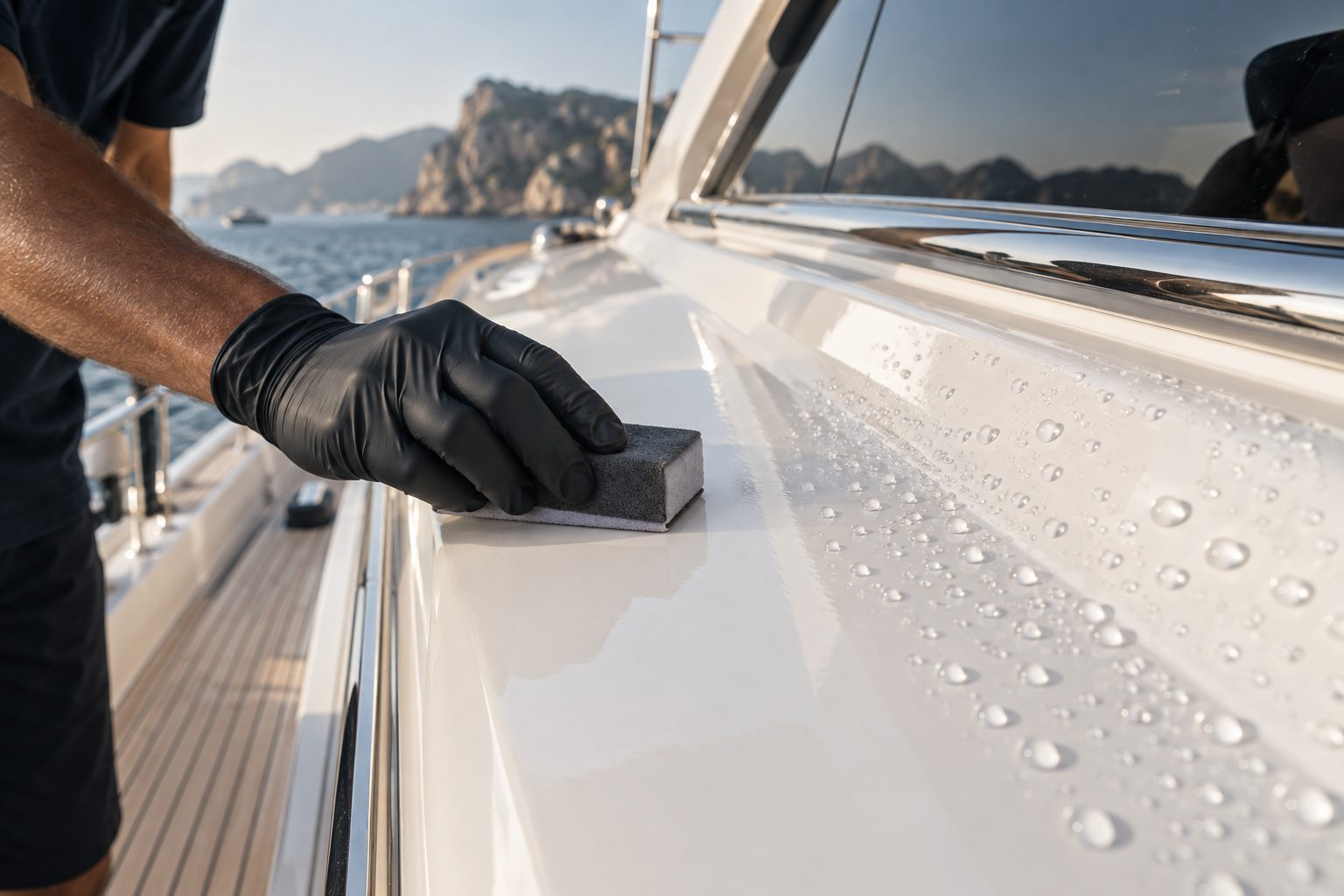
Why absent owners need a different kind of detailing relationship
A yacht that is used every weekend gets noticed constantly. Someone sees the first water spot, the first patch of mildew on a cushion, the first rust bloom on a stanchion base. A yacht that sits for six weeks while the owner is up north or abroad has nobody noticing anything. The problems still happen. Salt air, humidity, bird traffic, afternoon rain and strong sun do their work on a closed boat just as they do on an occupied one, and in South Florida they work quickly.
That is the reason a management company exists, and it is also the reason the detailing side has to be organized differently. When the owner is on board, the owner gives instructions and sees the results. When the owner is away, instructions come second hand, results are judged from photos, and nobody on site has the authority or the time to make every decision. The detailing crew has to be easy to direct, easy to verify, and careful about what it touches when nobody is watching.
This service is built around that reality. It is not a different set of products or a different level of effort. It is a different way of communicating: clear scopes in writing, access arrangements agreed in advance, photographs that show the state of the vessel before and after, and a plain list of anything noticed that sits outside the detailing scope, so the manager can pass it to the right trade.
Who usually gives the instructions
Depending on the vessel, the person who books and directs the work can be a professional management company, an individual yacht manager who runs a handful of boats, a captain who is employed by the owner, or a family member or assistant who has been given authority over the boat. Each of these people has a different workload and a different tolerance for back and forth. A management company with a large list of vessels wants a short message, a clear scope and a photo report. A captain who lives on board wants to be present, to point at the things he cares about, and to approve the work as it goes.
A good detailing crew adapts to whoever is in charge. It asks one question at the start: who is authorized to approve work, who is authorized to approve a change in scope, and who receives the report. The answer is written down, so that when a job grows by an hour or an interior surface turns out to need a different method, the crew is not guessing whose decision it is.
It also helps to know whether the owner has standing preferences that never reach the manager. Some owners do not want certain products used on teak. Some dislike the smell of a particular interior cleaner. Some have a specific shine they expect on the topsides. A short note from the owner, passed along by the manager once, saves a lot of corrections later.
Access, keys and marina arrangements
The first practical question on any managed vessel is how the crew gets aboard. Marinas differ. Some require a gate key or fob for the dock, some require every outside contractor to register at the dockmaster office, some ask for proof of insurance, and some limit which days or hours outside crews may work. The management company usually knows these rules already, and the detailing crew should follow whatever the marina requires. The guide to dockside detailing and marina rules covers what is common across South Florida marinas.
Boat access is a separate matter. A vessel may be opened by the captain, by the manager, by a marina staff member, or by a key left in an agreed place. The detailing crew should never be handed access that the owner has not approved, and it should never leave a vessel unlocked or with a hatch open that it found closed. Each visit should end with the boat secured the way it was found, and the manager should be told when that was done.
If interior work is part of the scope, the question becomes more sensitive. A closed boat holds personal items, documents, electronics, and sometimes valuable pieces of art or equipment. The usual arrangement is that the crew works only in the areas named in the scope, does not open drawers or lockers beyond what the task requires, and reports anything that looks out of place, such as signs of a leak, a bilge alarm, or an open window, instead of trying to fix it.
What a visit looks like when the owner is not there
A typical visit to a managed yacht starts with a walk-around, taken with a phone camera or a checklist. The crew notes the condition of the hull sides, the deck, the canvas, the glass, the stainless and the interior surfaces that are in scope. This initial record is not a formal survey. It is a simple, dated set of pictures and notes that shows how the vessel looked when the crew arrived.
Then the work follows the same order as any careful detailing job: top to bottom, dry tasks before wet ones, and the most delicate surfaces protected before anything messy starts. On a vessel that is regularly maintained, this might mean a thorough wash, a hand dry, a wipe of glass and stainless, a check of the canvas and a light interior pass. On a vessel that has been neglected, it might mean the first stage of a longer recovery, with specific areas flagged for further work such as gelcoat oxidation removal or teak care.
At the end, the crew repeats the photographs from the same positions. A report is sent to the manager, listing what was done, what was found, and what was deliberately left alone. Because the owner is not there to ask questions at the dock, the report has to answer them in advance.
- Arrival check and photographs of the condition on arrival
- Work completed in a stated order, with any products or methods that differ from the usual
- Closing photographs from the same angles as the opening set
- A written list of items noticed but not part of the scope
- Confirmation that the vessel was secured and how
Condition notes that help the manager, not just the crew
Detailers see parts of a yacht that managers rarely do, because they are close to every surface with a cloth in hand. That closeness is valuable. A detailer notices a hairline crack around a hatch frame, a sealant line that has pulled away, a gel patch that looks softer than the surrounding gelcoat, a canvas seam beginning to open, or a slow drip stain under a fitting. None of these items belong to the detailer to repair, and the detailer should not diagnose them. But reporting them clearly is part of being useful to someone who manages a vessel from a distance.
A good note is specific. It says where the item is, includes a close photograph and a wide photograph to show location, and states what was observed without guessing at the cause. For example, a note might say that a stanchion base on the port side has a brown stain running down the deck, that the sealant at the base looks cracked, and that the crew did not attempt to reseal it. The manager can then decide whether to call a rigger, a canvas shop or a general marine contractor.
Over several visits these notes build a useful history. A manager who can look back and see that a stain has been getting longer over four months has more information than one who sees only a single photo. It also helps with owner communication, since the manager can show the vessel's progress and not just describe it.
Scheduling around the owner's calendar and the manager's workload
Most owners tell their manager when they plan to use the boat. Good detailing is timed to finish before that date, with a margin for weather. The crew cannot promise exact arrival windows, since marinas, weather and traffic vary, but a visit planned two or three days ahead of the owner's arrival leaves room for a rain delay without leaving the boat half finished.
Managers often want recurring visits on a pattern that matches how the boat is used. A vessel used every weekend by a family might need a quick wash after each trip. A vessel that is used for a few weeks in winter and sits in summer might need a thorough detail before the season, a lighter visit mid-season, and protective work before the hot, wet months. The recurring maintenance plans page explains how those patterns are usually structured.
Some managers prefer to give the crew a standing set of instructions and to approve only exceptions. That works well when the scope is repeatable and the vessel is in stable condition. Others prefer to approve each visit. Either approach is workable, as long as the instruction on file is current and the crew knows which approach applies.
Managing several vessels with one detailing contact
A management company with a dozen vessels does not want a dozen different detailing relationships. It wants one point of contact who knows the portfolio, understands which boats are in which marina, and can schedule visits in a sensible route so that crews are not driving across the county for a half-hour job. A detailing company that works across several marinas, such as the ones covered on the marinas pages, can group visits by location and keep the manager's coordination simple.
The manager also benefits from consistency. If every vessel in the portfolio is detailed with the same level of reporting, the manager can compare them at a glance. A weekly or monthly summary listing each vessel, the work done, and the flagged items is easier to read than a stream of separate messages. It also helps the manager discuss costs and priorities with owners, since the information is already organized.
Where vessels differ, the scope should differ. A sportfish boat that goes out offshore needs a different routine from a pontoon boat that stays in the canal, and a sailboat with extensive canvas and rigging needs a different set of checks from a motor yacht with a large interior. The detailing crew should learn each vessel's specific demands and record them, so that each visit starts from that knowledge and not from scratch.
Interior care on a closed boat
In Florida's humid climate, a closed boat can become a mildew problem within weeks. Soft goods, headliners, carpet, cushions and lockers all hold moisture. Air conditioning or dehumidifiers help if the vessel has power and the equipment is working, but if the shore power trips or a unit fails, the interior can turn musty before anyone notices. A detailing visit that includes an interior check is often the first time someone smells the problem.
The crew should treat what it finds carefully. A musty smell is a symptom, not a diagnosis. It might come from a damp bilge, a clogged condensation drain, a closed locker with a wet towel, a leaking hatch or a failed dehumidifier. The detailer can clean what is surface mildew, ventilate where the manager has allowed it, and report the condition. Fixing the source belongs to someone else. The pages on interior mildew treatment and odor removal describe how those jobs are approached once the cause is understood.
Interior detailing on a managed vessel should also respect what the owner leaves on board. Fabrics, wood veneers, leather, electronics and decorative items all react differently to cleaners. The crew should ask in advance about anything fragile or valuable, and use the gentlest effective method on anything it is unsure about.
Preparing for owner arrival, charter use or a survey
Three events create deadlines for a managed yacht: the owner's arrival, a charter or guest booking, and a survey tied to a sale or insurance renewal. Each calls for a different kind of preparation.
For an owner's arrival, the aim is for the boat to look and smell like it was loved while the owner was away. Glass is clear, stainless is bright, decks are clean, cushions are fresh, and no insect or mildew surprise waits below. For a charter or guest booking, the standard is similar but the timeline is tighter, and the turnaround between guests has its own routine, covered in the charter turnover cleaning page. For a survey, the detailing should make surfaces visible without hiding anything. A surveyor needs to see the actual condition of the hull, deck and fittings, so heavy cosmetic work is better left until after the survey unless the manager has a reason to do it first.
The manager is in the best position to know which of these events is coming. A short message to the detailing crew, giving the date and the purpose, lets the crew plan the right scope instead of defaulting to a standard visit.
Communication that respects everyone's time
Managers are busy, and a detailing crew that sends fifteen messages per visit becomes noise. The most useful pattern is short and predictable: one confirmation before the visit, one report after it, and an immediate call only if something urgent appears, such as water in the bilge, an open hatch, a broken window or any sign of damage or intrusion.
For anything that involves a decision, such as a stain that will take extra time or a surface that might need a different method, the crew should send a photo, a plain description and one or two options, so the manager can answer in a sentence. Quotes are given by phone, and a larger job can call for an on-site visit before a quote is given, since the price depends on the actual condition of the vessel. A service call charge applies, and it is explained on the phone before dispatch.
When you are ready to set up a standing arrangement for one vessel or a whole portfolio, call. Have the vessel names, marinas, access arrangements and the name of the person who approves work, and the conversation will move quickly.
Questions people ask
Can the crew work when the owner and manager are not on site?
Yes, if access has been arranged and the scope is approved in writing by whoever is authorized. The crew works only in the areas named, secures the vessel the way it was found, and sends a report with before and after photographs. Anything unusual, such as water in the bilge or an open hatch, is reported at once by phone.
Do you need to meet the owner before starting?
Not usually. Most work is directed by the manager or captain. It helps to pass along any strong owner preferences, such as products to avoid on teak or fabrics that need gentle handling. If the owner is local and wants a walk-through, that can be arranged, but it is not required for routine work.
How are marina access rules handled?
The manager or captain usually knows the marina's rules for outside contractors, including gate access, registration and insurance requirements. The crew follows whatever the marina asks. Tell us the marina and the dock number when you call, and any paperwork the dockmaster needs, so nothing delays the visit on the day.
Will I get photographs and notes after each visit?
Yes, a short report with before and after photographs from the same angles is standard for managed vessels. It lists what was done, what was found and what was left alone. Observations outside detailing, such as cracked sealant or a canvas seam opening, are described and photographed but not repaired by the detailing crew.
Can one detailing contact handle several vessels in different marinas?
Yes. Visits can be grouped by marina and city so travel is sensible, and a single summary can list each vessel and what was done. Each vessel keeps its own scope, since a sportfish boat, a sailboat and a motor yacht need different routines. Call with the vessel list and marinas to plan it.
How is pricing handled for a managed vessel?
Quotes are given only by phone. Simple recurring work can often be quoted from a conversation, while complicated or neglected vessels need an on-site visit first so the quote reflects real condition. There is a service call charge, explained on the phone before dispatch, so there are no surprises when the crew is sent.
Describe the situation by phone and we will tell you what the job involves. Quotes are given by phone. Jobs that cannot be quoted without seeing them need a technician on site, and the service call charge is explained on the phone before anyone is dispatched.
(954) 719-3572