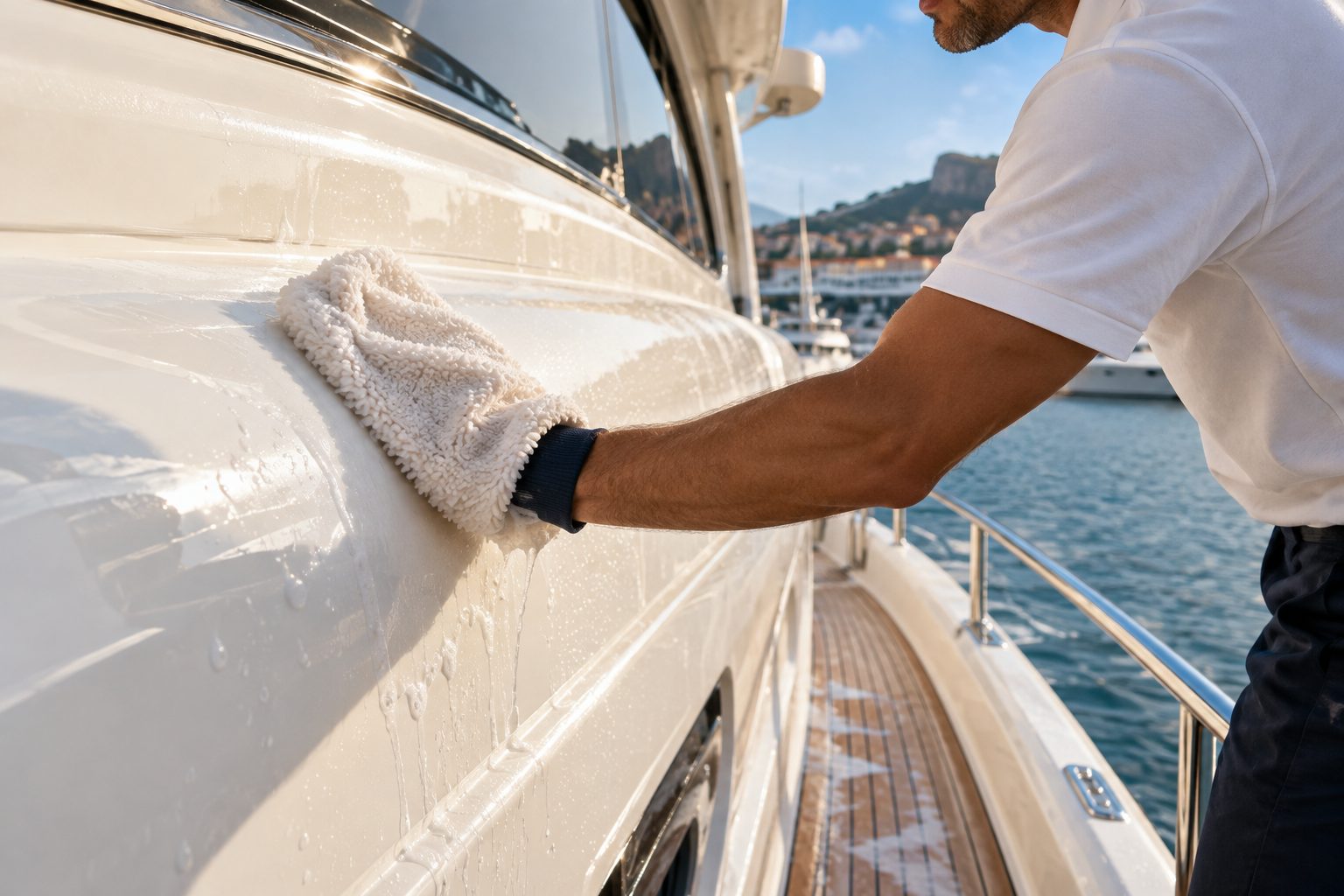
What oxidation really is
Gelcoat is a resin layer, usually colored, that forms the outer skin of a fiberglass boat. Ultraviolet light and heat slowly break down the surface of that resin. The result is a thin, powdery layer of degraded material that scatters light instead of reflecting it. That scattered light is what you see as dullness, and the powder is what comes off on your hand or a white cloth.
South Florida is hard on gelcoat for obvious reasons. Strong sun, high humidity, salt in the air and long warm seasons accelerate the process. Dark colors show it first because they reveal the haze more clearly, and horizontal surfaces such as decks, coamings and flybridge tops take the most direct exposure.
Oxidation is a surface condition, not a structural failure. It is the first stage of how gelcoat ages, which is explained in more detail in the owner guides on how gelcoat ages and understanding oxidation. Caught early, it is a polishing job. Left for years, it becomes a restoration.
Diagnosing it with a simple wet test
The quickest way to see what is underneath is a wet test. A small area is washed and dried, then lightly wetted with clean water. Wet gelcoat shows something close to the gloss that polishing could bring back. If the wet patch looks deep and rich, the gelcoat beneath the haze is healthy and compounding will likely restore it.
If the wet patch still looks flat, the damage may be deeper, or the gelcoat may be thin. Chalk that comes off on a cloth is the most common sign. A hull that shows fiber pattern, spidering or cracking is showing a different problem entirely, and compounding will not fix it.
A technician also runs a hand over the surface and looks at it from an angle against the light. A hull that feels rough, shows swirl marks from past work, or has patchy gloss between areas that were polished and areas that were skipped will need a different plan than a hull that is uniformly dull. The test patch decides the plan, not a guess made from across the dock.
The stages of cutting
Oxidation removal is done in stages, and each stage uses a finer abrasive than the one before. The first stage is a wash and decontamination, so grit and old wax are not ground into the surface. The second stage is the cut, using a compound and a pad suited to the severity of the oxidation. The third stage is refinement with a finishing polish that removes the marks the compound left behind. The last stage is protection.
A mistake that shows up often is skipping directly to the heaviest option. An aggressive compound with a wool pad removes oxidation quickly, and it also removes a lot of gelcoat. A better approach starts with the least aggressive combination that works on the test area, and steps up only if it has to.
Heat is the other concern. Rotary polishers build heat quickly, and gelcoat softens as it warms. Technicians keep the tool moving, work in small sections and check the surface temperature by hand. The full process is covered on compound and polish, and the owner guide on gelcoat compounding explains the terminology.
- Wash and decontaminate so nothing abrasive is trapped under the pad
- Mask trim, decals, rub rails and any painted boot stripe
- Test the least aggressive compound and pad on a small section
- Cut the oxidation in controlled sections, wiping often to inspect
- Refine with a finishing polish to remove cutting marks
- Clean off residue and apply a sealant or coating
When a hull is too thin to compound
Every compounding pass removes a very small amount of gelcoat. A boat that has been compounded several times over its life, or one that was built with a thin layer from the start, can reach a point where there is not much left. Going further risks burning through to the fiberglass laminate, which is a repair problem rather than a cleaning one.
Warning signs include color showing on the pad that looks like fiber or a change in the surface texture, edges and corners where the gelcoat is naturally thinner, and areas that have been repeatedly worked. Radiused edges, rub rail lines, hull-to-deck joints and the tops of coamings are the places where technicians slow down the most.
If a hull is too thin to continue, the honest advice is to stop and discuss options. That may mean a gentler polishing approach, a protective coating over what remains, a repair, or a repaint at a body shop. A good technician would rather tell you that than polish a hull through to the glass. More about that boundary is on gelcoat repair versus detailing.
How the work looks on different boats
A white center console that lived outdoors on a lift is usually the simplest case. The hull sides are oxidized evenly, the gelcoat is reasonably thick, and a medium compound followed by a finishing polish brings back a clean, bright finish.
A dark blue or black hull is a different job. Dark gelcoat shows every swirl and every hazy patch, and the surface is less forgiving. Finishing steps take longer, and the final polish has to be fine enough that the depth of color comes back without visible marks in direct sun.
A cabin cruiser with a long history of weekend polishing may have uneven gelcoat. Some panels are glossy, others dull, and the transition between them is obvious. The job there is blending: bringing the dull panels up to match without cutting the glossy ones further. In each case the plan depends on what the surface shows, which is why a general package price over the phone has limits and why more involved jobs need a look first.
Working around trim, decals and hardware
Polishing a hull means working close to things that can be damaged. Rub rails, stainless fittings, decals, hull numbers, windows, vinyl graphics and painted stripes all need attention. Compound slung from a pad can stain rubber and vinyl and is annoying to remove once it dries.
Technicians mask edges with marine-safe tape, keep the polisher at a safe distance from raised hardware, and clean up as they go. Hull numbers and registration decals are treated carefully, since they are legally required and costly to replace, a topic covered under hull numbers and decals.
Painted surfaces nearby, including a boot stripe or an accent line, usually cannot be treated the same way as gelcoat. Paint is thinner and softer than gelcoat. If a boat has both, the plan separates them, and the paint is handled with a much gentler method.
What cutting does not fix
Compounding is a tool for removing a thin, damaged surface. It does not fill scratches that are too deep, and it does not repair cracks, chips or blisters. Deep gouges can be reduced but may remain visible. Staining that has penetrated the gelcoat may lighten without disappearing.
It also does not make the gelcoat younger. A restored surface looks good and reflects light well, but the underlying resin is still the same age and still exposed to the same sun. That is why protection immediately after the cut is not optional. A bare freshly polished surface oxidizes faster than one that has been sealed or coated.
If you are weighing a more dramatic restoration of a badly weathered hull, the scope and stages are different and are described on fiberglass restoration. Honest expectations at the start prevent disappointment at the end.
Protecting the finish after the cut
Once oxidation is gone, the surface is clean, open and ready to be protected. A marine wax is the traditional choice. It is easy to apply and gives a warm look, but it wears off and needs to be renewed regularly. A synthetic sealant lasts longer and resists UV more effectively. A ceramic coating is the most durable of the three and gives the hardest, slickest surface.
No protective layer is permanent, and none removes the need for washing. Each makes washing easier and slows the return of oxidation. The comparison on wax, sealant and ceramic compared lays out the practical differences, and ceramic coating describes what the coating process involves.
How you use the boat should guide the decision. A boat that sits on a lift in the sun, a boat that stays in the water year round, and a boat that is stored under cover each age differently and call for different protection.
Keeping oxidation from returning
The best long-term approach is simple. Wash regularly with a marine soap, rinse salt off after use, protect the surface on a schedule that suits your exposure, and do not let a hazy surface go untreated for years. Light, early polishing removes far less material than a heavy cut after neglect.
Covers and lifts help. A boat that spends its idle time out of the direct sun ages more slowly. Where that is not possible, more frequent protection makes up some of the difference. A maintenance rhythm, discussed on recurring maintenance plans, spreads out the care instead of concentrating it into an expensive restoration.
Avoid household polishes, abrasive kitchen cleaners and automotive products not made for marine gelcoat. They can leave residue, scratch the surface or contain silicones that make future repairs difficult.
Pads, compounds and machines in plain terms
Owners sometimes hear technical talk about wool pads, foam pads, rotary machines and dual-action polishers and wonder what matters. The short version is that cutting power comes from the combination of abrasive and pad, and from the machine moving it. A wool pad with a heavy compound cuts fast. A foam pad with a fine polish cuts gently and finishes.
A rotary machine spins on a single axis and generates strong cutting force and more heat. It is efficient on heavy oxidation but takes a trained hand, since it can burn through gelcoat or leave holograms, which are faint swirling marks visible in sunlight. A dual-action machine oscillates as well as spins, which is gentler and more forgiving. Many technicians use both, starting with whichever matches the condition and finishing with the gentler tool.
None of this makes the equipment more important than the person using it. A careful technician with a modest setup will do better than a careless one with the best gear. What you can reasonably ask is what approach will be taken on your hull and why. A good answer mentions testing first, working in sections, controlling heat and inspecting under different light.
- Wool pads cut quickly and suit heavy oxidation on healthy gelcoat
- Foam pads cut more gently and are used for refining and finishing
- Rotary machines are powerful but need experience to avoid heat and swirl marks
- Dual-action machines are more forgiving and often used for final stages
- The test patch, not the tool, decides how aggressive the process should be
Oxidation on non-hull surfaces
Hull sides are not the only places gelcoat oxidizes. Cabin tops, flybridge surfaces, hatch covers, cockpit coamings and swim platforms often chalk worse than the hull because they face the sun directly. They are also surfaces people touch, sit on and lean against, so powdery residue ends up on clothing and skin.
These areas need extra thought. Many have non-skid molding, which cannot be compounded without destroying the texture, so those parts are cleaned and protected rather than cut. Smooth areas between the texture can be polished, but the masking is more detailed and the process slower.
Hatches, windows and rubber seals are another consideration. Compound residue can stain rubber and cloud acrylic, so they are protected before work begins and wiped carefully afterward. A thorough job keeps the finish consistent across the vessel, not only the places that are easiest to reach.
What to have ready when you call
Tell the technician the boat type and length, where it is moored, the hull color and when it was last polished or waxed, if you know. Describe what you see: chalk on a cloth, patchy gloss, stains or swirl marks. If previous work was done by someone else, mention it, since repeated compounding affects how much gelcoat remains.
Quotes are given by phone only. Oxidation removal on a small, uniformly dull boat may be quoted from a good description. A complicated job, such as a large yacht with mixed conditions, usually needs an on-site visit. A service call charge applies for that visit and is explained on the phone before dispatch.
If you are unsure whether your hull needs a light polish or something more, that is a reasonable question to ask. Call and describe what you are seeing, and we will help sort out the right level of work.
Questions people ask
How do I know if my gelcoat is oxidized?
Common signs are a dull, flat finish, a chalky powder that rubs off on a cloth, and patchy gloss between sheltered and exposed areas. A quick check is to wet a small clean area. If it looks noticeably deeper and glossier when wet, oxidation is likely the cause and polishing can probably restore it.
Can every oxidized hull be restored?
No. Most can, but a hull with very thin gelcoat, cracking or exposed fibers may not tolerate compounding. A technician will test a small area first and tell you honestly if the surface cannot be cut safely, and will discuss other options such as protection, repair or repainting.
Will compounding damage my gelcoat?
Each pass removes a very small amount of material, so it should be done only as much as needed. Using the least aggressive compound that works, controlling heat and avoiding edges where gelcoat is thin keeps the process safe. The risk grows with repeated heavy compounding over many seasons.
Do I need protection after oxidation removal?
Yes. A freshly polished surface is clean and open, and it oxidizes faster if left bare. A wax, sealant or ceramic coating adds a protective layer and makes washing easier. Which one fits depends on how you use the boat and how long you want the protection to last.
How long does the work take?
It depends on the boat's size, the severity of the oxidation and the number of stages needed, so no honest answer fits every vessel. A small, evenly weathered boat goes faster than a large dark yacht with mixed conditions. The time estimate is part of what is discussed on the phone.
How do I get a quote?
Call and describe the vessel, its location and what you see on the hull. Quotes are given only by phone. A more complicated job may need an on-site visit first, and there is a service call charge that is explained on the phone before anyone is dispatched.
Describe the situation by phone and we will tell you what the job involves. Quotes are given by phone. Jobs that cannot be quoted without seeing them need a technician on site, and the service call charge is explained on the phone before anyone is dispatched.
(954) 719-3572