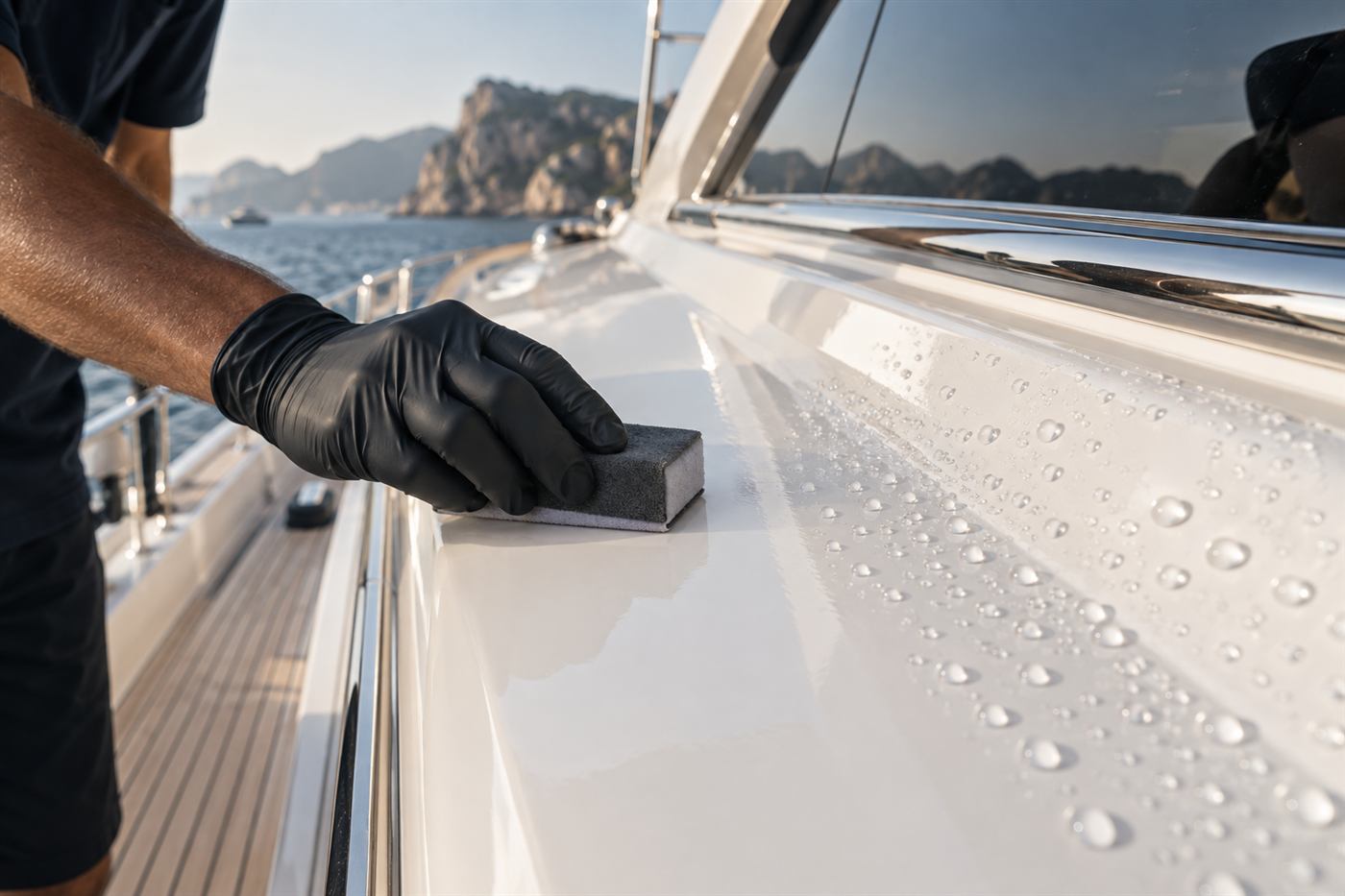
Why show detailing is different from normal detailing
A regular detail aims to leave a boat clean, protected and well presented. Show detailing has the same ingredients but a different audience and a harder clock. Visitors step aboard, open lockers, run a hand along the rails, sit on the cushions, look into the heads and examine the hull in bright light. Many of them have seen dozens of boats that day. The boat that stands out is usually the one where nothing is overlooked: the glass is clear, the stainless is bright, the teak is even, the carpet is spotless and there is no smell.
The clock is the other difference. A show date does not move. Whatever has to be done must be done before the doors open, and in many cases the boat has to be moved, positioned and set up in a tight window as well. Delays in other trades, weather and logistics can all squeeze the time left for cleaning. A show plan therefore works backward from the opening day, with buffers built in, rather than forward from whenever the work can start.
This guide is for owners, brokers, dealers and captains preparing a vessel for a show or a similar display. It does not promise any result, and it does not cover the show's own rules, which you must read and follow. Every show has its own requirements for setup, access, power, water, materials and what may be done on the dock, and those override anything here.
Read the exhibitor rules before anything else
Every show publishes rules for exhibitors, and they affect detailing directly. They may limit which days and hours you can work on the boat, restrict products and tools that can be used on the dock, set rules about water use and runoff, require insurance documentation for outside contractors, control who may access the berth and set times for loading in and moving out. Some shows restrict compounding and sanding on site because of dust and noise. Others limit the use of power equipment or require work to be finished before a certain hour.
Ask the show office or your dealer contact early for the current rules, and share them with whoever is detailing the boat. A detailer who learns about a restriction on the morning of setup may have no time to adapt. If a task cannot be done on site, it needs to be completed beforehand, at your home marina, a yard or a shop, before the boat is moved.
Also plan for the practical side of access. Show berths are often tight, crowded and sometimes temporary. There may be limited room to stage equipment, to carry water or to work on the hull from a dock. Ask about the berth layout, power and water availability and the access path. Our guide on dockside detailing and marina rules covers the common restrictions you may also meet at a show venue.
- Get the exhibitor rules in writing and share them with your detailer.
- Check which products, tools and hours are allowed on the dock.
- Confirm insurance and access requirements for outside contractors.
- Ask about berth layout, power, water and staging space.
Working backward from opening day
The most useful tool for show preparation is a simple timeline written from the opening day backward. Start with the day the doors open. Subtract the setup window. Subtract the transport or move to the venue. Then subtract the time needed for the main detail, the time for any repairs or other trades, and a buffer for weather and surprises. The result is the latest sensible date to begin, and an honest view of how much is realistic.
Do not put the whole detail in the final days. Heavy work such as compounding, polishing, teak restoration, carpet extraction and metal polishing belongs early, so that if something needs a second pass, there is time. The final days are for finishing: protection, glass, the interior wipe-down, last touches and a walk-through with a critical eye. Leaving restoration to the last minute is the most common way show boats end up with visible flaws.
Be realistic about the number of people and the amount of access. A large yacht takes more hands, and a crowded schedule at the dock can limit how many can work at once. We do not promise how long any job will take, since it depends on the boat's condition, size and access, but we can tell you what is sensible after a description or an on-site look. Our guide on how long yacht detailing takes explains what drives the time.
- Fix the opening day and the setup window.
- Work backward through transport, the main detail, repairs and other trades.
- Add a buffer for weather and second passes.
- Book the heavy restoration early and the finishing work last.
- Schedule a final walk-through with the owner, broker or captain.
The exterior display standard
On the exterior, display standard means that every surface looks deliberately cared for. The hull sides should be clean, clear of waterline stain and rub marks and evenly glossy. The topsides, cabin sides and flybridge should be clear of salt, dust and streaks. Glass should be spotless, with no water marks or film. Stainless and chrome should be bright and consistent, without spots, tea staining or fingerprints. Teak should be even in color and clean in the grain. Non-skid should be clean and the texture should be visible.
To reach that, the usual order is a wash, a decontamination of any embedded contaminants, correction of oxidation or dull spots where needed, polishing of metal, restoration of teak and finally protection. The services on compound and polish, bright work and metals and ceramic coating describe those steps. A fresh layer of protection gives a deeper, wetter look under show lights and makes the final touch-ups quicker.
Look at the boat the way a visitor will. Walk the dock and look at the hull from the angle most people see it, low and from the side. Then stand on deck and look down. Then go inside and look up. A reflection that shows swirl marks, a corner with grime, a streak on a window or a stain along the waterline is the sort of thing a keen visitor notices. A detailer works to find and fix those before the show, but the owner or broker should do their own critical pass too.
The interior display standard
Show visitors spend most of their time inside, and the interior has to be spotless and neutral in smell. Every surface that can be touched is a surface that will be touched. Galley counters, tables, sinks, faucets, mirrors, glass, the heads and shower, cabinets, drawers and handles should all be clean and dry. Carpet should be freshly vacuumed and spotless. Upholstery should be clean, even and clear of stains. Headliners should be clear of marks.
Odor is the one thing that can undermine everything else. A boat that has been closed up, especially in humid weather, can pick up a musty smell that visitors notice immediately. If the interior has any odor, find and treat the cause rather than masking it. The pages on odor removal and interior detailing explain how causes are identified and treated. A heavy fragrance is rarely a good choice, because some visitors react to it and it does not fix an underlying moisture issue.
Plan for how the interior will be kept during the show. Visitors may be asked to remove shoes or use covers, and a sign or a staff member at the entrance helps. Keep a small cleaning kit on board for spills and marks: microfiber cloths, glass cleaner, a small vacuum and a simple upholstery cleaner. A clean boat gets dirty quickly under heavy traffic, and a quick wipe each morning keeps it looking its best.
The details that visitors notice and exhibitors miss
Experienced visitors look at the places that busy exhibitors forget. They look at the underside of the cockpit table, the track of a sliding door, the corner of a locker, the grout line in the shower, the drain at the bottom of a hatch, the hinge on a cabinet and the screw heads on a rail. They look at the inside of the swim platform locker, the windlass area at the bow and the underside of the flybridge overhang. A boat can be spotless on the main surfaces and still show neglect in those places.
Metal is another giveaway. A rail that is bright on top and spotted underneath, a cleat with salt crust at its base or a hinge with rust bloom tells the visitor that the polishing was quick. Stainless and chrome are best polished and then wiped clean of residue, since leftover compound in a crevice shows white under bright light. The page on stainless metal polishing describes how that work is done.
Canvas and soft goods matter too. A bimini or cockpit cover with mildew spots, a dirty zipper, a cloudy window panel or a stained cushion undermines an otherwise good display. If a piece is past cleaning, decide early whether to replace it, since new canvas takes time to make and fit. Walk the boat with a checklist and a flashlight a week before the show, then again the day before, and fix what you find. That is how the final polish of a display standard is reached.
Transport, positioning and what happens in between
If the boat has to travel to the show, by water or by road, a detail done before departure can be undone on the way. Spray, bugs, road film, exhaust soot and handling marks all add up. A common plan is to complete the main restoration before the move, protect surfaces, then do a final wash and finishing detail after the boat is in its show position. That way, any marks picked up in transit are removed at the end, and the finish is as fresh as possible when the doors open.
Protect the boat during the move where possible. Covers for upholstery and carpet, wraps for delicate items and securing of loose objects reduce damage in transit. Stow breakables and loose items, and remove anything that could rub or scratch. The captain or transport company decides how the boat is secured and moved, and those decisions are theirs, not the detailer's. Cleaning plans should simply fit around them.
Allow time after arrival for reorienting the boat in its berth, setting out fenders, connecting power and water and staging furniture and props. Often the setup window is tight, and the detail has to fit between other setup tasks. Coordinate with the dealer, broker or show coordinator so that the cleaning crew knows when the boat will be ready for work and what is already done.
Show-day touch-ups and daily upkeep
Once the show opens, the work shifts to upkeep. Every morning, before the doors open, walk the boat and look for what changed overnight: dew spots on glass, dust on decks, bird droppings, fingerprints on glass and brightwork, marks on upholstery and anything that has shifted. A quick wipe-down of glass, stainless and high-touch interior surfaces, a vacuum and a rinse of the deck keep the boat looking fresh.
Keep a few simple supplies on board and organized: microfiber cloths, a glass cleaner suited to marine glass, a stainless polish, a quick detailer for the hull sides and a small brush and vacuum. Be careful with what goes on which surface, since the wrong product can leave streaks or damage a finish. If in doubt, ask your detailer what to keep on hand. Our guide on yacht detailing products explained helps with choosing.
Weather matters at an outdoor show. Rain leaves spots, wind brings dust and strong sun can bake residue on quickly. Be ready to rinse and wipe down after a shower, and plan for the shade and cooler hours. If your detailer can be on call for a touch-up during the show, discuss that in advance, including how and when they would be allowed on the berth, since access rules during show hours are often tight.
After the show and what to have ready when you call
When the show ends, the boat has usually seen heavy traffic, and a post-show clean is often sensible before it goes back into regular use or on to another venue. Carpet and upholstery take the brunt of foot traffic, and decks pick up marks. A reset detail restores the vessel and gets it ready for the next stage, whether that is a sale, a delivery or the owner's use.
When you call to plan show detailing, have the basics ready. The vessel type and approximate size. The show, the dates and the berth, if known. Where the boat is now and where the main detail will happen. What you already know needs work, such as oxidation, teak, stained carpet, odor or spotted metal. Whether you have the show's exhibitor rules. And who is coordinating, whether that is a broker, dealer, captain or the owner.
Call us when you have a date and we will talk through what is realistic. Quotes are given by phone, and for larger or more complicated show jobs we may suggest an on-site visit first. There is a service call charge, explained on the phone before anyone is dispatched. We will tell you plainly what the boat needs, what can be done in the time available and what is better left until after the show.
Questions people ask
How far ahead should I plan show detailing?
As early as you can. Work backward from the opening day, allowing for setup, transport, repairs by other trades and a buffer for weather and second passes. Heavy restoration belongs early and finishing work late. The calendar fills quickly before major shows, so contacting a detailer as soon as you have a date is wise.
Can compounding and polishing be done at the show venue?
That depends on the show's exhibitor rules, which often limit products, tools, dust, noise and hours on the dock. Heavy correction is usually best done beforehand, at your home marina or a yard. Ask the show office for the current rules in writing and share them with your detailer before planning the work.
Should the detail be done before or after the boat is moved to the show?
Often both. Main restoration and protection are done before the move, and a final wash and finishing pass is done after the boat is in position, to remove spray, road film and handling marks picked up in transit. How the boat is moved and secured is decided by the captain or transport company, and cleaning plans fit around that.
How do I keep the boat looking good during the show?
Walk it each morning before the doors open and look for dew spots, dust, droppings and fingerprints. Keep microfiber cloths, marine glass cleaner, a stainless polish and a small vacuum on board. Ask your detailer which products suit which surfaces, because the wrong product can streak or damage a finish.
Will a ceramic coating make the boat show-ready on its own?
No. A coating adds protection and a deeper look, but it is applied over a prepared surface, and preparation is where most of the work lies. Oxidation, stains, swirl marks and contamination should be corrected first. No product removes the need for a careful pass over every surface, inside and out.
How do I get a quote for show detailing?
Call us. Quotes are given by phone after we ask about the vessel, the show, the dates, the berth and the work needed. Larger or more complicated jobs may call for an on-site visit, and there is a service call charge, explained on the phone before dispatch. We will tell you plainly what is realistic in the time available.
Describe the situation by phone and we will tell you what the job involves. Quotes are given by phone. Jobs that cannot be quoted without seeing them need a technician on site, and the service call charge is explained on the phone before anyone is dispatched.
(954) 719-3572