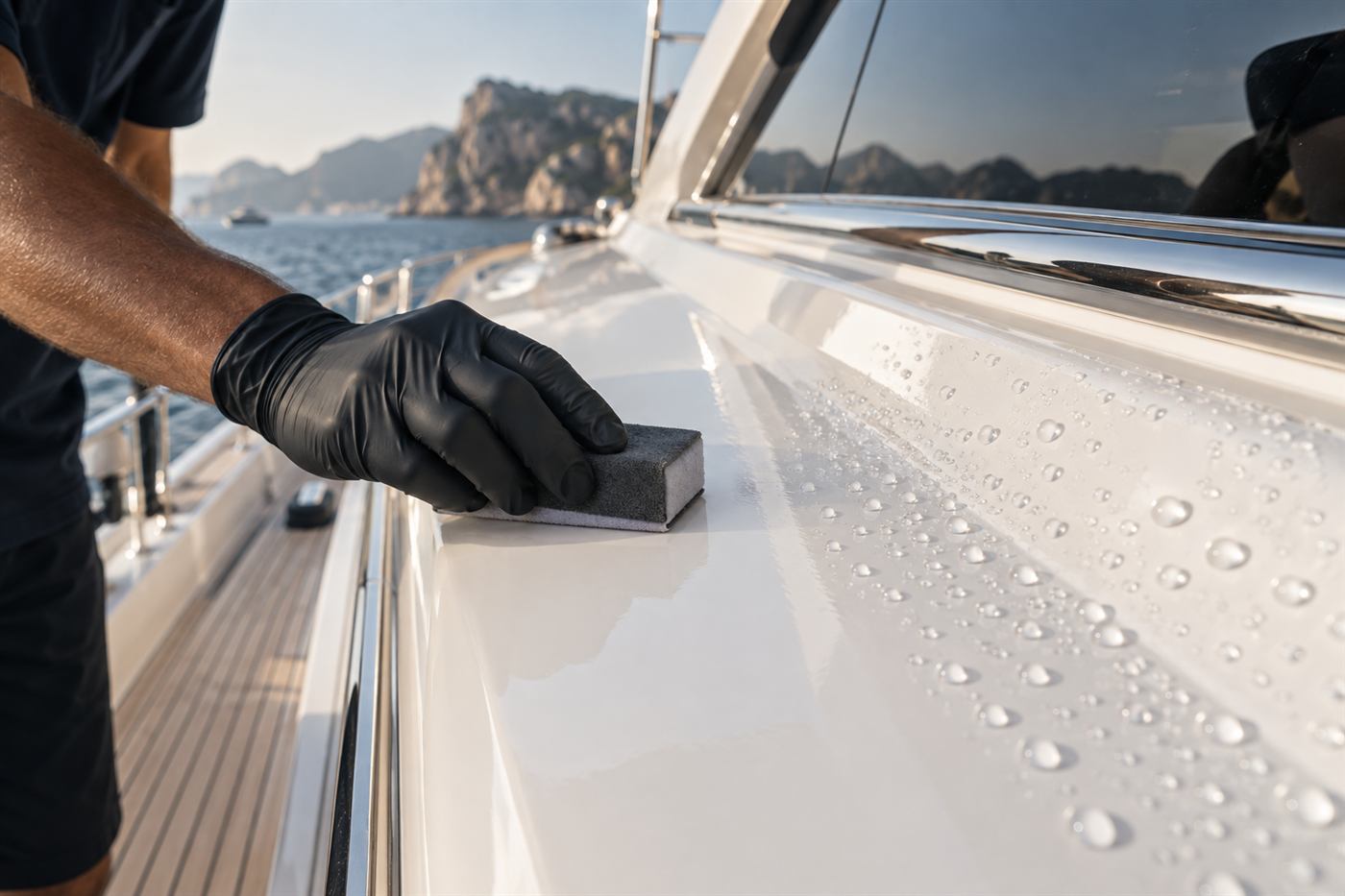
What each product actually is
Carnauba and similar waxes are natural or blended materials that sit on top of gelcoat or paint as a soft, glossy film. They fill microscopic pores, add depth to the shine and create a sacrificial layer. They are easy to apply, forgiving to work with and relatively quick to remove and redo. They also soften in heat and wear away relatively quickly under sun, washing and chemicals.
Synthetic sealants, sometimes called polymer sealants, are manufactured films that cross-link as they cure. They resist heat and detergents better than most waxes, give a sharp, glassy shine and typically last longer. They sit on the surface and are applied by hand or machine. The page on sealant application explains how they bond.
Ceramic coatings are liquid products, often based on silicon compounds, that cure into a hard, thin layer chemically bonded to the surface. They are harder than waxes and sealants, resist more chemicals, shed water and dirt, and can last considerably longer when applied and maintained properly. They are also less forgiving of poor preparation, harder to correct if applied badly and more demanding to install. The page on ceramic coating describes the process.
All three are protective layers over the finish, not the finish itself. None of them repairs oxidation, scratches or stains, which is why surface preparation matters more than the product name.
Side by side comparison
The table below sets out general differences. Real results vary with the product, the surface, the preparation, the climate and the care that follows, so the table describes tendencies and not promises.
- Wax is the most forgiving and the easiest to redo, but it lasts the least time in South Florida sun.
- Sealant is a practical middle option for many working boats.
- Ceramic coating gives the longest protection but demands the best preparation and the right maintenance.
| Quality | Carnauba wax | Synthetic sealant | Ceramic coating |
|---|---|---|---|
| Feel and look | Warm, deep gloss | Sharp, glassy gloss | Hard, slick, strong gloss |
| Durability | Shortest of the three | Moderate | Longest when maintained |
| Heat and detergent resistance | Low | Moderate to good | Good to very good |
| Preparation needed | Clean surface | Clean, decontaminated surface | Thorough cleaning and correction |
| Ease of application | Easy, forgiving | Moderate | Demanding, unforgiving |
| Ease of removal or correction | Easy | Moderate | Difficult, may need polishing |
| Reapplication interval | Frequent | Less frequent | Infrequent, with maintenance |
| Water and dirt shedding | Modest | Good | Very good |
| Upfront effort and cost | Lowest | Middle | Highest |
Preparation is where the difference really lies
Whatever protective layer is chosen, it bonds to what is under it. A wax over oxidized gelcoat looks shiny for a few weeks, then reveals a dull surface. A sealant over contamination fails to bond. A coating over uncorrected defects locks the defects in, since coatings are hard to remove and highlight imperfections underneath.
The usual sequence is a thorough wash, decontamination to remove embedded dirt and iron particles, and then correction by compounding and polishing where the finish needs it. Only then is protection applied. The more durable the layer, the more important the preparation. A wax can be applied over a lightly prepared surface with acceptable results. A coating applied the same way will look patchy and can fail early.
This is why the cost and time of a ceramic coating are mostly in the preparation. The page on compounding and polishing explains the correction step, and the guide on gelcoat compounding describes why it is not something to be rushed. An owner who is comparing quotes should ask what preparation is included, since two quotes for the same product can describe very different amounts of work.
How the boat is used changes the answer
A boat that lives on a lift or under cover, is used occasionally and washed carefully, puts little stress on its protective layer. A boat that sits in a slip in full sun, is used heavily, runs offshore, gets salt spray and is washed by many hands puts a lot of stress on it. The right product matches that stress.
For a boat in heavy use, or one that will be kept for many years, a coating can make sense, because its durability reduces how often the boat needs a full protective refresh. For a boat that will be sold soon, or one that the owner likes to wax by hand as a seasonal ritual, wax or sealant may be a better fit. For a charter boat that is turned around constantly and cleaned in a hurry by different crews, durability and tolerance of washing matter, but so does the risk of crews damaging a coating with the wrong products.
A fishing boat that takes fish blood, bait residue and hard scrubbing may suit a more durable layer, although chemical exposure can also damage coatings. A sailboat with a lot of non-skid and textured surfaces and relatively little glossy hull may benefit differently. The vessel-type pages, such as sportfish boat detailing, describe how use shapes care.
Appearance: gloss, depth and feel
Owners often care about how the finish looks, and the products differ. Carnauba wax is known for a warm, deep look, especially on darker colors, though its effect fades faster. Sealants give a crisp, mirror-like reflection that many people associate with a freshly polished hull. Ceramic coatings give a hard, glassy look with strong water beading, sometimes described as a candy shell.
Personal preference plays a part, and so does the color and condition of the finish. On white gelcoat, differences between products are subtle. On dark paint or Awlgrip-type finishes, they are more visible, and the care required is different, as the page on painted finish care explains. A matte or satin finish needs different products entirely, since waxes and many coatings are designed to add gloss.
It is also worth being realistic about the effect of protection on a worn finish. A coating over an oxidized hull makes it glossy but does not make it new. A fresh coat of wax cannot hide deep scratches. If the finish is tired, the right route is correction first, and then protection, and the protection should be chosen to suit the corrected surface.
Upkeep: what each choice asks of you
Every protective layer asks something of the owner. Wax asks for frequent reapplication, which suits an owner who enjoys the work or who has a detailer on a regular schedule. Sealant asks for less frequent reapplication and gentle washing. Ceramic coating asks for correct washing, appropriate products, regular inspection and occasional maintenance toppers, and asks that everyone who touches the boat follows the rules.
That last point is easy to overlook. A coating that is washed by a careful detailer but also by a dock hand with a stiff brush and household soap will wear faster than expected. If many different people will wash the boat, a coating's benefits depend on whether they follow the instructions. A simple, forgiving layer may be a better match for a boat that is handled by many hands.
The page on ceramic coating maintenance describes the care a coating needs, and the guide on how often to wash a yacht covers washing intervals in general.
Honest limits of every option
No protective layer is permanent. Wax wears off in weeks to months depending on conditions. Sealants wear off over months. Coatings wear off over a longer time, but they do wear, and no responsible detailer can name a precise lifespan. Marketing materials sometimes cite long lifetimes under ideal conditions, and boats in South Florida are rarely in ideal conditions.
No layer prevents damage from impact, abrasion, chemicals or neglect. Dock rash, fender scuffs, scratches from careless cleaning and etching from bird droppings can all happen to a protected surface. A coating may resist light marring better than wax, but it does not make gelcoat scratch-proof.
No layer fixes underlying problems. Chalky gelcoat, blistering, stained fiberglass and failing paint need to be addressed on their own terms. The page on gelcoat repair versus detailing explains where detailing ends and repair begins. Protection applied over damage that needs repair only hides it for a while.
Cost, effort and value over time
Quotes are given only by phone, so this page does not name figures. The pattern, however, is worth understanding. Wax costs the least to apply at any one time and the most over time, because it must be reapplied often. Coatings cost the most to apply, mainly because of preparation, and the least per season if they last as intended and are maintained. Sealants fall between.
Value depends on how long the owner expects to keep the boat, how much it is used, and how the finish looks today. A short-term owner may find wax or sealant makes more sense. A long-term owner of a heavily used boat may find a coating makes more sense. A boat for sale may benefit from correction and a clean, simple protective layer, and the guide on protecting yacht resale value explains how condition affects how buyers see a vessel.
Whichever way you lean, ask what is included, what is expected of you afterward and what the limits are. A detailer who can answer these plainly is more useful than one who simply recommends the most expensive option.
Three owner scenarios
Consider an owner of a center console who keeps the boat on a lift behind a canal home, runs it most weekends and rinses it with a hose after each trip. The hull is white gelcoat that was polished two seasons ago. For this owner, a sealant, refreshed once or twice a year, is a sensible fit. The lift keeps the hull out of the water, rinsing handles most salt, and the owner does not need the hardest layer available. A coating could work, but the extra preparation and strict washing rules may outweigh the benefit.
Now consider a motor yacht kept in a marina slip in full sun, used for long trips, with a professional crew washing it weekly. The topsides are a dark color, and every swirl and water spot shows. Here a coating has a clearer case. The crew will follow the maker's washing guidance, the surface is large and expensive to polish repeatedly, and the longer interval between protective applications saves effort over several seasons. The owner still needs to understand that the coating is a layer, not a shield.
Finally, consider a sailboat with a worn hull that the owner plans to sell within a year. The gelcoat is chalky, and the owner wants it to look right for showings. A careful polish followed by a sealant or wax gives a good appearance at a sensible effort. A coating would add effort for a benefit the owner will not be around to enjoy, though a buyer might appreciate it. The page on pre-sale detailing describes how preparation for a sale is usually approached.
None of these scenarios has a universal answer. They show how storage, washing habits, color, condition and plans for the boat push the decision one way or another. A good detailer asks about those things before recommending anything.
How to decide, and what to bring to the conversation
A short set of questions usually points to the right answer. How is the boat stored? How often is it used and washed, and by whom? What condition is the finish in now? How long do you expect to keep the boat? How much maintenance are you willing to do? Are there areas, such as graphics or non-skid, that complicate protection?
From those answers a detailer can recommend a protective layer and explain the trade-offs. Sometimes the right answer is a mix, with a coating on the topsides and a simple sealant on areas that are hard to coat or that get heavy wear. Sometimes the right answer is to correct the finish first and decide later.
To talk through your options, call. Describe the boat, how it is stored, what the finish looks like and what you want from it. Quotes are given by phone, and a more complicated job may need an on-site visit first, with a service call charge explained before dispatch.
Questions people ask
Is ceramic coating always better than wax?
Not always. A coating generally lasts longer and resists more, but it demands better preparation, correct upkeep and careful washing by everyone who touches the boat. Wax is easier and more forgiving, and suits some owners and boats better. The best choice depends on use, storage, finish condition and how long you will keep the boat.
Do I need to polish before applying a coating or sealant?
Usually yes if the finish is oxidized, scratched or stained. Protective layers bond to what is beneath them, and a coating can lock in defects. A thorough wash and decontamination are the minimum. Correction by polishing is the step that usually decides how good the final result looks.
Can I wax over a coating or coat over wax?
A coating needs a clean, prepared surface, so any wax must be removed first. Wax applied over a coating can mask its properties, though some makers sell compatible toppers. Check the maker's guidance, and ask the detailer which products suit your surface.
How long will each option last on my boat?
No honest detailer can give a fixed number. Wax is generally shortest, sealants longer and coatings longest, but sun, salt, storage, washing methods and chemicals all matter. Maintaining the layer correctly and inspecting it regularly gives the best chance of a long useful life.
Is a coating worth it on an older boat?
It can be, if the finish is first corrected and the boat will be kept and used for some time. On a badly worn hull, correction may take most of the effort, and the owner should weigh that against the benefit. A detailer can assess the surface and give a plain recommendation.
How are quotes handled for these options?
Quotes are given only by phone, because the price depends on the size of the vessel, the condition of the finish and the preparation needed. Larger or more complicated jobs may need an on-site visit first. There is a service call charge, and it is explained on the phone before anyone is dispatched.
Describe the situation by phone and we will tell you what the job involves. Quotes are given by phone. Jobs that cannot be quoted without seeing them need a technician on site, and the service call charge is explained on the phone before anyone is dispatched.
(954) 719-3572Related pages
Questions to ask before you decide
Choosing between a coating and a wax is easier when the decision starts with the boat instead of the product. Useful questions include how long you plan to keep the vessel, how much time you or your crew will spend on upkeep, and whether the boat is kept in the water or on a lift. Another question is how the finish looks today. A surface in good condition behaves differently from one that is faded or scratched, and the choice of protection should follow the condition, not the other way around. Writing the answers down makes the conversation with a detailer much more productive.
It also helps to ask the detailer what preparation each option requires on your particular hull. A coating asks for a very clean, corrected surface, and the work before it can be a meaningful part of the overall effort. A wax asks for less, but it also gives the surface less to hold on to. Ask what the upkeep schedule would look like and what happens if you miss a month. A frank answer to these questions tells you more than any product claim, and a good detailer will welcome them.
Finally, ask what the detailer will not promise. Any honest provider will tell you that no product makes a boat immune to scratches, staining or fading, and that results depend on conditions and care. Ask for the plan in plain terms, including what is being applied, how the surface will be prepared and what you should avoid afterward. The scope and any quote are explained before work begins, so you can compare options calmly instead of making the decision at the dock under time pressure.