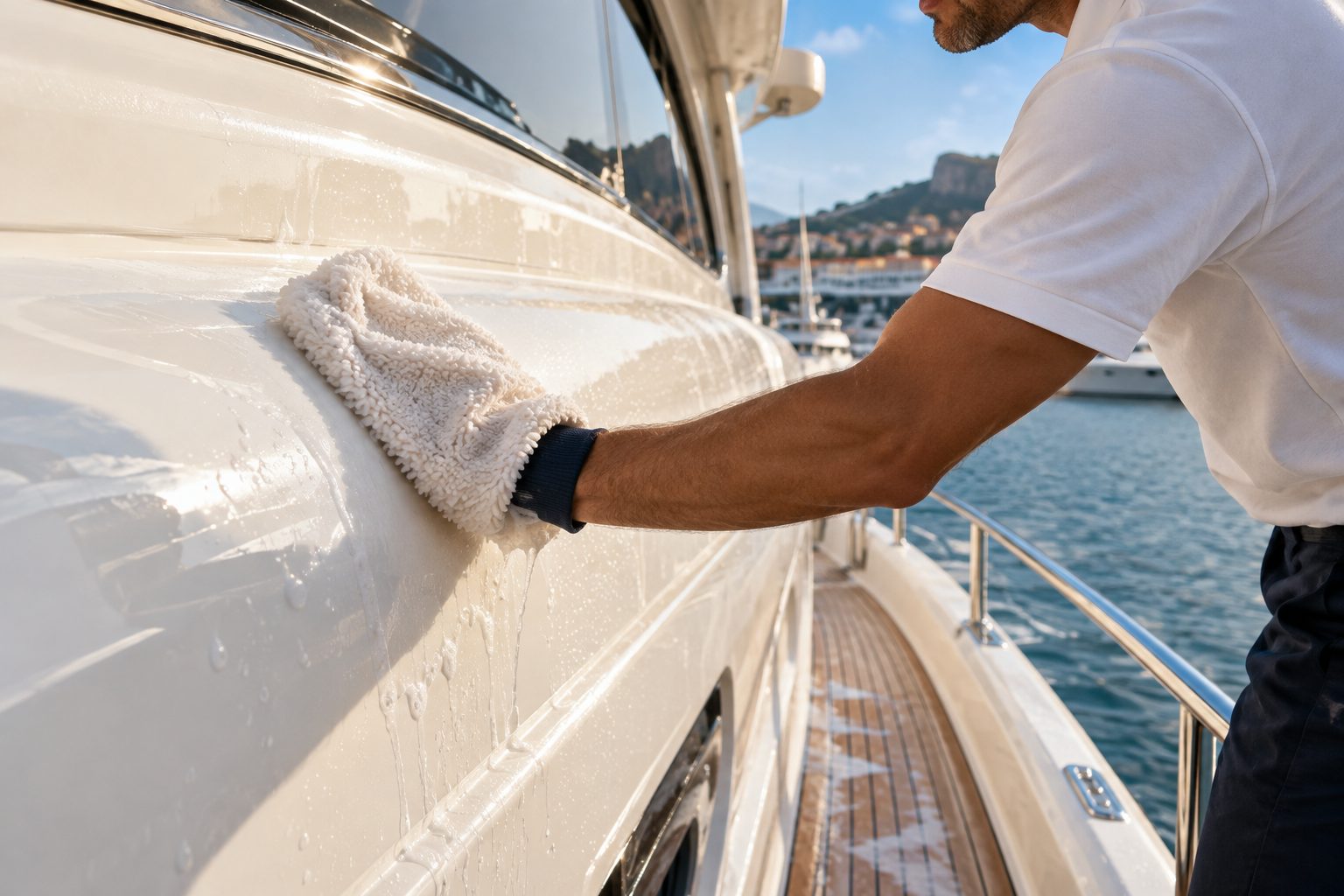
Searching for yacht detailing near me at Aventura? Best Yacht sends a real detailer dockside with before-and-after photos on every job. See our yacht detailing near me page for full marina coverage.
High-rise waterfront buildings with private docks, coordinating building access is usually step one.
Exterior wash-down, compound and polish, ceramic coating, bright work, interior detail, and teak and deck care, scheduled dockside. Call (954) 719-3572.
How a dockside job runs
Assess the vessel
Size, gelcoat condition and scope confirmed before a price is quoted.
Flat price agreed
Quoted before we schedule, not adjusted dockside.
Work the vessel dockside
At Aventura, coordinated around your schedule.
Walk-through and sign-off
Reviewed with you before we consider the job done.
Aventura ZIP codes we serve
Aventura is governed by the City of Aventura. For marina permits or dockage rules, that's the relevant authority, we handle the detailing, not the marina.
Docking behind a high-rise skyline.
The water itself, tucked behind the barrier island chain and sheltered from direct Atlantic swell, is calmer than the ocean-facing marinas further north in Fort Lauderdale or Palm Beach. That calm is a genuine advantage for scheduling exterior work, since chop and wake from passing vessels are less disruptive to a crew working from a dock or a small boat alongside the hull. It does not mean the water is gentle on a finish, though. This stretch of the Intracoastal carries steady boat traffic funneling toward Bakers Haulover Inlet a short distance south, and salt content in the water here is still fully marine, meaning standing water in a cockpit or on a swim platform behaves exactly like it would anywhere else on this coast.
What we typically see on Aventura docks.
The vessel mix here leans toward mid-size motor yachts and cruisers that fit comfortably behind a residential tower's private dock, along with a fair number of center consoles and smaller sport boats kept for quick runs out to the inlet. Because many of these boats sit in the shadow of a tall building for part of the day, sun exposure on a given hull can vary dramatically depending on which side of the building the dock sits on and what time of year it is, a west-facing dock gets brutal late afternoon sun in summer, while an east-facing one catches the harsher morning UV. That asymmetry means two boats at the same address can age at noticeably different rates, and it's one of the first things worth noting during an initial assessment.
Standing water and humidity below deck also behave differently here than at an open marina with more airflow across the fairway. Buildings that flank the water on both sides can reduce cross-breeze at the dock level, which means cabins and lazarettes hold humidity a little longer between uses. That's a small factor on its own, but combined with South Florida's baseline humidity, it's part of why interior detailing and below-deck attention matter as much as the exterior shine that's easier to notice from a balcony above.
Coordinating access is genuinely step one.
Noise and timing matter too, more so here than at a standalone commercial marina, because residential buildings often have quiet hours or restrictions on early morning and late evening dockside work out of consideration for residents in units facing the water. A generator-powered buffer or a pressure washer running at seven in the morning reads very differently next to a quiet residential tower than it does at a working marina full of live-aboard crews already up and moving. We plan around this as a matter of course rather than treating it as a special accommodation.
What people ask before booking here.
Do you coordinate with my building's management directly?
My dock faces west and gets hit hard by afternoon sun. Does that change anything?
It can mean a shorter interval between washes and closer attention to UV-driven oxidation on that side of the hull specifically, which we'll flag during the initial walk of the vessel.
Can you work around building quiet hours?
Yes, we schedule dockside work to fit whatever access and noise windows your building allows, tell us the restrictions and we'll plan the visit around them.
Is Bakers Haulover Inlet traffic a factor for boats docked here?
Wake from vessels running toward the inlet does add some chop along this stretch, which we account for when scheduling work that requires calm water alongside the hull.
Wash and correction on a sheltered Intracoastal dock.
Because Aventura's docks sit in relatively calm, sheltered water, exterior wash-down here tends to be a cleaner, more controlled job than at an open, wave-exposed marina, there's less concern about chop knocking a crew off balance or splashing wash water back onto a freshly rinsed panel before it's dried. That said, calm water brings its own quiet problem, algae and biofilm build a little faster at the waterline in slower-moving water than in a well-flushed channel, so the boot stripe and lower hull sections often need more attention here than an owner expects from looking at the topsides alone, which can look perfectly clean from the dock.
Gelcoat correction on boats we see in this area often shows an uneven oxidation pattern tied directly to which side of the building the slip faces, exactly the asymmetry mentioned above. A hull that catches hard afternoon sun on its port side for years develops a noticeably different oxidation depth than the shaded starboard side, which means a compounding job here is rarely a single uniform pass across the whole boat. We stage the cut by section, working harder where the sun has actually done more damage rather than treating the whole hull as if it aged evenly, which it usually hasn't.
The parts that show building shadow the most.
Stainless rails and hardware on a shaded dock face take longer to dry after a rinse than the same fittings in open sun, and slower drying means more time for water spots and the early stages of crevice corrosion to set in around fasteners and weld seams. Bright work on Aventura boats often needs a slightly more deliberate drying pass as part of the service, working a microfiber cloth into the fittings rather than letting the shade do a job the sun would otherwise help with elsewhere. Teak decking on the shaded side of a building-front dock tends to hold moisture longer too, which can mean a touch more attention to mildew prevention between scheduled cleanings compared with a fully sun-exposed dock further north.
Interior detailing matters as much here as anywhere on this coast, and arguably a bit more given the reduced cross-ventilation some of these residential docks see compared with an open marina fairway. Cabins that sit closed for stretches between weekend use build humidity that settles into headliners and upholstery, and a below-deck check during a scheduled visit catches early mildew signs before they become a bigger cleaning job. Galley and head areas, often the last thing an owner thinks about between uses, get the same attention as the visible salon and staterooms during a full interior pass.
What to expect booking dockside service in Aventura.
A first visit typically starts with a phone call to confirm the building, dock location and any access requirements the property has on file, followed by coordination with building management if that hasn't already happened on the owner's side. From there, scheduling a recurring wash-down program is usually the most efficient path for owners who keep a boat here full time, since it removes the need to re-coordinate building access every single visit once the arrangement is established. One-off jobs, a pre-sale detail, a post-charter clean, or a single compound-and-polish, are handled the same way, just without the recurring cadence.
Whether the work is a quick wash-down between uses or a full exterior correction and interior detail, the same underlying standard applies at every Aventura address we visit: an honest look at the vessel first, a scope that matches what the boat actually needs rather than a generic package, and work performed with the same care whether the dock sits in full sun or full shade behind the building above it. Call (954) 719-3572 to talk through your specific building and dock.
How the calendar changes work at this address.
Aventura's boating population shifts noticeably with the seasons, in step with the broader South Florida snowbird pattern. Winter months bring more owners back to their units and more regular boat use, which in turn means more requests for a quick wash before a weekend run or a detail ahead of guests visiting for the season. Summer sees quieter docks as some owners head north, but the boats left behind still need attention, arguably more of it, since a vessel that sits unused for stretches at a time in South Florida's summer heat and humidity accumulates mildew risk below deck and algae growth at the waterline just from sitting still, whether or not anyone's aboard to notice.
Hurricane season adds a practical wrinkle specific to a building-dock arrangement like this one. Some associations require boats to be removed from davits or hauled elsewhere ahead of a storm, and coordinating a pre-storm wash and post-storm cleanup around those building-specific timelines is something we plan for directly with owners who keep a boat here year-round. A boat that goes into that process already on a maintained schedule generally comes out the other side needing far less remedial work than one that was already overdue for attention before the weather even turned.
Matching the service to how the boat is actually used.
Not every boat behind an Aventura tower needs the same program. A center console used mostly for quick weekend runs to the inlet and back has different needs than a larger cruiser that mostly sits at the dock as a floating extension of the unit above it, used more for entertaining than for regular runs offshore. The first tends to accumulate salt spray and bottom growth faster relative to its size; the second tends to show more dust, pollen and standing-water spotting from simply sitting exposed to the elements without the self-cleaning effect that comes from regular use and rinsing underway. An honest walk of the vessel before quoting any work accounts for which pattern actually applies, rather than defaulting to a one-size-fits-all package regardless of how the boat spends its time.
This matters just as much for interior work. A boat used for regular entertaining needs more frequent attention to upholstery, galley surfaces and glass than one that mostly sits closed up between occasional weekend trips, even though the second boat might actually need more attention to humidity and mildew prevention precisely because it sits closed up so often. Getting this right means asking real questions about how the boat is used before recommending a schedule, not just quoting a generic maintenance package off a price sheet.
Do you handle boats that sit unused for long stretches during the off season?
Yes, and these often need more attention to below-deck humidity and waterline growth than a regularly used boat, even though the exterior may look fine from a distance.
Can you coordinate a pre-storm wash and post-storm cleanup around my building's hurricane plan?
Yes, tell us your building's timeline for haul-out or davit removal and we'll plan the visit around it rather than around a generic schedule.
Do you clean the dock area itself, not just the boat?
Our focus is the vessel, but we're careful to leave the dock and surrounding area as clean as we found it, mindful that it's shared building property, not a private commercial slip.
What if my unit doesn't have a private dock but the building has a shared marina?
Shared building marinas work the same way access-wise, we coordinate with whoever manages that facility, whether it's a dockmaster, a concierge desk or the association directly.
Working quietly at a residential address.
Detailing a boat behind a residential tower is a different kind of visit than working a commercial marina full of other crews and charter traffic. Neighbors are often close by, sometimes literally overhead on a balcony, and a crew working here treats that proximity with the same respect any contractor should bring to a residential job site, minimal noise outside agreed hours, gear kept tidy and out of walkways, and a clean handoff at the end of the visit that leaves no sign a crew was ever there beyond a freshly detailed boat. That standard doesn't change whether the vessel is a forty-foot cruiser or something considerably larger, and it's part of why buildings along this stretch of the Intracoastal continue to grant access to the same crews visit after visit.
For a vessel kept behind an Aventura tower, the most useful first step is simply a phone call describing the building, the dock orientation and how the boat gets used, so that a first visit can be scoped accurately rather than guessed at from a general description of the address alone. That single conversation, building name, dock facing, typical usage pattern, tends to answer most of the scheduling and access questions before the crew ever arrives, which keeps the first appointment efficient for everyone involved, the owner, the building and the crew doing the work. From there, whether the plan is a single visit or a standing schedule, the goal stays the same, a vessel that looks and holds up like it's genuinely cared for, not just wiped down the week before it's noticed. That's the standard we hold to at every address on this stretch of the Intracoastal, and it applies whether the boat is tied up for a single afternoon or docked at the same building for years.
Need detailing at Aventura?
Describe the situation by phone and we will tell you what the job involves. Quotes are given by phone. Jobs that cannot be quoted without seeing them need a technician on site, and the service call charge is explained on the phone before anyone is dispatched.
(954) 719-3572Related pages
Planning around balconies, elevators and gate staff
In Aventura, many boats sit behind buildings where the people who control access are not the boat owners. Property managers, security desks and gate staff often decide when a contractor may enter and which route to take. Before any visit, we ask the owner to confirm the process, since some buildings want advance names, vehicle details or a short window. It is easier to sort this out by phone a few days ahead than to be waiting at a gate while the morning slips away. Hurricane season and summer storms can change plans quickly, so a flexible attitude helps everyone involved and keeps people safe.
Loading is another practical piece. A crew carrying hoses, buckets, pads and ladders may need to cross lobbies, use service elevators or park in designated areas. Some buildings limit what may be rolled through common spaces. We plan equipment accordingly, using compact kits and protective mats, and we leave hallways clean. Respecting residents and staff keeps the arrangement welcome, and a smooth relationship with the building helps everyone who needs outside service. Call us if you are unsure, and describe what you see in plain words; you do not need to know the technical terms.
Once on the dock, the crew works with attention to neighbors above and beside. Water, soap and overspray should not drift onto adjacent vessels or onto the dock. Noise is kept moderate, and polishing machines are used with care for people nearby. If a resident asks us to pause, we pause and adjust. The goal is for the boat to look better by the end of the day without anyone in the building being bothered. In South Florida the heat, humidity and salt in the air make small problems grow faster than owners expect, so noticing them early is worth the effort.
Salt haze, sun angle and what shows on a sheltered dock
Boats in sheltered Intracoastal water avoid some of the pounding that open-ocean boats take, but they collect their own kind of buildup. Salt mist dries to a fine haze, humidity encourages mildew in shaded corners, and afternoon sun bakes everything into the finish. Windows and stainless often show the film first. A quick fresh-water rinse after use helps, though many owners find the film returns faster than expected, particularly in the warmer months. If anything here does not match what you see on your own boat, say so, because every vessel and every slip is a little different.
Sun angle plays a role in what you notice. A building can throw long shade across a slip in the morning, leaving one side of the boat cool and damp while the other bakes after lunch. That uneven exposure leads to uneven wear, with one side showing chalking or heat marks while the other stays greener or more stained. A technician looks at both sides and treats each according to what it actually shows, not as a single uniform surface. A short phone call before the visit usually clears up most questions and helps the crew bring the right tools the first time.
Hurricane season also deserves a place in the plan. Before a named storm, owners may be securing lines, removing canvas and arranging haul-out or other precautions. We do not schedule around hazards that put people at risk, and we do not make promises about weather. After a storm passes, a gentle wash and inspection can clear salt and debris, and help you notice anything that shifted. Talk with us beforehand so you know what is realistic for your boat. We would rather explain a limit honestly than promise something the surface or the weather cannot support.