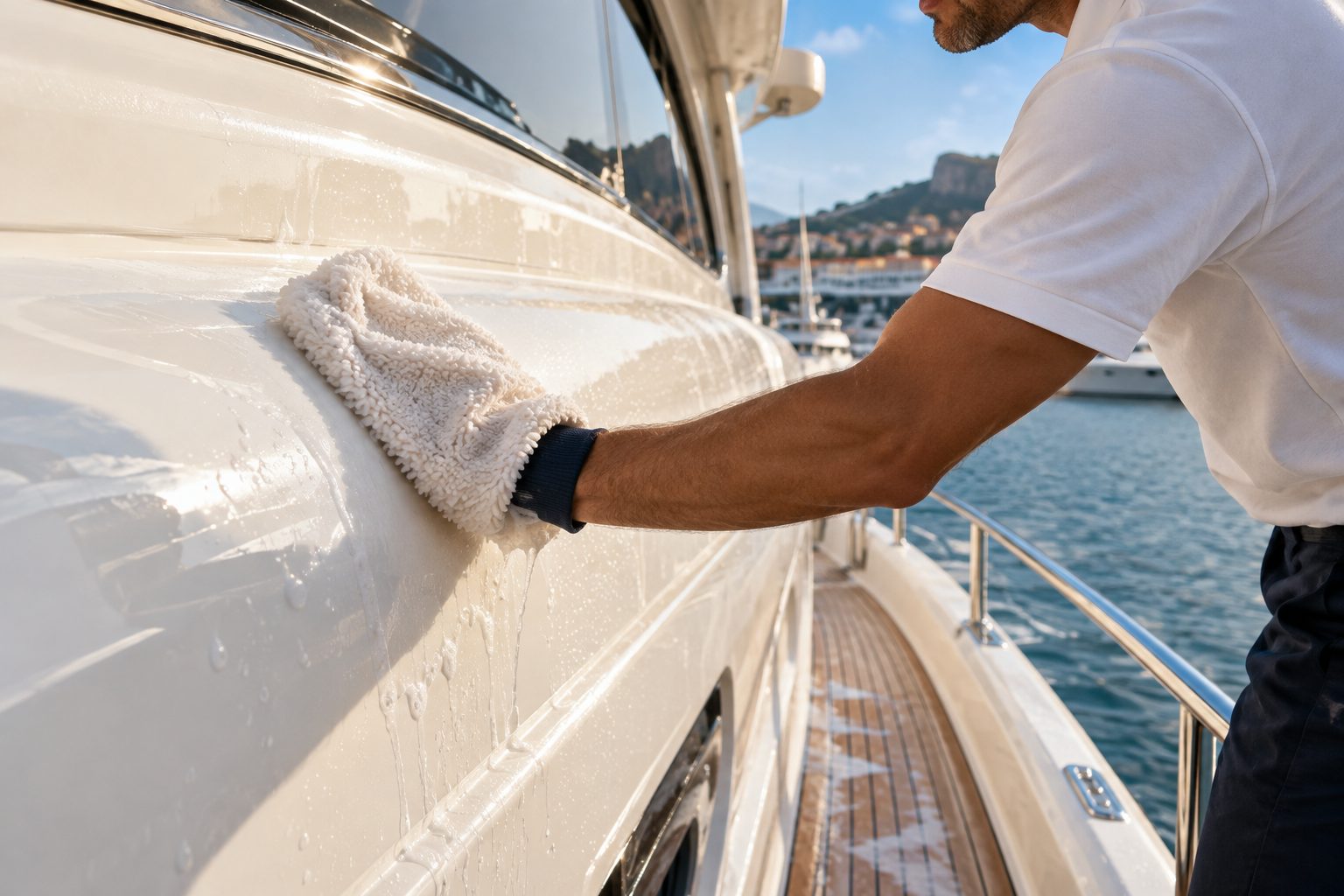
Why cleaning a boat is an environmental question
A car wash happens on pavement that drains to a treatment system or storm drain. A boat wash happens next to the water itself. Whatever runs off the deck, hull or dock can end up in the marina basin, canal or bay within seconds. South Florida marinas sit in sensitive places: tidal waterways, seagrass beds, mangrove shorelines, and canals that connect to larger bodies of water. These are also places where people swim, fish and boat.
Cleaning runoff carries a mix of things. Some are obvious: soap, dirt, algae, salt and oil. Some are less obvious: metals from bottom paint dust, residues from polishes and waxes, fuel traces, particles from sanding and compounds, and whatever cleaning chemistry was used. Each of these has a different effect on water, and the effect depends on the amount, the setting and how often it happens.
No one cleaning session is likely to be disastrous. The point is cumulative. Hundreds of boats washed regularly in the same basin add up, and small changes in habits by many owners and professionals make a real difference. Responsible practice is about reducing avoidable impact while still keeping a boat clean and protected.
There is a practical side as well. Marinas have rules about washing, and some enforce them closely. Local governments regulate discharges to water. A boat owner or a detailer who ignores those rules risks trouble with the marina and with regulators. Following the rules protects both the water and the people who work on it. Our guide on dockside detailing and marina rules describes what marinas typically ask of vendors.
Start with the mildest effective method
The best environmental practice is also the simplest: use the gentlest method that gets the job done. Many jobs need only fresh water, a soft mitt and a small amount of marine soap. Using stronger chemistry when it is not needed adds to the load on the water and often damages the boat, which then needs more intervention.
That principle works at several levels. Rinse regularly, so that dirt and salt do not build up and need stronger cleaners. Wash before stains set. Protect surfaces with wax, sealant or coating, so that dirt releases easily. Treat problems early, when a light treatment will do, rather than waiting until a heavy one is needed.
Matching the product to the problem reduces waste. An oxidation problem needs polishing, not repeated washing with strong detergents. A rust stain needs a targeted rust treatment, not a general degreaser. A technician who diagnoses first and chooses accordingly usually uses less product overall. Our guide on yacht detailing products explained describes how products are chosen.
Dilution is part of this. Many people add extra soap on the theory that more is better. It is not. Excess soap does not clean more, it makes rinsing harder, increases the volume going into the water and can leave residue that attracts dirt. Follow the dilution on the label and measure rather than pouring by eye.
Finally, avoid unnecessary tasks. Washing a boat that is already clean, or using heavy products as a routine, is a waste. Wash when it is needed, and use the lightest option.
Reading biodegradable and eco-friendly claims
Cleaning products are often marketed with terms such as biodegradable, eco-friendly, green, non-toxic and low in phosphates. These can be useful or they can be vague, and they deserve a careful reading.
Biodegradable means that a substance can be broken down by microorganisms. It does not say how quickly, under what conditions, or what it breaks down into. Something that degrades in a warm, oxygen-rich wastewater plant may not degrade in cold, still marina water. Some products labeled biodegradable are still harmful to aquatic life in the short term, before they break down. Others are mild and break down quickly. The label alone does not tell you which.
Non-toxic is similarly loose. A product can be non-toxic to people and still be harmful to fish or plants at a certain concentration. A phosphate claim addresses one specific problem, nutrient pollution, but says nothing about other ingredients. Green and eco-friendly have no fixed meaning.
More helpful are specifics: a full ingredient list, a safety data sheet, a stated pH, and independent certifications where they exist. Look for products that list what is in them and give clear use directions. Be cautious about products whose claims rest on a single attractive word.
It also helps to remember that even a gentle product can cause problems if used in large amounts or in the wrong place. Biodegradable soap in large volumes still adds nutrients and surfactants to the water. A mild product does not excuse careless use. The safest approach is a good product used sparingly and with attention to where it goes.
- Look for a full ingredient list and a safety data sheet
- Treat broad words such as green and eco-friendly as marketing until proven otherwise
- Remember that biodegradable does not mean harmless in the water
- Use less product, measured to the label, even when it is gentle
Managing runoff in general terms
Runoff is the water that leaves the boat carrying whatever it picked up. How much you can control it depends on the setting, but several general principles apply.
First, reduce the volume. Using a trigger nozzle or a controlled flow instead of a constant stream cuts the water used and the amount carried away. Work in sections, so that soap does not sit and have to be flushed with large volumes.
Second, direct and capture where practical. Some marinas and yards use wash pads, drains to treatment systems or containment methods for hull work, especially for jobs involving paint dust or bottom work. Some detailers use vacuum collection, absorbent mats or collection systems at the dock. Not all methods are suitable for all situations, and what is appropriate depends on the marina's rules and the task. Ask what the marina expects.
Third, keep solids out of the water. Sanding dust, paint chips, polish residue and large debris should be collected, not rinsed into the basin. Use drop cloths, vacuum equipment and wipes to collect solids from the dock and deck before washing down.
Fourth, avoid spills and manage them quickly. Fuel, oil, hydraulic fluid and chemicals should never be washed overboard. If a spill reaches the water, notify the marina and follow the reporting rules that apply. Small leaks are usually best handled with absorbent pads and proper disposal.
Finally, think about timing and weather. Washing just before heavy rain can send extra runoff into the water. Wind carries spray farther than expected, so protect neighbors and nearby water when it is breezy.
Working with marina rules and local requirements
Rules vary from marina to marina and from city to city. Some marinas prohibit any washing with soap at the slip and direct owners to a wash station. Some allow only certain products. Some require vendors to carry insurance or register in advance, or to follow best practices for runoff. Others restrict work to certain hours.
Local and state regulations also apply. Discharges of pollutants into waterways are regulated, and enforcement is real. Hull cleaning below the waterline, anything involving anti-fouling paint, sanding, and large amounts of detergent are areas that attract particular attention. This guide cannot list every requirement and does not replace the rules that apply to your marina and municipality. The dockmaster or marina office is the right source for what is allowed where you keep your boat.
Ask early. Before scheduling a detail, check what the marina expects from vendors and what it expects from owners. Share the answers with your detailer. A responsible detailer wants to know the rules and will adjust methods to fit. If a marina's policy seems unclear, ask for it in writing, or ask the dockmaster to point you to the section.
Pay attention to what your neighbors are doing as well. If you see a spill, a washdown that sends soapy water across the dock, or sanding dust drifting over the water, it is reasonable to mention it to the dockmaster. Marinas rely on everyone to keep the water clean.
Hull work, bottom paint and above-the-waterline limits
Most detailing is done above the waterline, where the surface is gelcoat, paint, metal, teak, glass and fabric. Work below the waterline, especially involving bottom paint, is a different matter. Anti-fouling paints are designed to release materials that discourage growth, and scrubbing, sanding or cleaning them can release those materials into the water.
Rules around in-water hull cleaning and bottom work vary and can be strict. Some marinas forbid in-water bottom cleaning entirely, and some limit it to specific methods or contractors. Where boats are hauled, work is done on a pad with containment. A detailer who works dockside should not scrub or sand bottom paint without confirming what is allowed.
This is one reason that our work focuses on the surfaces above the waterline. Our page on hull cleaning above the waterline explains where that boundary sits. If you need bottom work, ask the marina about approved providers and methods, or arrange a haul-out.
Waterline stains are a gray area. They sit at the boundary and are often cleaned from above using gentle methods and care. Our page on waterline stain removal describes the approach. If a method would put material in the water, it is not appropriate, and a good technician will say so.
Water, energy and waste in everyday detailing
Beyond what goes into the marina, there is the water and material a cleaning job consumes. Washing a large yacht can use a lot of fresh water, and in a region that cares about water supply, that is worth thinking about. Trigger nozzles, controlled flow and working in sections cut use considerably, and so does fixing leaky hose fittings before the day starts.
Equipment choices play a role. Efficient vacuums and extractors that remove moisture reduce drying time and the need for repeat visits. Rechargeable tools reduce the use of fuel-powered equipment and exhaust fumes at the dock. Fuel-powered equipment should never be used in enclosed spaces, for safety as well as air quality.
Waste is the third piece. Used microfiber towels, pads, empty product containers, absorbent mats and disposable wipes accumulate. Washable towels and pads reduce waste. Chemical waste and rags that have touched solvents, fuel or oil need proper disposal, not the dock trash can. Local waste facilities can advise on how to handle them.
Transport and scheduling count as well. Grouping work at a marina into a single visit, rather than several short trips, reduces travel. A boat kept on a regular schedule needs fewer emergency visits, and each visit is lighter. These are modest effects, but they add up across a season.
None of this needs to be dramatic. Responsible practice is made of many small, sensible decisions, repeated consistently by owners and professionals who care about the water they work beside.
Choosing methods that last and reduce repeat cleaning
Durable protection is an environmental choice as well as a practical one. A surface that is protected with wax, sealant or a coating sheds dirt and salt more easily, so it can be cleaned with less product and less effort. A neglected surface needs stronger chemicals and more frequent heavy work.
The same logic applies to correction. A careful, minimal polish that restores a surface and is followed by protection will last longer than repeated aggressive restoration. Our guide on wax, sealant and ceramic compared explains how each option behaves, without exaggerating any of them.
Think too about materials that are replaced because they were damaged by poor cleaning. A teak deck thinned by pressure washing, canvas shredded by harsh chemicals or clear vinyl clouded by solvents all end up as waste and need replacing. Gentle care keeps materials in service longer.
Equipment matters. Reusable microfiber towels, washable pads and refillable containers reduce single-use waste. Properly cleaned and stored tools last longer. Dispose of used towels, empty containers and chemical waste in line with the rules where you live, and never pour chemicals into storm drains or the water.
None of this requires perfection. It requires attention, and a willingness to use less, ask questions and plan.
What owners can do, and what to ask a detailer
Owners can set the tone. Choose a detailer who is willing to talk about methods and rules. Ask what products they use and why, how they handle runoff, what they do with waste, and how they adapt to your marina's policies. A professional who has thought about these questions will have clear answers. One who has never considered them may need a conversation.
Ask about alternatives. If a task can be done with less chemistry, a different tool or a different method, say so. Many owners are surprised that a lighter approach works. If a stronger product is needed, ask why, and how it will be contained and removed.
Do your part between visits. Rinse and wash gently, use marine products in the right amounts, keep fuel and oil out of the water, and report problems. Our guide on how to wash your own boat describes a low-impact routine.
Be realistic as well. Some tasks require chemicals, and some require compromise between effect and impact. The goal is not to avoid all cleaning products, which would leave boats damaged and dirty. It is to use what is needed, carefully, and to avoid what is not.
If you want to talk through how a visit would work at your marina, call. Describe the boat, the marina and any concerns about runoff or rules. Quotes are given only by phone, and complicated jobs need an on-site visit, with a service call charge explained before dispatch.
Questions people ask
Does biodegradable soap mean I can wash the boat anywhere?
No. Biodegradable describes how a product breaks down over time, not whether it is harmless when it enters the water. Large amounts of even mild soap add nutrients and surfactants to a marina basin. Use the minimum amount, follow the label, and follow marina rules about where washing is allowed.
What is the most environmentally sound way to clean a boat?
Use the mildest method that works, rinse regularly so heavy cleaning is rarely needed, measure soap to the label, collect solids and spills rather than washing them overboard, and follow marina and local rules. Protecting surfaces with wax or coating also reduces how much cleaning they need.
Can I clean the bottom of my boat at the dock?
Many marinas restrict or forbid in-water bottom cleaning, especially on boats with anti-fouling paint, because scrubbing can release material into the water. Ask the marina what is allowed and which providers are approved. Detailing work usually concerns surfaces above the waterline.
How do I know a product is safe for the water?
Look beyond labels such as green or eco-friendly. Check for a full ingredient list and safety data sheet, read the directions, and ask the manufacturer or a professional if you are unsure. No product is harmless in unlimited amounts, so use sparingly and keep runoff under control.
What should I do if fuel or oil gets in the water?
Stop the source if it is safe to do so, use absorbent pads to contain what you can, and notify the marina right away. Follow the reporting rules that apply to your location. Never wash fuel or oil overboard, and do not use soap or dispersants unless authorities tell you to.
Will a detailer follow my marina's rules?
A responsible one will, if told what they are. Ask the dockmaster what vendors must do, then share it before the visit. If a rule affects the method, such as washing restrictions or product limits, discuss how the work will be adjusted. When in doubt, ask for the policy in writing.
Describe the situation by phone and we will tell you what the job involves. Quotes are given by phone. Jobs that cannot be quoted without seeing them need a technician on site, and the service call charge is explained on the phone before anyone is dispatched.
(954) 719-3572