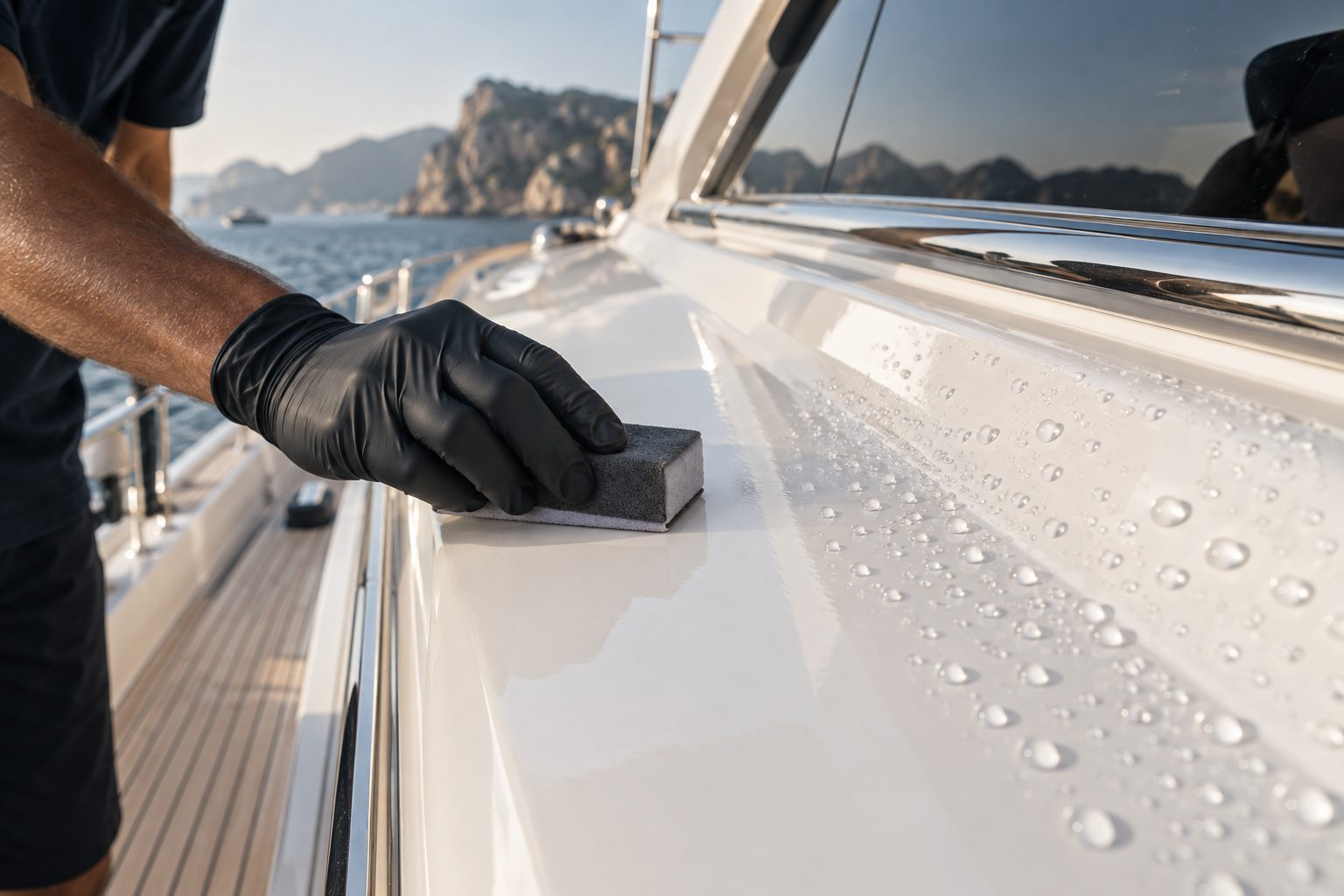
Oxidised gelcoat cut back and refinished in stages, compound to remove the damaged surface layer, then polish to restore genuine depth and shine. Filler wax hides oxidation for a few weeks; this actually removes it.
Serving marinas and private docks across Fort Lauderdale, Miami-Dade and Palm Beach County. Call (954) 719-3572.
What the job actually involves
Assess the gelcoat
Oxidation level checked before deciding how aggressive to go.
Compound in stages
Cut back gradually rather than one aggressive pass that risks the gelcoat.
Polish to finish
Restores depth and gloss once the damaged layer is gone.
Protect the result
Sealed or coated so the correction actually lasts.
Understanding the enemy before fighting it.
Gelcoat is a pigmented resin layer, not paint, and it doesn't fail the way automotive clear coat fails. Oxidation is the slow breakdown of the resin's outer molecular structure under sustained UV exposure, which is why a chalky, dull hull rubs a white residue onto a cloth, that residue is degraded resin itself, not just surface dirt sitting on top. Left alone, this degraded layer keeps growing deeper as UV continues to break down fresh material underneath, which is why a hull that goes years without attention eventually reaches a point where correction removes so much material that the pigment layer becomes visible, and no amount of further polishing brings genuine color back at that point.
Understanding this distinction, degraded resin versus surface dirt, is exactly why we assess gelcoat condition honestly before recommending a scope. Light oxidation genuinely responds to a single compounding pass and a finishing polish. Moderate oxidation needs staged cutting, working from a more aggressive compound down to a finer finishing polish. Heavy oxidation may need wet-sanding before compounding is even useful. And beyond a certain point, correction becomes cosmetic improvement rather than genuine restoration, and we tell owners directly when a hull has reached that stage.
The difference between correction and damage.
A single aggressive compounding pass across an entire hull, regardless of how each section has actually aged, is the fastest way to turn a correction job into a thickness problem. Gelcoat has a finite depth, and every pass of compound removes a small, permanent amount of material. Staging the work, starting conservative and escalating only where genuinely needed, means a section that's only lightly oxidized gets a gentler treatment than a section that's badly degraded, preserving gelcoat thickness where the hull doesn't actually need aggressive intervention.
This staged approach takes considerably more time and judgment than a single blanket pass, but it's the difference between a correction that genuinely restores the surface and one that simply thins the gelcoat evenly without actually fixing anything, since an aggressive compound applied to lightly oxidized gelcoat removes healthy material unnecessarily while barely addressing the areas that actually needed the work.
How do you decide how aggressive to be on a specific section of hull?
We assess oxidation depth section by section rather than assuming uniform aging, and match the compound aggressiveness to what each specific area actually needs.
Is there a point where a hull is too far gone to correct?
Yes, and we're honest about it. Beyond a certain oxidation depth, further compounding risks removing too much gelcoat, and we'll tell you directly when a hull has reached that point rather than recommending an aggressive correction that compromises the surface.
Restoring genuine depth after the cut.
Compounding alone leaves a hazy, dull finish even after successfully removing oxidized material, since the abrasive cutting process itself leaves fine marks in the surface that need refinement. Polishing follows to remove these fine marks and bring out the genuine depth and gloss the fresh gelcoat is actually capable of, using progressively finer abrasives until the surface reaches true clarity rather than the flat, hazy look a compound-only pass leaves behind.
This two-step sequence, compound then polish, is why we never describe this service as just one or the other. Skipping the polish step after compounding leaves a corrected but visually unfinished surface, while polishing without first compounding away genuine oxidation just moves already-degraded material around without addressing the underlying problem.
Why correction without protection doesn't last.
A freshly compounded and polished surface is, ironically, more vulnerable to salt and UV in the short term than it was before correction, since the protective oxidized layer, degraded as it was, is now gone, exposing genuinely fresh gelcoat that hasn't yet built up any resistance. Sealing or coating this surface immediately after correction protects the investment in the work just performed, rather than leaving fresh gelcoat exposed to South Florida's demanding environment with no protection at all.
Wax provides a sacrificial, shorter-lived protective layer, while ceramic coating, described in detail on its own page, provides a considerably longer-lasting protective bond. We discuss both options honestly with every owner after a correction, since the right choice depends on the vessel's long-term plans and how it's actually used.
Do I need to protect the surface immediately after correction?
Yes, freshly corrected gelcoat is more vulnerable to salt and UV until it's sealed or coated, and we build protection into every correction job as a standard final step.
Early signs an owner can check for themselves.
Oxidation doesn't announce itself suddenly, it progresses gradually, and catching it early means a much less aggressive correction than waiting until the problem is unmistakable. The earliest sign is usually a subtle loss of reflection sharpness, a hull that used to show a crisp reflection of the dock or nearby boats starts showing a softer, hazier image even though the color still looks fine from a distance. Running a hand across the surface and checking for a fine white residue transferring to skin or a cloth is a simple, reliable test, that residue is degraded gelcoat resin, the clearest early indicator available without professional equipment.
Owners who catch oxidation at this early stage often need only a light compound and polish pass rather than the more aggressive, multi-stage correction required once chalkiness becomes visible from normal viewing distance. We're glad to walk any owner through this simple self-check during a routine wash-down visit, since catching the problem early genuinely saves money and gelcoat thickness down the line.
How can I tell if my gelcoat needs correction before it looks obviously bad?
Check for a subtle loss of reflection sharpness and run a hand across the surface checking for white residue transfer, both early indicators before chalkiness becomes visible from a distance.
Why dark hulls and white hulls correct differently.
Dark-colored gelcoat, navy, black, deep red, shows both oxidation and correction swirl marks far more visibly than white or light-colored gelcoat, since imperfections that would be nearly invisible against a white background stand out starkly against a dark, glossy surface. This means dark hulls demand a more careful, more finely finished polish stage, often requiring an additional finishing pass with an ultra-fine polish specifically to eliminate the swirl marks a standard compound and polish sequence would leave visible.
White and light-colored gelcoat is more forgiving of minor technique imperfections but shows oxidation-related yellowing more readily over time, a distinct aging pattern from dark hull chalkiness that calls for its own specific assessment. We adjust our approach based on the vessel's actual color, recognizing that a one-size-fits-all technique genuinely underserves either extreme of the color spectrum.
Does hull color affect how compounding and polishing gets done?
Yes, dark hulls need a more careful finishing approach to eliminate visible swirl marks, while white hulls show a different aging pattern, yellowing rather than chalkiness, that we account for separately.
Setting realistic expectations.
A proper compound and polish, followed by appropriate protection, genuinely restores a hull's appearance, but it doesn't stop the underlying oxidation process from beginning again, it resets the clock rather than pausing it permanently. How long the result actually lasts depends heavily on the vessel's specific exposure, described in detail across our marina coverage pages, and on the maintenance schedule that follows, regular washing genuinely slows the return of oxidation, while a hull left unwashed after correction returns to needing attention faster than one maintained properly afterward.
We're upfront about this reality with every owner, a correction is an investment that pays off considerably better when followed by consistent maintenance rather than treated as a one-time fix that permanently solves the problem. Ceramic coating, applied after correction, extends this window meaningfully compared with wax alone, though even a coated hull benefits from regular washing to get the most out of that protection.
How long will a compound and polish job actually last?
It depends heavily on your vessel's exposure and the maintenance schedule that follows, we'll give you a realistic estimate specific to your boat and dock rather than a generic promise.
Why bigger boats need multiple visits, not longer days.
A full compound and polish on a substantial motor yacht represents genuinely significant surface area, often thousands of square feet across hull, superstructure and hardtop, and compressing this into a single marathon session risks rushing the staged, careful approach described throughout this page. For vessels at this scale, we recommend sequencing the work across multiple visits, one section at a time, rather than sacrificing quality for a faster overall timeline. This staged approach also lets an owner or captain plan around the vessel's continued use between sessions, rather than losing the boat entirely for one extended stretch.
Coordinating this kind of multi-visit correction means real project management, tracking which sections have been completed, matching technique consistently across sessions so the finished hull looks uniform rather than showing where one visit's work ended and the next began, and sequencing sections sensibly based on the vessel's actual use schedule.
Will a large vessel be out of commission for an extended period during correction?
Not necessarily, we stage the work across multiple visits so the vessel remains usable between sessions rather than requiring one extended, disruptive block of time.
An assessment that goes beyond just looking at the surface.
Before any compound touches a hull, we check for more than just oxidation depth. Stress cracks, often called spider cracking, indicate a structural or impact issue beneath the gelcoat that compounding won't fix and could actually worsen if aggressive cutting is applied over a compromised area. Blisters, small raised bumps that can indicate moisture intrusion into the laminate below the gelcoat, need their own specific diagnosis rather than being treated as simple surface oxidation. We flag anything beyond standard oxidation honestly, recommending a marine surveyor or fiberglass repair specialist when a problem falls outside what compounding and polishing can appropriately address.
This honest pre-assessment protects an owner from paying for a cosmetic service that won't actually solve an underlying structural issue, and it protects the vessel from having correction work applied over a problem that needed different attention entirely.
Do you check for anything beyond simple oxidation before starting?
Yes, we look for stress cracks, blisters and other signs of a deeper issue, and flag these honestly rather than compounding over a problem that needs different specialist attention.
Why humidity and direct sun affect this specific service.
Compounding and polishing perform best within a moderate temperature and humidity range, extreme heat causes compound to dry and cake too quickly on the surface before it's had time to work properly, while high humidity can affect how polish cures and how consistently a finish comes out across a large surface. We plan the timing of correction work around South Florida's actual daily conditions, often starting earlier in the day during summer months to avoid working through the most intense midday heat, and monitoring weather closely for any correction job that's genuinely weather-sensitive.
Direct, intense midday sun on a hull being actively compounded can also cause compound to flash-dry unevenly across a section before the polishing step catches up, leading to an inconsistent finish. We work with shade, timing and technique together to avoid this, rather than pushing through regardless of conditions and accepting an uneven result.
Compound and polish remains one of the more technically demanding services on our list, part science, part genuine craft, and getting it right means honest assessment, patient staging, and real attention to conditions rather than rushing a process that rewards careful, deliberate work. Reach out and describe your vessel's current condition, and we'll put together an honest scope.
Matching product aggressiveness to the actual problem.
We work with a range of compound grades, from mild cutting compounds suited to light oxidation through more aggressive formulations reserved for genuinely heavy correction, along with finishing polishes graded specifically for restoring clarity after cutting. Rotary and dual-action polishers each have their place, a dual-action tool is generally more forgiving and better suited to a wide range of conditions, while a rotary tool, in experienced hands, can address more severe correction faster, though it carries more risk of burning through gelcoat if used carelessly.
Choosing the right combination of pad, compound and tool for a specific section of hull is exactly the judgment that separates a properly executed correction from one that either fails to remove genuine oxidation or removes too much material unnecessarily. This is technique developed through real hands-on experience with gelcoat specifically, not simply generic buffing knowledge borrowed from automotive paint correction, which behaves differently under a buffer than marine gelcoat does.
Do you use rotary or dual-action polishers?
Both, depending on the specific correction needed, a dual-action tool for more forgiving, general work and a rotary tool for more severe correction where experienced technique matters most.
Whatever the specific condition of your vessel's gelcoat, light chalkiness just starting to show or years of accumulated oxidation, the same honest, staged approach applies, an assessment that tells you the truth about what the hull actually needs, and work executed with the patience and technique that genuine gelcoat correction demands.
Why we never quote correction over the phone.
Compound and polish is the service on this list where an accurate scope matters most, since the difference between light oxidation and years of neglect changes both the time required and the technique appropriate for the job dramatically. Quoting a fixed price without seeing the actual gelcoat condition risks either underquoting a job that turns out to need considerably more staged work than expected, or overquoting a hull that's in better shape than a phone description suggested. We assess in person every time, agree a flat price before scheduling, and don't adjust that price mid-job once the crew is already dockside and working.
This assessment step also gives an owner the chance to ask questions directly, about timeline, about technique, about whether coating makes sense as a follow-up, before committing to anything. We'd rather spend the extra time getting this conversation right than rush into a job with an inaccurate scope on either side. That upfront honesty, more than anything else, is what makes a correction job go smoothly from the first assessment through to the final protective coat applied at the end, without any surprise conversation about scope or price once the crew is already on the water and the hull is already partway through a stage of correction that can't easily be undone once it's begun, gelcoat that's been removed simply cannot be put back, which is exactly why getting the scope right the first time matters as much as it does, on every hull we're trusted to correct, large or small, dark or white, new to us or long familiar, at whatever stage of oxidation it happens to be in right now, and whatever it genuinely takes to bring it back honestly, one careful stage at a time, exactly the way genuine gelcoat correction is supposed to work, done right the first time.
Ready for compound & polish?
See all services, See marinas & areas
Describe the situation by phone and we will tell you what the job involves. Quotes are given by phone. Jobs that cannot be quoted without seeing them need a technician on site, and the service call charge is explained on the phone before anyone is dispatched.
(954) 719-3572