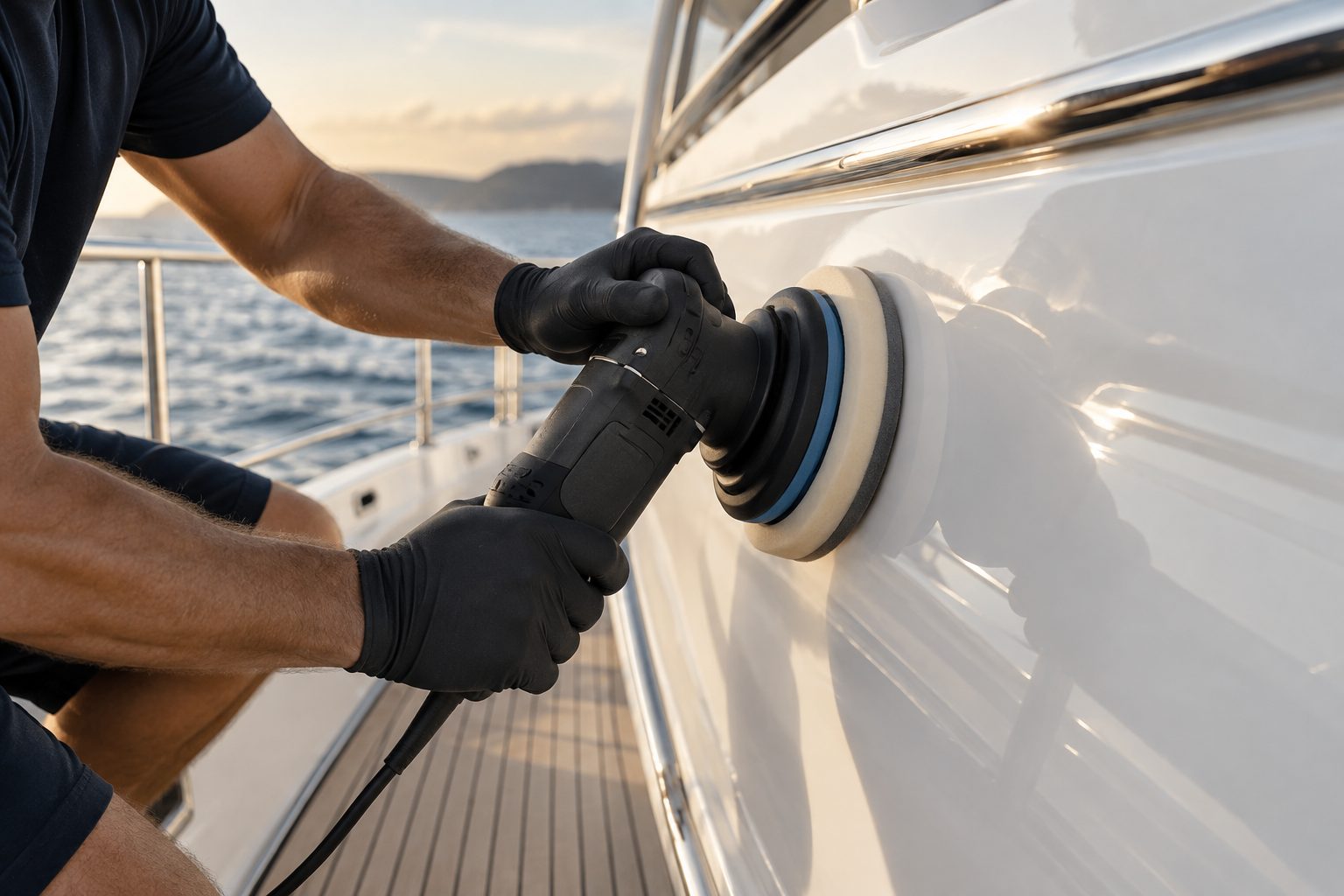
What a painted hull is and why it needs different care
Many larger yachts, and a growing number of smaller ones, have topsides finished with a two-part polyurethane paint, applied over a prepared and faired surface. Brand names such as Awlgrip and Alexseal are commonly used by owners as shorthand for this type of finish. The result is a deep, uniform gloss and a very smooth, flat surface, which is why painted hulls are admired on a calm morning at the dock.
The coating is thin. A gelcoat layer is measured in a fraction of a millimeter at the thin end and can be cut back repeatedly over its life. A polyurethane topside coating is considerably thinner than that in terms of material that can be safely removed. Once it is cut through, the underlying primer or fairing shows, and the only fix is repainting, which is a large job on a yacht.
That difference changes everything about the way the surface is handled. Where gelcoat can be compounded to remove oxidation, a painted hull is usually cleaned, polished gently and protected. The aim is to maintain what is there and to remove as little as possible. Many painted hulls never need cutting at all if they are washed and protected properly from the start.
We treat painted surfaces as a separate category from gelcoat. The difference between them is explained in our guide on gelcoat versus paint care, and you should tell us on the first call which finish your vessel has, because the approach, products and pads all change.
Why aggressive compounds are risky on paint
A cutting compound works by abrasion. It contains tiny particles that scour a thin layer from the surface, removing oxidation, scratches and dullness along with some of the original material. On gelcoat, this is an accepted tool. On polyurethane paint, the same action can burn through the clear film, leave hazing, or create a patchy, uneven sheen that is very hard to reverse.
Heat is part of the danger. A rotary machine with a wool pad generates heat quickly, and paint softens as it warms. A pass that lingers too long in one spot, or an edge pushed with too much pressure, can cut through at a ridge, a body line or a rail. These are the places where paint is thinnest and where a mistake shows immediately.
There is also the problem of colored or metallic finishes. Dark colors, metallics and pearls show every defect, and a polish that works on white can leave haze or marring on a dark hull. Even a small test area can look fine in one light and cloudy in another. For this reason, cautious technique, finer abrasives and frequent inspection are the norm on paint.
That does not mean a painted hull can never be polished. A light, controlled machine polish with a fine finishing product can remove surface haze and fine swirls, and it is a legitimate service. The point is that it is done with restraint, a test spot comes first, and the decision to proceed is based on the condition of that specific paint, not a standard routine.
Wash chemistry that keeps paint healthy
Most of the long-term care of a painted hull is chemistry, and it is mostly about what you do not use. A pH balanced marine boat soap, applied with a soft mitt and rinsed thoroughly, is the foundation. Household detergents, kitchen degreasers and heavy alkaline cleaners can dull the gloss, strip protective layers and leave a film. Strongly acidic products can etch the surface, and some contain solvents that soften polyurethane.
Water quality matters. Hard water and salt water both leave mineral deposits as they dry. On a glossy dark surface, those spots are obvious. Rinsing with fresh water and drying promptly reduces the problem. Our page on yacht wash and dry explains the technique and why it matters on high-gloss finishes.
Stain removal also needs care. Rust, tea staining from nearby metal, exhaust soot and waterline marks are common, and aggressive remover products can affect paint as well as the stain. The right approach starts with the gentlest product that works, tested on a small area, and progresses only if needed. Where a stain will not come out without risk to the finish, we say so.
For routine cleaning between professional visits, a regular schedule of gentle washing does more for painted hulls than occasional heavy treatment. Read our guide on why household cleaners damage boats for a list of the common offenders.
Protecting painted surfaces
Protection is where a painted hull gets most of its benefit. A sealant or a coating sits on top of the paint and absorbs the sun, salt and washing wear. Compatible products are important. Some paint manufacturers state which waxes, sealants or coatings are suitable, and which contain ingredients that should be avoided. We check for that guidance and follow it.
New paint has its own rules. Polyurethane paint takes time to fully cure, and applying wax or sealant too early can trap solvents or interfere with curing. The manufacturer or the painter will usually specify a waiting period before protection is applied. If your hull was recently painted, tell us the date, the product and who applied it, and we will plan around that.
A synthetic sealant is a common choice for painted hulls, and some owners choose ceramic coatings designed for automotive-type paint. Our pages on sealant application and ceramic coating describe how each works and what to expect. Neither is a permanent shield, and neither replaces correct washing.
Whatever protective layer is used, it should be thin, even and removed cleanly. Residue in seams, around hardware and along rubber trim is unattractive and can be tricky to get out of a textured area. On painted hulls with dark colors, product residue shows as streaks, so removal technique and clean towels are important.
Common problems on painted hulls
Painted hulls tend to show a particular set of problems. Fine swirl marks from improper washing or dirty towels appear as a web of tiny scratches in sunlight. Dullness develops where sun exposure is strongest, often on the side facing the sun and on horizontal surfaces such as the top of the cap rail. Chalking can appear on older paint or on certain colors, and some pigments, particularly reds and some blues, fade more than others.
Another frequent issue is contact damage: scuffs from fenders, dock lines, pilings and other boats, which often leave transfer marks that look like scratches but are actually material deposited on the paint. Many of these wipe off with the right cleaner. Others have cut into the paint and need repair. You can read more about these on our page for dock line and fender marks.
Chips and cracks around fittings are a different matter. Once the paint is broken, water can get under the film, causing blistering or lifting. That is a repair issue for a painter, not a detailer, and we will point it out when we see it. Our page on dull painted hulls explains how dullness is assessed and when it can be improved by polishing.
Early identification matters. A quick inspection after each wash, looking along the hull in raking light, shows small problems while they are still easy to handle. We note them in our walk-through so you know what is happening to the finish.
What we do on a painted hull visit
A visit begins with an assessment. We ask about the paint system, the age of the paint, previous polishing and any known problems. We look at the hull in daylight, from several angles, and run a hand over it to feel for roughness. We pick a small, inconspicuous test area for any product we are unsure about.
The wash itself follows a careful routine: a thorough rinse to remove loose grit, a two-bucket or equivalent method with soft mitts, and a gentle soap. We work from the top down and rinse often so that soap does not dry on the surface. Drying is done with clean, soft towels or a blower so water spots do not form.
If the surface needs more than a wash, we choose the mildest step that does the job. That might be a clay treatment to lift bonded contamination, a fine finishing polish to remove haze, or a targeted stain treatment. We avoid cutting compounds unless the condition clearly requires it and the paint can safely take it. Then a compatible protective layer is applied in thin coats.
At the end we walk the hull with you or your captain, point out what was improved and what was not, and note anything that needs a painter or other trade. Photographs before and after give a record of the condition. For recurring service, see our recurring maintenance plans page.
- Assessment of paint type, age and history
- Small test area before any new product
- Soft mitts, clean towels and pH balanced soap
- Mildest effective method, not a standard routine
- Thin, even application of compatible protection
- Walk-through and notes on anything that needs a painter
South Florida conditions and painted hulls
Strong sun is the main enemy of painted hulls here. Ultraviolet light breaks down the polyurethane over time, and heat accelerates it. Dark hulls absorb more heat and show wear sooner, and some colors fade faster than others. A protective layer helps, but the most useful habit is to keep the hull clean so that dirt and salt do not hold moisture and dull the gloss.
Salt air in coastal marinas brings a steady deposit of fine salt on every surface. Left to build, it dulls the paint and holds moisture against hardware and trim. Regular rinsing after use is the simplest defense. Our guide on rinsing after saltwater use explains how to do it without damaging the finish.
Summer storms leave rain streaks, and the water in them carries dust and mineral deposits. On a dark hull, these are obvious. A protected surface releases them easily. An unprotected one can hold them, and the minerals can etch if left too long. Our guide to summer heat and UV on boats covers the wider effects of the season.
Boats on lifts or under covers wear more slowly than boats in open slips. Covers can rub and mark paint if they are dirty or loose, and shrink wrap leaves residue. We see these effects often and treat them as part of the assessment.
What painted hull care cannot fix
It is better to be clear about the limits. Polishing cannot restore paint that has been cut through or has failed. It cannot fix cracks, lifting, blisters or areas where primer shows. It cannot reverse deep chemical fading, and it cannot change the color. If a hull has reached the end of its paint life, the answer is a repaint, which is the work of a paint shop and not a detailer.
Some defects are in the paint film itself, such as orange peel from the original application, runs, sags and dust nibs. A skilled detailer can sometimes reduce these, but removing them involves taking off material, which is a risk. We would sooner tell you what is safe to attempt than do something that makes the surface worse.
We also avoid making claims about the life of a protective layer or the effect of any product on the underlying paint. What we can say is based on what we see on boats, and on the guidance from paint and product makers. If your painter or paint manufacturer has specific care instructions, share them with us before the visit.
If you are uncertain whether your hull is painted or gelcoat, ask the yard that built or painted it, check the paperwork, or ask us to look. A quick check of the finish can usually tell the difference, and it saves a mistake.
Preparing for the visit and what to have ready
Have the following ready when you call: the length and type of the vessel, the paint system if you know it, the color, the age of the paint, whether it has been polished before and whether any touch-up or repair has been done. If you have the painter's care sheet, keep it handy. Photographs of problem areas help us understand what to expect.
On the day, make sure the technician has access to the full hull, which may involve moving fenders or lines. Remove loose items from decks and rails. Let the dockmaster or building manager know that a contractor will be working at the slip if the marina requires notice. Our page on preparing your yacht for detailing has a longer checklist.
Think about timing. Painted hulls should not be worked in direct hot sun if it can be avoided, since a hot surface makes soaps and products dry too fast. Early morning or shade on the working side is better. Rain can also stop a job, and we plan for that.
We take your questions seriously. If you would like to know more about the right care plan for your painted hull, call and we will talk through the vessel, the finish and the marina, and explain how scheduling and quotes work. Larger or more complicated jobs need an on-site visit, and the service call charge is explained on the phone before anyone is dispatched.
Questions people ask
Can a painted hull be compounded like gelcoat?
Usually not in the same way. Polyurethane paint is much thinner than gelcoat, and aggressive compounding can cut through it or leave haze. A light, controlled polish with a fine product may be appropriate after a test area. The decision depends on the paint condition and age, and the safest approach is the mildest step that works.
What soap should I use on a painted yacht hull?
A pH balanced marine boat soap, used with a soft mitt and thorough rinsing, is the usual choice. Avoid household dish detergent, kitchen degreasers, strong alkaline cleaners and acidic products, which can dull the gloss or affect the finish. If your paint maker has a care guide, follow it for product choice.
Can I wax or seal a freshly painted hull right away?
Not always. New polyurethane paint needs time to cure fully, and applying protection too early can interfere. The painter or paint maker normally specifies a waiting period. Tell us the paint product, the date it was applied and who did it, and we will plan around the cure period before any protective layer goes on.
Why does my dark painted hull show so many spots and swirls?
Dark and glossy finishes reveal every defect. Water spots from hard water or salt, fine swirls from gritty towels or mitts, and residue from products all show clearly. Rinsing well, drying promptly, using clean soft towels and keeping a protective layer on the surface reduces how often these problems appear.
Can scuffs from fenders and dock lines be removed?
Often, yes. Many scuffs are transfer marks from rubber or rope sitting on the surface of the paint, and the right cleaner lifts them without harming the finish. If the paint itself has been cut or cracked, cleaning will not remove the mark and a painter may be needed. We test first and tell you what is realistic.
How do I get a quote for painted hull care?
Quotes are given by phone only. We ask about the vessel, the paint system, its condition and where it is kept. Larger or more complicated jobs need an on-site visit. There is a service call charge, and it is explained on the phone before any technician is dispatched.
Describe the situation by phone and we will tell you what the job involves. Quotes are given by phone. Jobs that cannot be quoted without seeing them need a technician on site, and the service call charge is explained on the phone before anyone is dispatched.
(954) 719-3572