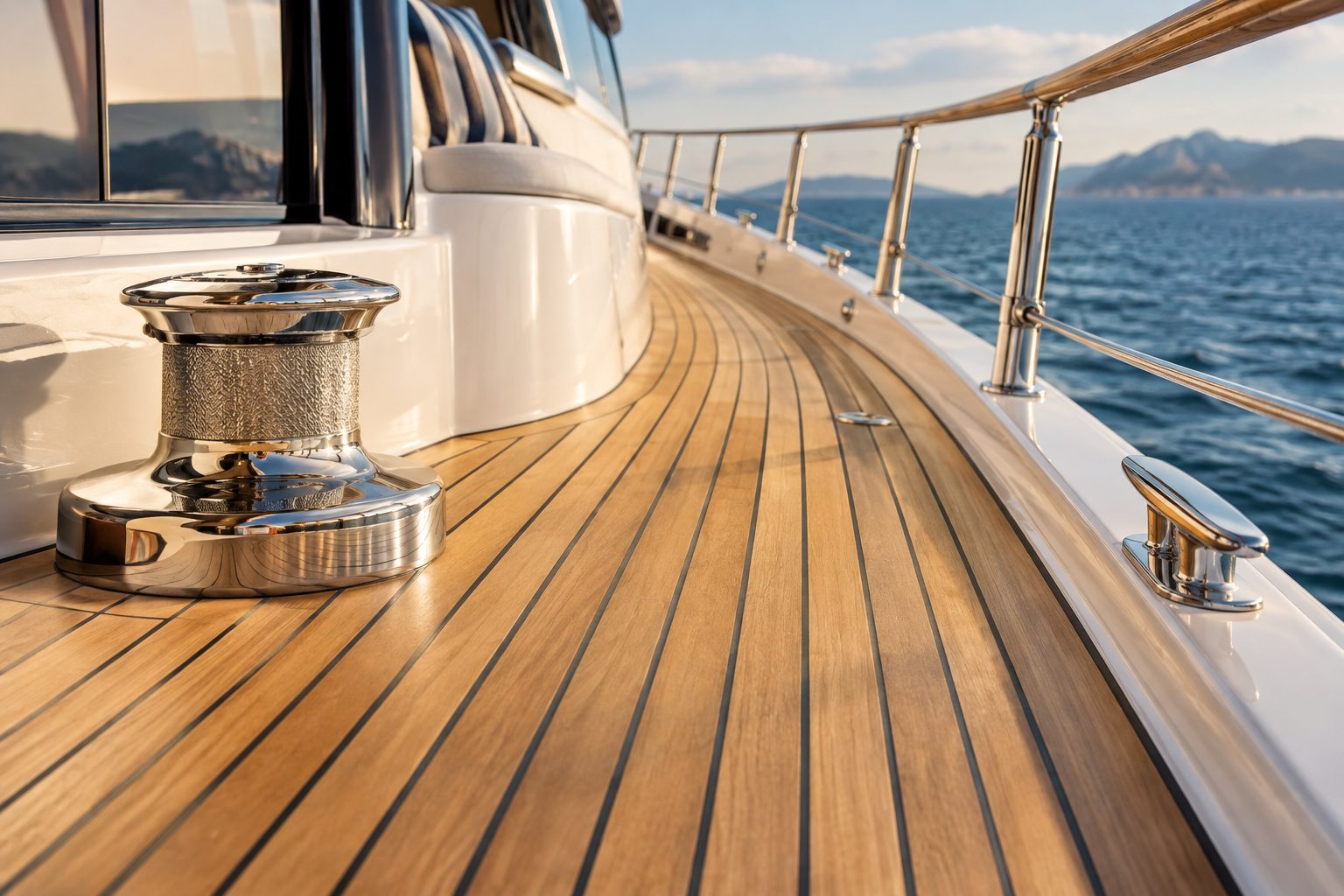
A durable ceramic layer applied over properly corrected gelcoat, giving next season's salt, UV and airborne grime something to attack besides your actual finish. Coating over uncorrected gelcoat just seals in the damage.
Serving marinas and private docks across Fort Lauderdale, Miami-Dade and Palm Beach County. Call (954) 719-3572.
What the job actually involves
Correct the gelcoat first
Coating only goes over a properly compounded and polished surface.
Prep and decontaminate
Surface cleaned of any residue before application.
Apply the coating
Applied in controlled sections for even, correct curing.
Cure and inspect
Checked for even coverage before the vessel goes back in service.
A chemical bond, not a sacrificial layer.
Wax and traditional sealants sit on top of gelcoat as a sacrificial layer, they're designed to be the thing UV and salt attack first, wearing away over weeks and needing regular reapplication. A ceramic coating works differently, forming a genuine chemical bond with the gelcoat surface itself, creating a harder, more chemically resistant layer that doesn't wear away the same sacrificial way wax does. This fundamental difference in how the two products actually work is why a properly applied coating lasts considerably longer than wax under the same South Florida conditions, though it also means coating application demands more precise surface preparation than wax ever required.
This chemical bond also changes how water and contaminants interact with the surface. Coated gelcoat exhibits a pronounced hydrophobic effect, water beads and sheets off rather than sitting and evaporating in place, which directly reduces the water spotting that plagues an uncoated hull between washes. Airborne grime, bird droppings and general marina grit also release more easily from a coated surface during a routine wash, since they have less to physically bond with on a chemically sealed, harder layer.
Coating over oxidation seals in the problem.
A ceramic coating bonds to whatever surface it's applied over, and if that surface is still oxidized, degraded gelcoat, the coating simply locks that degradation in place under a hard, difficult-to-remove layer. This is one of the most common and most costly mistakes we see from owners who've had coating applied elsewhere without proper correction first, the hull looks temporarily better right after application, but the underlying oxidation is still there, now sealed beneath a coating that makes future correction considerably more difficult and expensive to perform.
We never apply coating without first confirming the gelcoat has been properly compounded and polished, either by us as part of the same job or verified independently if a vessel arrives with recent correction already completed elsewhere. This isn't a sales tactic to sell a bigger job, it's the only way a coating actually protects a genuinely healthy surface rather than sealing in a problem that will eventually need to be addressed anyway, at greater cost and difficulty.
What if I just want coating without a full correction first?
If the gelcoat genuinely doesn't need correction, that's fine, but we verify condition first rather than assuming, since coating over real oxidation causes problems down the line that cost more to fix later.
Can you apply coating over correction someone else already did?
Yes, we'll assess the existing correction work first to confirm it's suitable before applying coating over it.
Why controlled conditions matter so much.
Ceramic coating application is genuinely weather and environment sensitive in a way that washing or even compounding isn't. The surface needs to be fully decontaminated of any wax, oil or polish residue before application, since even trace amounts prevent proper chemical bonding. Application happens in controlled sections rather than across the whole hull at once, since the coating needs a specific working time before it starts curing, and working too large an area risks the product curing unevenly before it's properly leveled and wiped.
Temperature, humidity and direct sun exposure during application and initial cure all affect how the coating bonds and levels, and we plan application timing around actual daily conditions rather than a fixed schedule, sometimes working early morning or choosing shaded sections first to avoid direct sun accelerating cure before the product has properly leveled.
Does weather actually affect coating application?
Yes, significantly, and we plan timing around actual conditions rather than a fixed schedule to ensure proper bonding and even cure.
Setting realistic expectations, not marketing claims.
How long a ceramic coating actually performs depends on the specific product used, the quality of application, and the vessel's real environmental exposure, described in detail across our marina coverage pages. A coating on a boat docked at an exposed marina like Bahia Mar or Hillsboro Inlet works against considerably harder conditions than one on a sheltered residential canal, and we set expectations honestly based on the specific vessel's actual dock rather than a generic timeframe that ignores where the boat actually sits.
A coated hull still needs regular washing to perform as intended, coating reduces how hard salt and UV can work against the surface, it doesn't eliminate the maintenance requirement entirely. We're clear about this with every owner considering coating, since understanding it upfront prevents the common disappointment of assuming a coating means the boat never needs washing again.
Does a coated boat still need regular washing?
Yes, coating reduces how hard the environment can work against your finish, it doesn't eliminate the need for regular maintenance washing.
Protection beyond just the hull.
Ceramic coating technology extends beyond gelcoat to stainless, chrome and glass, each with formulations suited to that specific material. A coated stainless rail resists water spotting and fingerprints more readily than uncoated metal, and coated glass sheds rain and salt spray more effectively, reducing the streaking that plagues windows and enclosures on an uncoated vessel. We discuss these additional applications with owners who want comprehensive protection across the whole vessel rather than just the hull, since the same underlying chemistry applies with material-specific adjustments.
Coating metals and glass follows the same principle as gelcoat, proper preparation and decontamination first, since coating over existing tarnish, oxidation or water spots simply seals those imperfections in rather than addressing them.
Can bright work and glass be coated too, not just the hull?
Yes, we offer coating for stainless, chrome and glass as well, each with formulations suited to that specific material.
Why coating is an investment decision, not an impulse purchase.
Ceramic coating represents a genuine upfront investment compared with wax, and we talk through this honestly with every owner rather than overselling coating as universally the right choice for every vessel. For a boat kept long-term at an exposed South Florida marina, the reduced correction frequency and improved year-round appearance a coating provides tends to pay for itself over time compared with repeated wax application and more frequent compounding. For a boat that changes hands often or sees limited time at any single exposed dock, the calculation looks different, and we're upfront about that too.
We'd rather have an honest conversation about whether coating makes sense for a specific vessel's actual situation than sell every owner the same recommendation regardless of fit. Some owners are better served by a disciplined wax and wash routine, others genuinely benefit from coating's longer-term protection, and the right answer depends on the boat, the dock and how it's actually used.
Is ceramic coating worth it for every vessel?
Not necessarily, it depends on your specific situation, and we'll give you an honest recommendation rather than a blanket sales pitch either way.
Getting the most out of the protection you've paid for.
A coated hull still benefits from marine-safe soap and soft media during regular washing, though harsh degreasers or acidic cleaners can degrade the coating's chemical bond over time and should be avoided. We use coating-safe products on any vessel we know has been recently coated, and we ask directly about coating status before a first wash-down on a new client's boat, since the wrong product choice can shorten a coating's effective lifespan considerably.
Periodic maintenance boosters, lighter-duty topper products applied over an existing coating, can extend the coating's hydrophobic performance between full reapplication cycles, and we're glad to discuss whether this makes sense for a specific vessel's maintenance program depending on how the coating is aging and how the boat is used.
Do I need special products for washing a coated boat?
Standard marine-safe soap works fine, but harsh degreasers or acidic cleaners should be avoided since they can degrade the coating over time.
Recognizing when protection has genuinely worn thin.
A coating's hydrophobic performance gradually diminishes over time as the chemical bond wears from environmental exposure and regular washing, and recognizing this decline is part of a thorough maintenance visit rather than something an owner needs to track independently. Water that used to bead and sheet off cleanly starts sitting flatter on the surface, a reasonably reliable visual indicator that renewal is worth considering. We check for this during routine visits on any vessel we know has been coated, and flag it honestly rather than waiting for an owner to notice the gradual change themselves.
Renewal doesn't necessarily mean a full correction and reapplication from scratch, if the underlying gelcoat is still in good condition beneath the aging coating, a fresh application over properly prepared existing coating can restore performance without the full scope of an original application. We assess this honestly on a case by case basis rather than assuming every renewal requires starting completely over.
How do I know when my coating needs renewal?
Watch for water no longer beading and sheeting off as cleanly as it used to, a reasonable visual indicator, and we'll check for this during any scheduled visit and flag it honestly.
From a center console to a full superyacht.
Coating application scales considerably with vessel size, a compact center console might be coated in a single session, while a large motor yacht's full exterior, hull, superstructure, hardtop, represents a genuinely substantial undertaking that we stage across multiple visits the same way described for correction work on our compound and polish page. This staging protects both quality and the coating's actual performance, since rushing an application on a large surface to compress it into a single day risks the exact bonding and curing issues that careful, controlled application is designed to avoid.
Whatever the vessel size, the same fundamentals apply, correction first, proper decontamination, controlled application conditions, and an honest conversation about what the coating will and won't do for that specific boat going forward.
Do you coat vessels of any size, not just smaller boats?
Yes, and for larger vessels we stage the application across multiple visits to protect quality rather than rushing to compress it into a single day.
Ceramic coating represents a genuine step up in protection for the right vessel in the right situation, but it only delivers on that promise when correction comes first, application happens under controlled conditions, and expectations are set honestly from the start. Reach out and describe your vessel's current condition, and we'll walk through whether coating makes sense for your specific boat.
Why location changes the coating conversation.
Our marina coverage pages describe in detail how exposure varies dramatically across this coast, and coating recommendations follow that same variation directly. A vessel at Bahia Mar, Hillsboro Inlet or Miami Beach, facing some of the heaviest salt and UV exposure we service, tends to see the strongest case for coating's durability advantage over wax, since the environment works so much harder against an unprotected finish at these addresses. A vessel in a sheltered canal at Lighthouse Point or a shaded dock behind an Aventura tower faces a gentler environment where the calculation shifts somewhat, though coating still provides genuine benefit, just with a longer timeline before the durability advantage becomes as dramatically apparent.
We factor a vessel's actual dock location into every coating conversation, since recommending the same approach regardless of whether a boat sits at the most exposed marina on this coast or the calmest residential canal would genuinely underserve owners at both extremes.
Does my specific marina or dock affect whether coating makes sense?
Yes, genuinely, more exposed addresses see a stronger case for coating's durability advantage, and we factor your specific location into every recommendation.
Coating protects, it doesn't eliminate the need for care.
The single most important thing to understand about ceramic coating is that it changes the terms of the ongoing maintenance relationship, it doesn't end that relationship. A coated hull still needs regular washing, still benefits from periodic inspection, and still ages, just more slowly and more gracefully than an uncoated surface would under the same South Florida conditions. We're direct about this with every owner considering coating, since the value of the investment depends entirely on continuing the maintenance habits that protect it, not on assuming the coating alone handles everything going forward.
Whatever stage your vessel is at, freshly corrected and ready for its first coating, or due for renewal after years of protection, the same honest, staged approach applies, correction first, careful application under controlled conditions, and clear expectations set from the very first conversation.
Not every ceramic product performs the same.
The ceramic coating market includes products ranging genuinely widely in quality and performance, from consumer-grade sprays that provide modest, short-lived hydrophobic effect to professional-grade coatings formulated for real, multi-season durability under demanding marine conditions. We select products based on the specific vessel and its actual exposure rather than defaulting to whichever product happens to have the highest markup, and we're transparent with owners about which tier of product we're recommending and why.
This transparency matters because coating pricing varies considerably by product tier, and an owner deserves to understand what they're actually paying for, a premium professional-grade product justified by genuinely demanding exposure at an address like Bahia Mar, or a more moderate product that's entirely appropriate for a sheltered canal boat that doesn't need the most aggressive protection available.
Do you use different coating products for different situations?
Yes, we select based on your vessel's actual exposure and needs, and we're transparent about which product tier we're recommending and why.
Where the conversation actually begins.
Every coating job starts with the same honest question, what condition is your gelcoat actually in right now, not what an owner assumes or hopes it might be. From there, the path is straightforward, correction if it's needed, proper preparation, careful application matched to real weather conditions, and a clear conversation about maintenance and realistic longevity before anything gets scheduled. It's a more involved process than a quick wax application, but it's also the only way coating actually delivers the protection it's genuinely capable of providing. If you're not sure whether your vessel is ready for coating or still needs correction first, describe the current condition and we'll give you an honest read before recommending anything, whether that means starting with a wash-down assessment, moving straight into correction, or scheduling coating on gelcoat that's already in good shape. Whichever it turns out to be, you'll know exactly what's actually needed before any work begins, and exactly why we're recommending it for your specific boat, dock and use, nothing assumed and nothing oversold, just an honest assessment and a scope built to match it, exactly the same standard we bring to every service on this site, from a routine wash to the most demanding correction and coating job we take on, at any dock along this entire coast, from Palm Beach down to Miami Beach and everywhere in between, wherever your vessel actually calls home along this stretch of Florida coastline, today or years from now, whichever visit this happens to be, first visit or fiftieth.
Ready for ceramic coating?
See all services, See marinas & areas
Describe the situation by phone and we will tell you what the job involves. Quotes are given by phone. Jobs that cannot be quoted without seeing them need a technician on site, and the service call charge is explained on the phone before anyone is dispatched.
(954) 719-3572