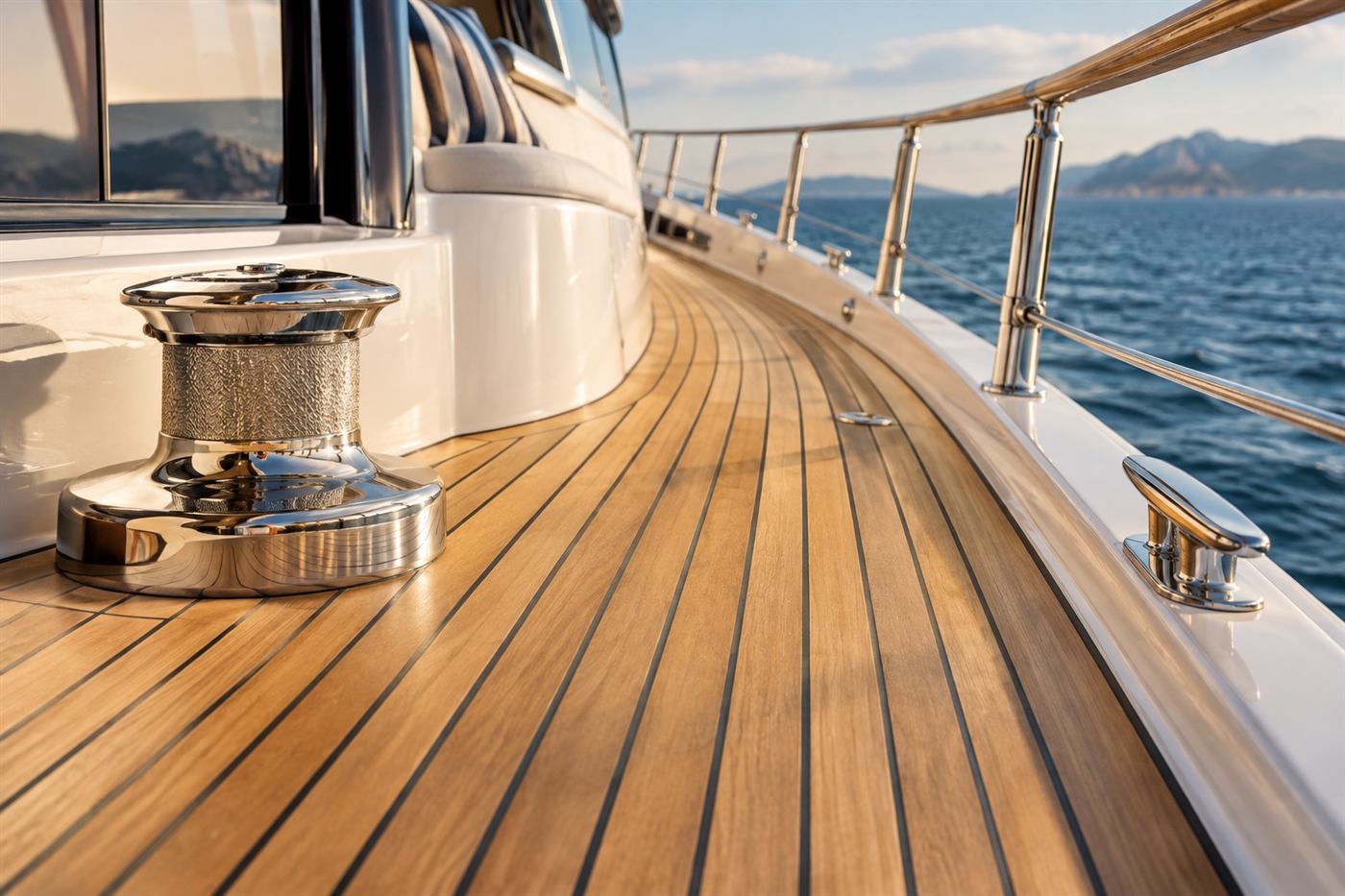
Stainless, chrome and rails polished and protected, with real attention to the fasteners and welds where corrosion actually begins, not just the visible flat surfaces.
Serving marinas and private docks across Fort Lauderdale, Miami-Dade and Palm Beach County. Call (954) 719-3572.
What the job actually involves
Assess the metal condition
Pitting and early corrosion checked, not just surface tarnish.
Polish in stages
Cut back oxidation before refining to a mirror finish.
Treat vulnerable points
Fasteners, welds and crevices get specific attention.
Protect the finish
Sealed to slow the next round of salt exposure.
Understanding what the metal is actually up against.
Marine-grade stainless steel earns its name from a chromium oxide layer that forms on its surface and resists corrosion under normal conditions, but that layer isn't invincible, and the marine environment attacks it constantly. Tea staining, that faint brown or rust-colored bloom owners notice on rails and hardware, and true pitting corrosion both start the same way, chloride ions from salt water breaking down the protective oxide layer faster than it can naturally reform, particularly in spots where moisture sits without ever fully drying. Understanding this mechanism is exactly why we focus bright work attention on the places moisture actually lingers, not just the flat, easily visible surfaces that catch an owner's eye from the dock.
Crevices where two pieces of metal meet, the underside of a bracket or fastener head, and the heat-affected zone immediately adjacent to a weld are the three places we check most carefully during any bright work visit, since these are consistently where corrosion begins regardless of how shiny the rest of a fitting looks. A weld's heat-affected zone is particularly worth understanding, the intense heat of welding disturbs the metal's chromium content right at and around the weld seam, leaving that specific band more vulnerable to corrosion than the surrounding material even though it's part of the same piece of stainless.
Why we don't jump straight to a mirror finish.
Metal that's developed real tarnish or the early stages of pitting needs a staged approach similar to gelcoat correction, an initial cutting compound to remove oxidation and any surface pitting that's still shallow enough to polish out, followed by progressively finer compounds that bring the surface to a genuine mirror finish rather than leaving it looking merely clean. Skipping straight to a fine polish on metal that still has real tarnish or pitting present just moves that damage around without actually removing it, producing a temporary shine that doesn't last and doesn't address the underlying problem.
Genuine pitting corrosion that's progressed beyond what polishing can address, actual material loss rather than surface discoloration, is something we flag honestly rather than attempting to polish away. At that point, a fitting may need replacement rather than restoration, and we tell owners directly when that's the case instead of charging for polishing work that won't produce a meaningful result.
Can polishing fix pitting corrosion, not just tarnish?
Shallow pitting often responds to staged polishing, but deeper pitting represents actual material loss that polishing can't restore, and we're honest about the difference before recommending a scope.
Why does the area near a weld need special attention?
Welding heat disturbs the metal's protective chromium content right at the seam, making that specific band more vulnerable to corrosion than the surrounding metal, even on the same fitting.
Different metals, different failure modes.
Chrome plating, common on older hardware and some fittings, fails differently than solid stainless, once the thin chrome layer is breached by a scratch or pitting, the base metal underneath corrodes rapidly and visibly, often producing bubbling or flaking that can't be polished back to a smooth finish the way stainless pitting sometimes can. We assess chrome fittings carefully before polishing, since aggressive compounding on a chrome surface that's already breached can worsen the exposed area rather than improve it, and we're upfront when a chrome fitting has reached the point where replacement makes more sense than continued polishing.
Aluminum, found on some hatch frames, ladder components and certain hardware, corrodes through a different chemical process entirely, oxidizing to a dull white or gray powder rather than the red-brown rust associated with ferrous metals or the tea staining seen on stainless. Aluminum needs its own specific cleaning approach and, where appropriate, a protective coating suited to that metal rather than the products and techniques used on stainless or chrome.
Do you treat chrome and aluminum the same as stainless?
No, each metal fails differently and needs its own appropriate approach, and we assess which metals are present on your vessel before recommending a specific technique.
Where a cosmetic issue is also a safety issue.
Sportfishing tower structures, outrigger bases, and sailboat rigging fittings, turnbuckles, chainplates, standing rigging terminals, represent bright work where corrosion isn't just a cosmetic concern, it's a genuine structural safety issue given the loads these fittings carry underway. We treat these fittings with particular care during any bright work visit, checking for early corrosion signs that a purely cosmetic polish would miss, and flagging anything that looks like it needs a rigger's or fabricator's assessment beyond what cosmetic polishing addresses.
This distinction matters because a polished, shiny turnbuckle can still have internal corrosion or stress cracking invisible from the outside, and we're clear with owners that our bright work service addresses visible surface condition and obvious external corrosion, not a substitute for a qualified rigger's structural inspection of load-bearing fittings.
Does bright work service include a structural safety check on rigging?
We flag anything visibly concerning, but a full structural assessment of load-bearing rigging fittings should also involve a qualified rigger, and we're clear about that distinction.
Why sealant matters as much as the polish itself.
A polished fitting left unsealed starts the tarnish process again almost immediately in South Florida's salt-heavy environment, since the fresh metal surface exposed by polishing has no protective barrier against the same chloride attack that caused the tarnish in the first place. We apply a protective sealant as a standard final step after polishing, not an optional add-on, since this single step meaningfully extends how long a fitting stays genuinely clean between visits rather than needing repolishing within weeks.
Different sealant products suit different metals and different exposure levels, and we select based on the specific fitting and its actual location on the vessel, a rail on an open, ocean-facing marina like Bahia Mar or Hillsboro Inlet needs more robust protection than the same fitting on a sheltered canal dock.
Is sealant included in a standard bright work visit or is it extra?
It's a standard part of the service, not an optional add-on, since it directly affects how long the polishing work actually lasts.
Matching frequency to exposure, described across our marina pages.
Bright work frequency follows the same exposure logic described throughout our marina coverage, a vessel at an open, ocean-facing address like Bahia Mar, Hillsboro Inlet or Miami Beach needs considerably more frequent attention than one on a sheltered residential canal in Lighthouse Point or Delray Beach, since crevice corrosion and tea staining both develop faster under heavier, more constant salt exposure. We recommend an interval specific to a vessel's actual dock rather than a single generic schedule applied regardless of location.
Vessels that run offshore regularly, sportfishing boats through Hillsboro Inlet or Pompano Beach's working fleet, accumulate salt on towers and outriggers faster than a boat that mostly stays at the dock, and we factor actual use pattern into the recommended interval alongside dock location, since both variables genuinely affect how quickly bright work needs attention.
How do you determine the right bright work interval for my specific boat?
Based on your dock's actual exposure and how the vessel is actually used, both described in detail across our marina coverage pages, rather than a single generic schedule.
Where corrosion affects function, not just appearance.
Deck hardware with moving parts, winches, hatch hinges, cleats with internal mechanisms, faces a maintenance concern beyond pure appearance, salt working into these mechanisms causes stiffness and eventually functional failure long before the exterior finish shows obvious signs of wear. A thorough bright work visit includes attention to these mechanical points specifically, checking for smooth operation and addressing early salt intrusion before it progresses to genuine mechanical binding or failure.
This functional check matters as much as the cosmetic polish for hardware an owner actually relies on underway, a winch that seizes or a hatch hinge that fails at an inconvenient moment is a genuine inconvenience regardless of how polished the surrounding metal looks.
Do you check that mechanical hardware still functions smoothly, not just looks polished?
Yes, we check moving parts, winches, hinges and similar mechanical hardware, for smooth operation as part of a thorough bright work visit, not just surface appearance.
Why some consumer products cause more problems than they solve.
Aggressive consumer-grade metal polishes, particularly ones containing harsh acids marketed for fast results, can remove protective oxide layers too completely or leave chemical residue that accelerates future tarnish if not properly neutralized and rinsed afterward. We use professional-grade products formulated specifically for marine stainless and chrome, chosen for genuine long-term results rather than the fastest possible visual improvement, and we're glad to advise owners who do their own routine wiping between professional visits on which products are actually safe for long-term use.
This distinction matters because an owner trying to save money with an aggressive consumer product sometimes ends up needing more corrective work later than if they'd simply left the metal alone between professional visits, an outcome that costs more overall despite the DIY effort intended to save money.
What if I want to do some polishing myself between your visits?
We're glad to recommend genuinely safe products for routine maintenance between visits, since some aggressive consumer products can actually accelerate future tarnish.
Whether it's a single fitting that's developed a stubborn tea stain or a full bright work pass across an entire vessel's rails, towers and hardware, the same careful, staged approach applies, honest assessment first, appropriate technique for the specific metal involved, and protection built into every job as a standard final step. Reach out and describe what you're seeing, and we'll assess honestly before recommending a scope.
Sailboat rigging, sportfish towers, and motor yacht rails.
A sailboat's bright work priorities center on rigging-adjacent fittings, turnbuckles, chainplates, standing rigging terminals, and the specific safety consciousness described above applies most directly here, since these fittings carry genuine structural loads underway. A sportfishing convertible's priorities shift toward tower legs, outrigger bases and rod holders, functional hardware that takes real handling wear alongside standard salt exposure. A motor yacht's rails, ladders and cleats represent more purely decorative and moderate-handling bright work, though the same crevice corrosion risk applies regardless of the vessel type.
We adjust our approach to each vessel type's specific bright work profile rather than applying a single generic technique across every boat, recognizing that a sailboat's rigging fittings and a motor yacht's decorative rails simply aren't the same job even though both fall under the same general service category.
Do you have specific experience with sailboat rigging hardware?
Yes, rigging-adjacent bright work is a regular part of our work across several sailing communities we service, and we bring the appropriate care to these safety-relevant fittings.
Why bright work scales with fitting count, not just hull length.
Bright work pricing scales differently than exterior wash-down or even gelcoat correction, since it depends more on the actual number and condition of individual fittings than on overall vessel length alone. Two boats of similar size can have genuinely different bright work scopes, one with extensive rail systems, multiple ladders and a full tower, another with more modest hardware, and we assess actual fitting count and condition during an initial visit rather than quoting purely off vessel length.
This is one more reason we quote after an in-person assessment rather than sight unseen, an accurate bright work scope genuinely depends on seeing exactly what hardware is present and what condition it's actually in, not just how long the boat measures overall.
Whatever the specific metals and fittings on your vessel, from a sailboat's safety-critical rigging to a motor yacht's polished rail system, the same commitment to honest assessment and proper technique applies to every bright work visit we perform.
Why this often pairs well with a wash-down or correction.
Bright work is one of the services owners most commonly fold into a combined visit alongside exterior wash-down, since a crew already dockside working the hull can address rails, cleats and hardware in the same appointment without a separate scheduled trip. This pairing tends to be more efficient for owners on a recurring maintenance program, since bright work at every wash-down visit, even a lighter touch-up pass rather than a full correction, keeps fittings from ever reaching the point where a deeper correction becomes necessary.
For a vessel getting a full gelcoat compound and polish, bright work often makes sense as part of the same overall visit too, since a crew already staged and working the boat can address metals efficiently alongside the gelcoat correction, and the two services complement each other visually, a freshly corrected hull looks considerably better next to genuinely polished bright work than next to tarnished rails that undercut the overall impression.
Should bright work be scheduled with other services or separately?
Often it pairs well with wash-down or correction visits for efficiency, though it can also stand alone, and we'll recommend whichever makes sense for your specific situation.
Bright work is often the detail that finishes off a vessel's overall presentation, the shine on a rail or a stainless ladder catches the eye in a way that complements everything else we do, and getting it right, thoroughly and honestly, is exactly the standard we bring to every fitting we touch.
Small crevices, big consequences.
If there's one lesson years of working on marine metals across this coast has reinforced more than any other, it's that the damage nobody sees coming almost always starts in the smallest, least visible spot on a fitting, a crevice behind a bracket, the underside of a fastener head, the narrow band right next to a weld. A hull correction or a full bright work polish that skips these areas, however good the visible surfaces look afterward, leaves the actual problem untouched and quietly progressing. That's exactly why we check these spots on every single visit, not as an occasional deep-dive service, but as standard practice on every fitting we touch. It's a small habit that costs a few extra minutes per visit and saves owners considerably more than that in avoided replacement costs down the line, whether the fitting in question is a decorative rail or a load-bearing rigging terminal. Reach out to schedule an assessment, and we'll walk your vessel with exactly this attention to detail before recommending anything, checking the crevices and fastener bases along with the surfaces that are easy to see from a distance, and telling you honestly what each fitting on your vessel actually needs, whether that's a quick polish, a fuller correction, or a rigger's own inspection before we touch anything further, whatever the specific fitting genuinely calls for, decided honestly rather than assumed from a distance, one fitting, one weld, one crevice at a time, on every vessel that trusts us with its metals, large or small, sail or power, docked anywhere along this coast, from a quiet residential canal to the most exposed marina berth we service anywhere in South Florida we're called to work, on any given day of the year.
Ready for bright work & metals?
See all services, See marinas & areas
Describe the situation by phone and we will tell you what the job involves. Quotes are given by phone. Jobs that cannot be quoted without seeing them need a technician on site, and the service call charge is explained on the phone before anyone is dispatched.
(954) 719-3572