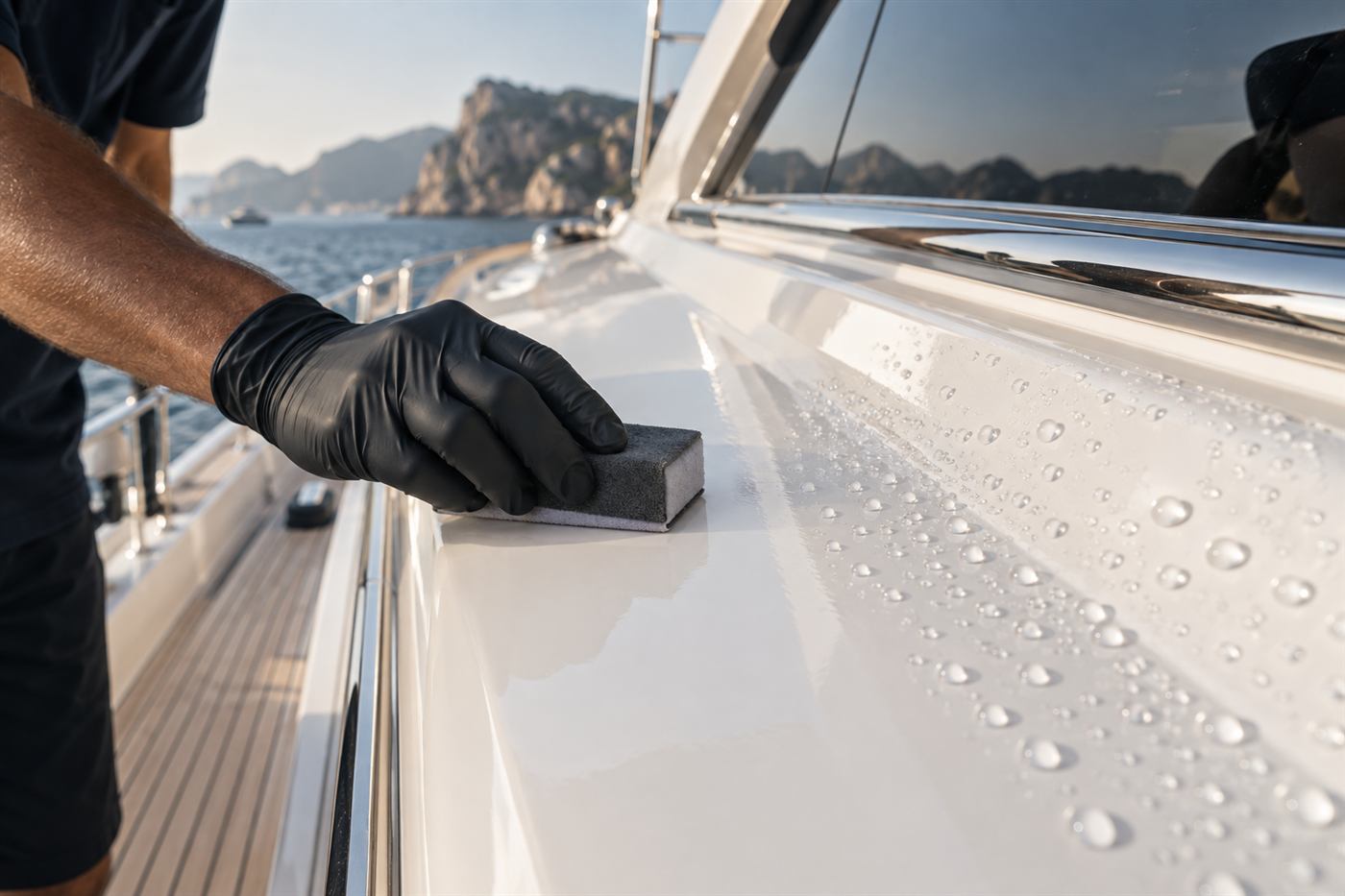
Teak cleaned, brightened and sealed with the grain, not scrubbed across it. Cross-grain scrubbing is the single most common way teak decking gets prematurely worn down, the difference between decades of life and just a few seasons.
Serving marinas and private docks across Fort Lauderdale, Miami-Dade and Palm Beach County. Call (954) 719-3572.
What the job actually involves
Assess the teak condition
Wear pattern and grain direction checked before starting.
Clean with the grain
Never scrubbed across it, that's what wears teak out early.
Brighten if needed
A brightening treatment for teak that's greyed or stained.
Seal or oil
Sealed appropriately for the vessel's use and mooring.
Teak's soft and hard growth bands wear unevenly.
Teak, like most woods, grows in alternating bands of softer spring growth and harder summer growth, and this alternating structure is exactly why aggressive across-grain scrubbing does so much damage. Scrubbing across the grain wears down the softer spring-growth bands faster than the harder summer-growth bands, and over repeated cleanings this differential wear creates the rippled, corrugated surface pattern that marks teak decking as prematurely aged, a texture that no amount of oil or sealant can reverse once it's set in. Cleaning with the grain, following the wood's natural direction, wears both bands more evenly and preserves the flat, smooth surface that properly maintained teak should have for decades rather than just a few seasons.
We assess grain direction and existing wear pattern before starting any teak service, since a deck that's already been damaged by previous aggressive scrubbing needs a different, more conservative approach than teak that's simply dirty or grayed but structurally still even. Recognizing this distinction is exactly what separates genuine teak care from a quick pressure-wash that looks clean immediately but accelerates the exact damage an owner is trying to prevent.
How can I tell if my teak has already been damaged by cross-grain scrubbing?
Look for a rippled or corrugated texture across the deck rather than a flat surface, that ridged pattern indicates differential wear from scrubbing across the grain rather than with it.
Two legitimate finishes, two different maintenance paths.
Teak left untreated with UV exposure naturally weathers to a silver-gray patina that many owners genuinely prefer for its understated, classic look, and maintaining this finish means periodic cleaning without heavy oiling, since oil actually works against the natural weathering process that produces this color. A warm honey-toned finish, by contrast, requires regular oiling or sealing to maintain that color against UV's natural graying effect, a genuinely different maintenance commitment than the low-intervention gray patina approach.
We ask owners directly which finish they actually want before recommending a maintenance plan, since applying oil to teak an owner wants to weather naturally to gray works against their own stated preference, and skipping oil on teak an owner wants to keep honey-toned lets it gray faster than they'd like. This is a genuine preference question, not a right-or-wrong technical decision, and we respect whichever direction an owner chooses.
Which teak finish is better, gray patina or honey oiled?
Neither is objectively better, it's a genuine aesthetic preference, and we maintain either approach correctly once you tell us which look you actually want.
The black lines between teak planks matter too.
The dark caulking compound between individual teak planks does more than look traditional, it seals the seams against water intrusion into the plywood or fiberglass substrate underneath. Aggressive cleaning or pressure washing at too high a setting can damage or dislodge this caulking prematurely, and we're careful about pressure and technique specifically around seams to avoid exactly this kind of accidental damage. Caulking that's already cracking, pulling away, or missing in sections needs a different conversation entirely, since deteriorated seams let water reach the substrate underneath and can lead to genuine structural issues if left unaddressed.
We flag seam condition honestly during any teak assessment, distinguishing between seams that just need gentle cleaning and seams that have deteriorated enough to need a specialist's re-caulking work, since this specific repair falls outside standard teak cleaning and calls for its own dedicated attention.
Do you re-caulk seams that have deteriorated?
Re-caulking is a specialized repair we'll flag honestly and typically recommend a specialist for, since it's a different scope than standard cleaning, though we're careful never to damage sound existing caulking during a regular service.
Cockpit soles wear differently than accent trim.
Teak in a high-traffic cockpit sole, described in more detail across our marina coverage of working sportfishing fleets, takes genuinely different wear than decorative teak trim on a helm station or interior accent piece, foot traffic, dropped gear, salt spray from active use, all accelerate wear on functional deck teak in ways that simply don't apply to teak that mostly gets admired rather than walked on. We adjust cleaning frequency and technique accordingly, treating a hard-used cockpit sole with the tighter cadence appropriate for genuine wear, while decorative teak trim gets a gentler, less frequent maintenance rhythm suited to its actual exposure.
This distinction matters for setting realistic maintenance expectations, an owner comparing notes with another boat owner about teak care frequency should understand that a working sportfish boat's cockpit and a leisure cruiser's accent trim are genuinely different maintenance conversations, not the same schedule applied uniformly regardless of use.
Does a working boat's cockpit teak need more frequent care than decorative trim?
Yes, high-traffic functional teak wears differently and generally needs more frequent attention than decorative accent teak that sees minimal handling.
A different material, a different conversation entirely.
Some vessels are fitted with synthetic teak alternatives rather than genuine wood, materials designed to mimic teak's appearance and non-skid properties without the natural wood's specific maintenance requirements around grain direction and oiling. We service synthetic decking too, though the approach differs meaningfully from genuine teak, no grain to respect, different cleaning products appropriate to the synthetic material, and no need for the oiling or sealing conversation that applies specifically to real wood.
Identifying which material a specific vessel actually has, genuine teak or a synthetic alternative, is one of the first things we confirm before recommending an approach, since applying real-wood technique to a synthetic surface, or vice versa, wastes time and doesn't produce the intended result on either material.
Do you service synthetic teak alternatives as well as real wood?
Yes, though the approach differs meaningfully from genuine teak, and we confirm which material your vessel actually has before recommending a specific technique.
Molded and applied texture needs its own approach.
Not every deck surface we service is teak, molded gelcoat non-skid texture and applied non-skid coating both need genuinely different care than smooth gelcoat or genuine wood, since the standard compound-and-polish technique used elsewhere on a hull would polish this texture smooth and defeat its entire safety purpose. We clean non-skid thoroughly, addressing embedded dirt and salt within the texture's pattern, without using techniques that would flatten or degrade the traction it's specifically designed to provide.
Over time, non-skid texture can wear down naturally from foot traffic regardless of cleaning technique, and recognizing when texture has genuinely worn thin, rather than just needing a good clean, is part of an honest assessment we bring to any deck-focused visit. A deck that's lost genuine traction from wear needs a different conversation about renewal or reapplication, a scope that falls outside standard cleaning.
Do you clean non-skid surfaces without wearing down the texture?
Yes, we use techniques appropriate to preserving traction rather than the polishing approach used on smooth gelcoat, and we'll flag if texture has genuinely worn thin from age rather than just needing a clean.
Why South Florida's climate affects timing.
Teak care timing benefits from the same seasonal awareness described throughout our marina coverage, wet season's frequent afternoon rain means teak stays damp longer between cleanings, which can accelerate mildew growth in seams and grain if not addressed regularly, while dry season's more consistent sun and lower humidity mean teak dries faster but takes more direct, unbroken UV exposure. We adjust cleaning frequency and, where oiling is part of the maintenance plan, timing around these seasonal patterns rather than applying a fixed schedule blindly year-round.
Any oiling or sealing application benefits from a stretch of dry weather to properly cure without rain interference, and we plan these specific steps around the forecast, similar to the weather-sensitivity described for ceramic coating application elsewhere on this site.
Does wet season versus dry season change your teak care approach?
Yes, wet season needs closer attention to mildew prevention in seams and grain, while any oiling or sealing work benefits from being timed around a dry weather stretch for proper cure.
Why teak cleaners with acid or bleach cause long-term damage.
Many consumer teak cleaning products contain acids or bleach formulated to brighten wood quickly, and while these products do produce a fast visual improvement, they also strip natural oils from the wood and can weaken the surface fibers with repeated use, accelerating the exact aging process an owner is trying to prevent. We use products formulated for genuine long-term teak health rather than the fastest possible visual brightening, and we're glad to advise owners who want to do some of their own routine cleaning between professional visits on which products are actually safe for repeated, long-term use.
This is a genuinely common mistake we see on vessels that arrive with previous owner or previous service history involving aggressive, acid-based brightening products, teak that looks fine initially but shows accelerated fiber breakdown and premature grain roughness from repeated harsh treatment. Reversing this kind of cumulative damage isn't always fully possible, which is exactly why product choice matters as much as technique from the very start.
What if my teak has been treated with harsh brightening products in the past?
We'll assess the current condition honestly, some cumulative fiber damage from harsh products isn't fully reversible, but switching to gentler, long-term-appropriate products going forward slows further deterioration considerably.
Whatever the specific condition of your teak, gray patina holding up well, honey tone needing a fresh oil, or a deck that's suffered from previous aggressive treatment, the same grain-respecting, honest approach applies to every visit we make. Reach out and describe your teak's current condition, and we'll put together an accurate scope.
From sailboat cockpits to superyacht swim platforms.
A sailboat's cockpit teak, common throughout our coverage of sailing communities in Delray Beach and Lighthouse Point, tends to see a mix of foot traffic and rigging-adjacent wear, while a large motor yacht's teak swim platform and flybridge decking, common at addresses like Pier 66 and Bahia Mar, represents a genuinely larger surface area needing the same staged, methodical approach described for large-vessel gelcoat correction elsewhere on this site. We scale our approach to the actual square footage and specific wear pattern present, rather than applying a single generic timeline regardless of vessel size.
Working sportfishing boats near Hillsboro Inlet and Pompano Beach put their cockpit teak through the heaviest functional use we see anywhere on this coast, tackle, ice, fish blood and salt spray all accumulating in ways a purely decorative teak surface never experiences, and we bring the same honest distinction between functional wear and cosmetic aging described throughout this site to every teak assessment on a working vessel.
Do you scale your approach based on vessel type and teak surface area?
Yes, a sailboat cockpit, a large motor yacht's flybridge decking, and a working sportfish boat's cockpit sole all get an approach matched to their specific size and actual use pattern.
Why properly done teak work takes real time.
Genuine grain-respecting teak cleaning, followed by brightening if needed and then sealing or oiling, takes considerably longer than a quick pressure-wash pass, and we're upfront about realistic time expectations before starting any teak job. Rushing this process to compress it into less time than it genuinely needs risks exactly the aggressive, across-grain technique that causes the premature wear this whole page describes avoiding.
For a full deck on a larger vessel, we may recommend staging the work across more than one visit, similar to the staging described for large-scale gelcoat correction, rather than rushing a single long day that risks quality for the sake of a faster overall timeline.
Teak might be the most visually rewarding service on our list when done properly, that warm, even glow across a well-maintained deck, but it's also one of the easiest to genuinely ruin through rushed or aggressive technique. We treat every teak surface with the patience it demands, whatever the vessel, whatever the current condition, and whatever finish an owner ultimately prefers.
Why we won't rush a job that shouldn't be rushed.
Every mistake described on this page, cross-grain scrubbing, harsh acid brighteners, seam-damaging pressure levels, shares a common root cause, someone trying to get a teak deck looking good quickly rather than correctly. We understand the appeal of a fast, dramatic-looking result, but genuine teak longevity comes from patient, grain-respecting technique applied consistently over the vessel's ownership lifetime, not from any single aggressive treatment that produces a temporary shine at a real long-term cost.
If an owner asks us to work faster than the job genuinely allows, we're honest about the tradeoff involved rather than quietly cutting corners that would show up as accelerated wear months or years down the line. This patience is exactly what protects the investment a genuine teak deck represents, and it's worth understanding before any work begins.
Will you rush a job if I need it done faster?
We'll always tell you honestly if a faster timeline means cutting a corner that risks the wood's long-term condition, rather than quietly compromising quality to meet a rushed schedule.
What a first assessment actually covers.
A first teak visit starts with genuinely walking the deck, checking grain direction, wear pattern, seam condition, and asking directly which finish, gray patina or honey oiled, the owner actually prefers going forward. From there, we build a realistic scope and timeline, whether that's a straightforward cleaning for teak in good condition, a fuller brightening and re-oiling for teak that's grayed unevenly, or a longer conversation about a deck that's suffered real cumulative damage from previous aggressive treatment.
Whatever the starting condition, this same honest assessment process is where every teak relationship begins, and it's what lets us recommend a scope that genuinely matches your vessel rather than a generic package pulled off a price sheet. From there, most owners settle into a recurring rhythm that keeps the deck looking properly cared for continuously, rather than letting it drift toward the kind of neglect that eventually needs a much larger, more disruptive correction. That steady rhythm, more than any single visit, is what actually gets a teak deck to the decades of genuine service it's capable of providing when it's cared for the right way from the start. That's the standard we bring to every teak deck we're trusted to maintain, wherever it's docked and however hard it's actually used, from a quiet weekend sailboat to a working charter boat running the inlet every single day of the season, whatever the deck actually needs to hold up well through years of continued use, season after season, wash after wash, cleaned with the grain every single time, never once cut across it for the sake of speed, no matter how tempting that shortcut might look on a busy day at a busy marina, on any boat, of any size, teak, synthetic, or textured non-skid alike, treated with the patience each specific surface genuinely deserves, visit after visit, deck after deck, season after Florida season.
Ready for teak & deck care?
See all services, See marinas & areas
Describe the situation by phone and we will tell you what the job involves. Quotes are given by phone. Jobs that cannot be quoted without seeing them need a technician on site, and the service call charge is explained on the phone before anyone is dispatched.
(954) 719-3572