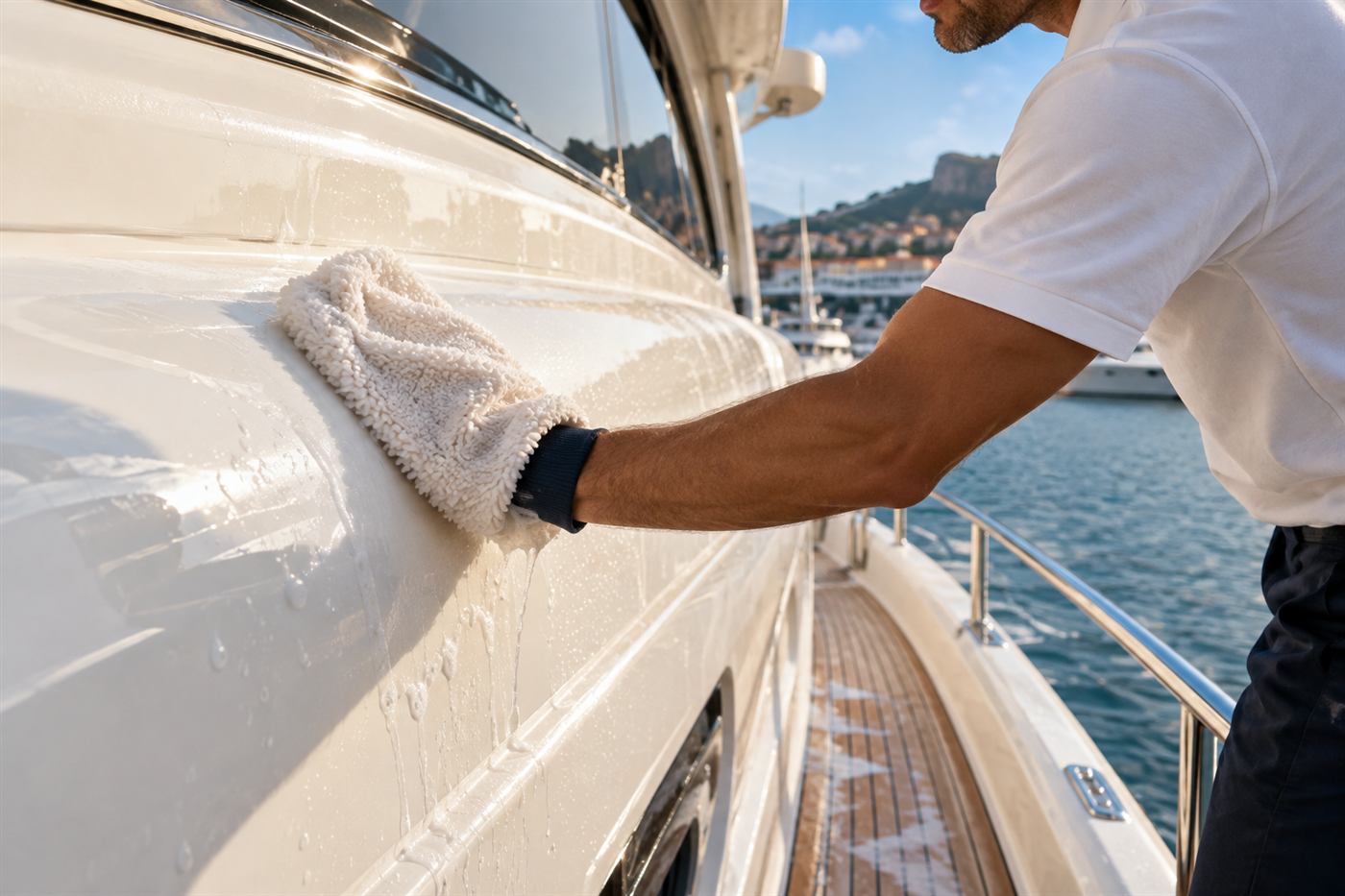
Why a yacht club slip is a different setting
Most commercial marinas rent slips to anyone with a boat and a payment method. A yacht club is a membership organization. The dock, the clubhouse, the grounds and the people on them belong to a community with its own expectations. Members care about how the club looks, how it sounds and how it runs, and so does the staff. A detailing visit that would pass unnoticed at a busy public marina can cause real friction at a club if it is handled carelessly.
That does not make club boats harder to detail. It makes them different. The work itself, washing, polishing, protecting and cleaning interiors, is the same. What changes is the framework around it: who has to approve a vendor, which hours are allowed, where equipment can be set down, how water and runoff are handled, and what counts as acceptable noise near the clubhouse.
Owners at clubs across South Florida, from Miami through Fort Lauderdale to Palm Beach County, often tell us the same thing. They want the boat to look right for the next regatta, family weekend or club cruise, and they do not want to be the member whose contractor caused a complaint. We take that seriously, and this page explains how we work within a club environment.
Club rules come first
Every club has its own rulebook. Some publish a list of approved service providers and require anyone outside it to be vetted. Some ask for a certificate of insurance on file before a vendor can enter the property. Some limit exterior work to certain days or hours so that evenings, weekends and event days stay quiet. Some restrict the use of pressure washers, polishers or certain cleaning products on the docks. Some require vendors to check in with the dockmaster or the front office every time.
We do not guess at these things. Before the first visit, we ask you to find out what the club requires, and we work with whatever process it uses. If the club needs paperwork, we tell you what we can supply and what you may need to request from the office. If there is a vendor list and we are not on it, we leave it to you and the club to decide how to proceed. We would rather wait for approval than put a member in an awkward position.
On the day itself, we check in as required, keep to the allowed hours and park where vehicles are permitted. If the dockmaster asks us to pause, move or stop, we do. Good relations with a club's staff matter to everyone involved, and that includes the owner who invited us.
Member vessels and what they tend to look like
Boats at yacht clubs cover the full range. There are sleek sailing yachts with teak decks and varnished trim, sportfish boats with towers, cruisers kept for family weekends, daysailers used for racing, and older classics that the owner has maintained for decades. Many are well kept already, so the work is often about maintaining a high standard rather than rescuing a neglected vessel.
That changes the conversation. With a boat that has been cared for, there is less heavy correction and more careful attention to detail: the shine in the corners of a toe rail, the edges of a hatch, the brightwork that catches the eye when you step aboard. Owners ask about consistency, so that the finish on the hull matches the finish on the cabin top and the transom.
We also see boats that have not been touched for a season because the owner traveled. A club slip in summer, with the boat closed and the sun beating down, can lead to mildew inside and algae on shaded deck areas. In those cases, an honest assessment comes first, then a plan that fits the owner's timeline. See our motor yacht detailing and sailboat detailing pages for how we approach each type.
Scheduling around regattas, tournaments and club events
A club calendar fills up. Regattas, fishing tournaments, holiday parties, sailing school sessions, seasonal dinners and weekend cruises all affect who is on the docks and when. Detailing is best planned well ahead of an event rather than squeezed in the day before, when the docks are busy, the weather may turn and there is no room to correct anything that needs a second pass.
When you call, mention the date that matters. If there is a tournament, a club cruise or a family event, we work backward from it. Polishing and protection work should come first, with enough time for the surface to settle. A final wash and wipe-down can be arranged closer to the date. This approach avoids rushing, which is where mistakes happen.
We do not promise arrival windows or guarantee a time on a particular day, because club schedules, tides, weather and dock traffic all vary. What we can do is plan with you, stay in contact, and adjust if the club needs the dock cleared for an event. If you race, tell us about the class rules and what the fleet expects of a hull. Some surfaces need to stay a particular way, and we want to hear about that before we begin.
Water, runoff and care for the docks
Clubs care about the water they sit on. Many sit in sheltered basins or along the Intracoastal Waterway, where environmental rules and member expectations are strict. Wash water that runs off a hull and into the basin carries soap, dirt and whatever was on the surface. We use marine-appropriate products and avoid anything the club does not allow. If a facility asks us to keep runoff to a minimum, to use a particular wash method or to skip a certain step, we adjust.
We also think about the dock itself. Hoses can trip people. Buckets and equipment can block walkways. A polisher left plugged in near a wet surface is a hazard. Good detailing practice includes keeping the work area tidy, coiling lines, putting equipment away promptly and leaving the dock cleaner than we found it.
Power and water access should be arranged beforehand. Some slips have shore power and a spigot at every pedestal. Others share access along the dock. If the club limits power draw or requires a specific adapter, tell us and we will bring what is needed. Never run a long cord across a walkway without asking, and we do not either.
Brightwork, teak and the finishes members notice
Club boats are often judged on their details. A visitor walking along the dock may not examine the gelcoat, but they notice a bright rail, an even teak deck, a clean set of canvas covers and a hull that reflects the sky. These are the finishes where small neglect shows quickly.
Stainless and chrome hardware benefits from regular cleaning, because salt sits in the crevices and creates staining that dulls the shine. Our bright work and metals service handles the cleaning and polishing, and we tell you honestly when a part has pitting that polishing cannot reach.
Teak needs a careful approach. Aggressive brushing or harsh chemicals can wear away the soft grain, and over time the deck loses thickness. Some owners prefer a natural silvery weathered look, while others want the warm honey tone. We ask about your preference and match the process. For details on how we treat teak, see teak deck care. A club boat that is seen often deserves attention that is regular rather than occasional.
Canvas, cushions and interiors for boats used by families
Club life is social. Boats host guests, children, pets and food. That means cushions pick up sunscreen and drink spills, canvas gets handled, and cockpit floors collect sand and crumbs. Most of this is routine dirt, and it cleans up well if treated in time.
Interiors on boats used mostly on weekends often develop a closed-up smell if the air conditioning is not run between trips. A damp towel, a half-empty cooler or a closed head can seed mildew in a few days of warm weather. We look at the whole cabin, not just the visible surface, and we explain where the moisture is coming from so that cleaning has a lasting effect.
If your boat has a galley, we clean it with attention to food safety. If it has a head, we sanitize it with products suited to marine plumbing. Our interior detail page covers what is involved. Where an item needs repair or replacement rather than cleaning, such as a cracked cushion or a failing seal, we say so plainly and leave the repair to the right specialist.
Club fleets, sail schools and shared vessels
Some clubs operate their own fleet: training dinghies, sailing school boats, committee boats, launches and race support vessels. These are used hard by many hands and often end up with a different kind of dirt from private yachts. Scuff marks, drink stains, mildew in lockers and worn non-skid are common, and the vessels need to be ready for each new class or event.
Fleet care is a different conversation from caring for a single yacht. It calls for a repeatable routine, clear scheduling with the club's staff, and attention to safety items that the club's own people are responsible for. We clean and detail the surfaces and leave mechanical or rigging matters to the club's own maintenance team.
If you are a club manager, commodore or fleet captain and want to talk about how a regular program might work, call and describe what you have. See our yacht club fleet care page for how we think about it. Because every club's needs differ, we discuss scope on the phone and, where it is complicated, arrange an on-site visit first.
Etiquette on the dock
Simple courtesy goes a long way. Keep conversation quiet near other boats. Do not use music or loud machinery. Do not lean on other members' vessels or leave tools on their decks. Stay in the area agreed for the work. Be polite to staff and members, and refer any questions about the club itself to the dockmaster or the front office rather than answering for them.
If a member stops to ask about our work, we are happy to answer, but we do not discuss other owners' vessels or schedules. Privacy matters at a club, and what we see on a boat stays with the boat.
We also keep an eye out for things that are not part of our job but that an owner would want to know. A frayed dock line, a chafed fender or a small leak is worth mentioning. We report what we see and leave the fix to the owner and the right professional. Good manners and good communication make the whole arrangement work.
Arranging a visit at your club
The first step is a phone call. Tell us the name of the club, the type and length of your vessel, where it is berthed and what you want done. Mention any club rules you already know about, and tell us whether the club needs insurance paperwork or a vendor approval. We will tell you what to ask the office and how we can help the process along.
Pricing is given only by phone because it depends on the boat, its condition and the access at your club. Complicated jobs need an on-site visit, with a service call charge that we explain on the phone before dispatch.
Once the details are settled, we plan the work around the club's calendar and your own. If you are unsure what your boat needs, describe what you see and we will help you work out a sensible order of jobs. Whether you are preparing for a regatta, a season of cruising or simply a cleaner boat at the dock, call when you are ready.
Questions people ask
Does my yacht club have to approve you before you can work?
That depends entirely on the club. Many require approved vendors, insurance paperwork or a check-in with the dockmaster. Ask the club office what applies to outside contractors, and tell us what they say. We follow the club's process and will not begin work until you and the club are comfortable.
Can you detail my boat the week before a regatta or tournament?
Sometimes, but it is better to plan earlier. Polish and protection work needs time, and docks are busy before events. Call as soon as you know the date and we will work backward from it. We cannot promise a specific day or time, because weather and dock schedules vary.
Will wash water and products be a problem at my club?
We use marine-appropriate products and follow whatever runoff rules the club sets. If the club limits a method, a product or the hours of work, we adjust. Tell us what the rules are and we will plan around them rather than discover them on the day.
Do you work on racing sailboats and their hulls?
Yes, with care. Racing hulls often have particular finish requirements, and some class rules affect what may be applied. Tell us about the class and what the fleet expects, and we will discuss what is suitable. We would rather ask first than apply something that does not suit the boat.
Can you look after a club-owned fleet?
We can discuss it. Fleet work depends on the number of vessels, their uses and how the club wants the work scheduled. We clean and detail surfaces and leave mechanical and rigging matters to the club's maintenance staff. Call with a description and we will suggest how to start, possibly with an on-site visit.
How do I get a quote for a club boat?
By phone. We do not publish rates because they depend on the boat, its condition and the access at your club. Larger or more complicated jobs need an on-site visit, and there is a service call charge that we explain on the phone before dispatch. Call and describe your vessel.
Describe the situation by phone and we will tell you what the job involves. Quotes are given by phone. Jobs that cannot be quoted without seeing them need a technician on site, and the service call charge is explained on the phone before anyone is dispatched.
(954) 719-3572Related pages
Working with a club dockmaster and house staff
At a yacht club, the person who matters most to a cleaning visit is usually not the member but the dockmaster or the staff who run the docks. Before any crew steps on the property, it helps to find out who approves outside vendors, whether a vendor form or a gate list is required, and which hours are quiet. We encourage owners to make that introduction themselves, since the club recognizes its members. Once the dockmaster knows a visit is coming, the boat is easier to reach, parking is easier to sort out, and a hose or cart is less likely to cause a complaint.
On the day itself, the crew follows the club's habits, not its own. That may mean no running power tools before a certain hour, no soap runoff near a restaurant terrace, or staying clear of a fuel dock that is busy on weekends. Some clubs ask vendors to check in at an office each time, and some restrict which cleaning products may be used near the water. A good crew asks about these things before starting and accepts the answers without argument. The goal is that the staff forget the visit happened, because nothing about it caused them extra work.
After the work, the crew leaves the finger pier cleaner than it was found, picks up every scrap, and reports anything it noticed that the owner or staff should know, such as a chafed dock line, a loose cleat, or a fender that has gone flat. These are courtesy observations and not upsells. If a repair is needed, it is something for the boat owner and the club to handle. The scope of the cleaning and any quote are explained before work begins, so the owner, the captain, and the dockmaster all understand what will happen and when the crew will be out of the way.