Why scope is the first question to settle
Most disagreements between owners and detailers come from a mismatch in expectations. The owner says detail and means everything visible. The detailer hears detail and plans a wash and a wax. Neither is wrong, because the term has no fixed definition in the industry. The only reliable way to avoid the gap is to describe the work in terms of surfaces and services, and to confirm the list before the work begins.
A dockside detail means the work is done with the boat in its slip, rather than hauled out on stands in a yard. That affects what is practical. Work above the waterline, on decks, topsides, glass, metal, canvas, teak and the interior is normally done dockside. Work that needs the hull out of the water, such as bottom paint and anything below the waterline, belongs in a yard. Our page on hull cleaning above the waterline explains where that line sits.
Scope also depends on the condition of the boat. A boat washed every week needs a lighter process than one that has not been cleaned for a season. A technician cannot know the condition until they see it, which is why complicated jobs are confirmed with an on-site visit and why quotes are given only by phone after a conversation about the boat.
The sections below go through the common service types and describe what each normally involves. Treat them as a vocabulary to use on the phone, not as a fixed menu. If a task you want is not listed, ask about it, because most requests can be described in a sentence.
Exterior wash-down and dry
An exterior wash is the foundation of nearly every visit. The technician rinses salt and loose dirt first, so that grit is not dragged across the surface by a wash mitt. Then they wash from the top down with a marine-safe soap and soft tools, rinse thoroughly, and dry so that fresh water does not leave mineral spots in the Florida sun.
The areas covered usually include the hull sides above the waterline, the deck, cockpit, swim platform, flybridge, superstructure, railings and hardware. Windows and glass may be included in a standard wash or listed as a separate task, depending on how the detailer describes it. Ask which.
What a wash does not do is correct damage. A wash removes dirt, salt, algae film, and loose contamination. It does not remove oxidation, deep stains, rust bleeding from hardware, or scratches. If the hull is chalky or streaked, a wash will show you the true condition, and the next step is a different service. You can read more on the exterior wash-down page.
Some owners want a wash and dry on a regular rotation, with heavier work scheduled less often. That is a sound approach, and it keeps the boat from slipping into a condition that needs restoration. Our guide on how often to wash a yacht covers rhythm in more detail.
- Pre-rinse to lift salt and loose grit
- Top-down wash with marine soap and soft tools
- Thorough rinse and hand dry to avoid water spots
- Check of drains, scuppers and seams for debris during the wash
Compounding, polishing and gloss restoration
Compounding and polishing are corrective services. They remove a very thin layer of oxidized or scratched gelcoat or paint to reveal fresh material underneath, then refine the surface so it reflects light evenly. This is the work that brings back depth and color on a hull that has gone dull.
A typical sequence includes inspecting the surface, testing a small area to choose the right pad and compound, working section by section, wiping off residue, and then applying a sealant or wax to protect the finish. The number of passes depends on how oxidized or scratched the surface is, which is why two boats of the same size can need very different amounts of time.
This service is not an add-on to be tacked on to a wash without planning. It needs shade or cooler conditions, clear access to the hull sides, and enough time to work methodically. It also needs the surface to be clean first, so a wash comes before it. Our guide to compounding explains abrasives, heat and test spots, and the compound and polish page lists what the work normally includes.
Be clear on what you expect. Compounding improves gelcoat, but it cannot repair a deep gouge, a crack, a blister, or delamination. Those are repair jobs and belong to a fiberglass shop. A technician should tell you honestly what polishing can and cannot achieve on your boat.
Wax, sealant and ceramic protection
After a surface is clean and corrected, it needs protection. Protection is a separate step from correction, and it is also a separate decision. Wax, synthetic sealant and ceramic coating each protect differently and last for different lengths of time under different conditions.
Wax gives warmth and depth and is relatively quick to apply, but it wears away under sun and washing. Synthetic sealants bond to the surface and tend to last longer. Ceramic coatings form a harder layer that resists contamination and is easier to wash, but they require careful preparation and are not a substitute for care. Our guide to wax, sealant and ceramic compared lays out the differences without hype.
When someone says detail includes protection, ask which product and what that means for the length of time between visits. A wax applied to a compounded hull is not the same service as a ceramic coating, and the quote should reflect which one is meant. Coatings in particular are a separate service with their own preparation, cure time and maintenance, described on the ceramic coating page.
Whatever the choice, protection extends the benefit of every wash. A protected surface sheds salt and dirt more easily, which makes the next wash shorter and gentler on the finish.
Brightwork: stainless, chrome, aluminum and metal care
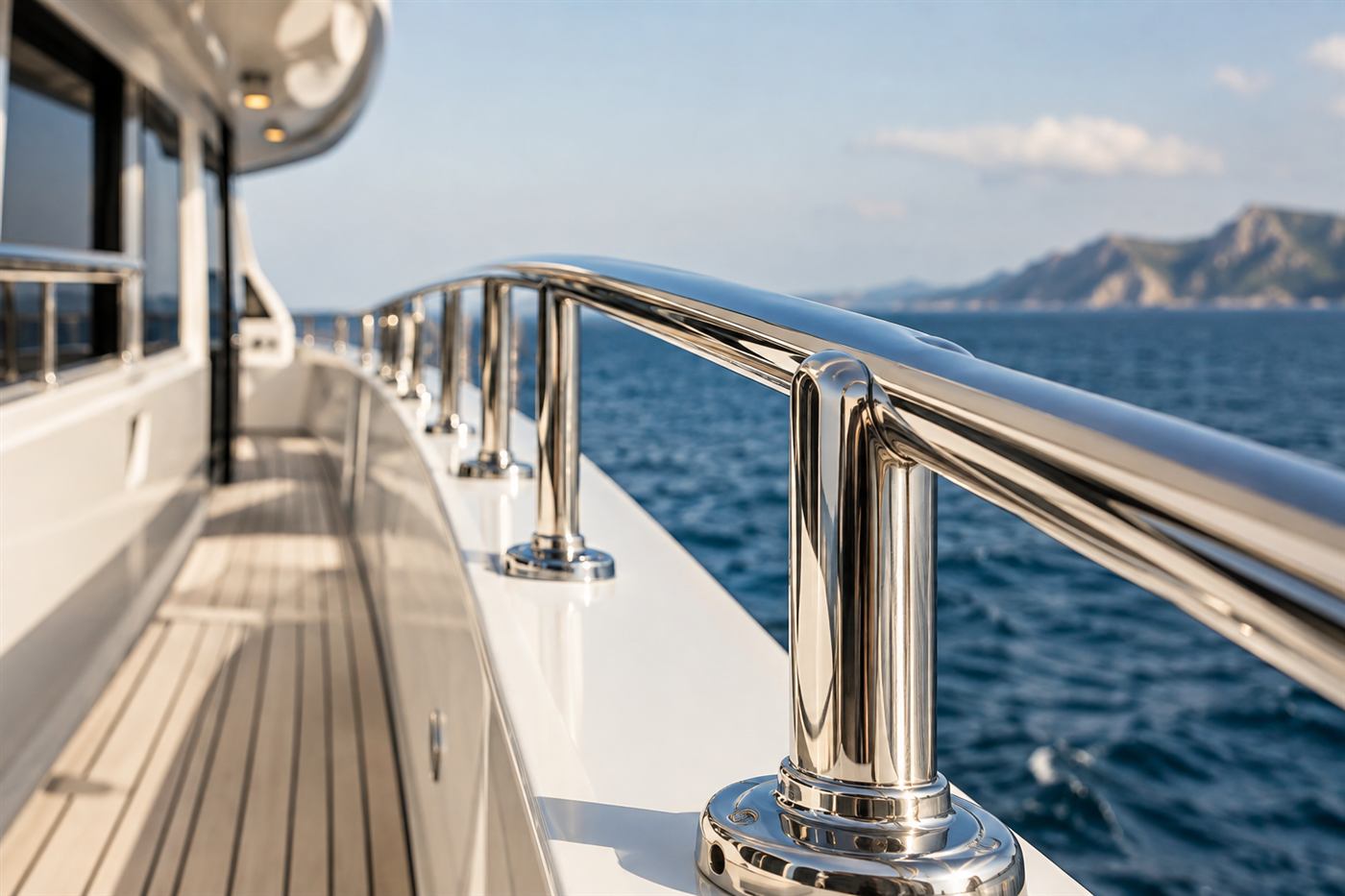
Brightwork covers the polished metal on a boat: stainless rails, cleats, hinges, ladders, chrome fittings, aluminum frames and trim. In a marine environment these metals are constantly exposed to salt, humidity and sun, and they develop tea staining, pitting, haze and surface rust.
A typical service involves cleaning to remove salt and surface contamination, then polishing to restore luster, and then applying a protective product. Heavily pitted or corroded metal may improve but not return to new condition, and badly corroded parts may need replacement, which is outside the scope of detailing.
Scope questions to ask: Are all rails and fittings included, or only the ones that are easy to reach? Does the service include the tower, the arch and the bow rails, or only the main deck? Are stainless fasteners cleaned, or just the large pieces? Our bright work and metals page describes the usual range.
Remember that brightwork is also the area where rust stains transfer to gelcoat and teak. Fixing a stain without addressing the metal that causes it only gives temporary relief. A good technician points out the source.
Teak, decking and non-skid care
Teak is a category by itself. Cleaning, brightening, and sealing teak are three separate steps, and not every boat needs all three at every visit. Some owners prefer the natural weathered look and ask for cleaning only. Others want the warm color restored and protected with a sealer or oil.
The technician will check the condition of the wood, the direction of the grain, the caulk lines between planks, and whether the surface is sound. Teak that is thin, cracked or lifting is a repair issue, not a cleaning issue. Our guide to protecting teak between details explains how to avoid undoing the work.
Non-skid is the textured fiberglass surface on decks and cockpits. It traps dirt, so it often looks worse than the rest of the deck. Cleaning it requires a stiff brush and an appropriate cleaner, and it needs to be thorough because grime sits in the texture. A deck with worn-out non-skid may clean up but remain slippery, and that is a safety matter to raise with the owner.
Ask whether a teak service includes sealing, and whether non-skid cleaning is part of a standard wash or a separate task. The answers differ by detailer, and your quote depends on them.
Glass, canvas, vinyl and upholstery
Windows, hatches and portlights collect salt film and water spots that are hard to remove after they dry. A glass service uses non-abrasive methods and products appropriate to marine glass, and care around seals and frames. Some glass has coatings or tint that restrict which products are safe, so tell the technician if you know of any.
Canvas, clear vinyl and enclosure windows need gentler treatment. Many household cleaners, and any abrasive, can cloud or scratch soft plastic. Fabric covers and biminis need cleaning that respects waterproofing and stitching. Our guide on protecting canvas and enclosures explains the risks.
Vinyl seating and cushions can be cleaned and conditioned, but mildew, sunscreen staining and sun damage vary in how well they respond. Upholstered interior furniture needs methods that match the fabric. The technician may recommend a test spot, and the owner should expect honesty if a stain is likely to remain.
Be specific. If you want only the glass on the flybridge, say so. If you want all interior and exterior glass, say that. A short conversation avoids surprises.
Interior cleaning and detailing
Interior detailing covers the living spaces: salon, cabins, galley, heads, and sometimes the engine room and bilge. A standard interior clean usually includes vacuuming, dusting, wiping surfaces, cleaning glass and mirrors, sanitizing the galley and heads, and cleaning floors. Deeper work, such as carpet extraction, headliner cleaning, mildew treatment, and odor work, is a step beyond that.
Boats are sealed, warm and humid environments, so mildew and musty odors are common. A cleaning that removes visible dirt may not fix a smell whose source is hidden in a bilge, a cushion, or a damp locker. A good technician will tell you where the smell seems to come from and what is needed to address it. Our interior detail page describes what is covered, and our mildew treatment page explains how that differs from routine cleaning.
Mechanical spaces are a separate category. Engine room and bilge cleaning involves oil, fuel residue and sometimes sensitive equipment, and it is normally a dedicated job. If you want it included, say so, and ask what the technician will and will not touch around wiring, fuel lines and machinery.
Clear the interior of personal items before the work, as described in our guide on preparing your yacht for detailing.
What usually counts as separate work
Some tasks are commonly treated as their own jobs, even when the owner thinks of them as part of a detail. Knowing which ones prevents the feeling of being surprised on the day.
These tend to be separate services: heavy oxidation removal on a neglected hull, rust stain removal that needs dedicated chemistry, waterline stain work, teak brightening and sealing, ceramic coating, paint protection film, engine room and bilge cleaning, deep carpet and headliner cleaning, mildew remediation, canvas and isinglass restoration, and anything involving gelcoat repair or paint touch-up.
Also separate are items that involve other trades. Replacing corroded hardware, repairing cracked gelcoat, fixing leaking hatches or ports, re-bedding fittings, and repairing electrical or plumbing issues belong to marine repair professionals. A detailer can point these problems out, but cleaning does not fix them.
Sometimes a task starts as a small request and turns out to be larger. A black stain that looks like surface dirt may be deep mold in a seam. A rust stream may come from a fitting that is actively failing. If scope changes during a visit, the technician should stop and discuss it with you before continuing. That is the point of a quote given by phone and of an on-site visit for complicated work.
- Oxidation correction beyond a normal polish
- Ceramic coating and paint protection film
- Teak brightening and sealing
- Engine room, bilge and mechanical space cleaning
- Mildew remediation and odor treatment
- Any gelcoat, paint or hardware repair
How to describe what you want on the phone
A useful call has four parts. First, the boat: type, approximate length, and the marina or location. Second, the condition: when it was last cleaned, and what bothers you most. Third, the services you want, using the vocabulary above. Fourth, any constraints: dates, access, pets, or areas to avoid.
From that conversation the technician can tell whether a straightforward quote is possible or whether the job needs a look first. Simple, repeat work is often quoted by phone. Complicated jobs, such as a heavily neglected boat, a large vessel with multiple surfaces, or one with unusual materials, need an on-site visit. A service call charge applies for dispatch, and it is explained on the phone before anyone is sent.
Ask for the scope in plain words at the end of the call: here is what will be done, here is what is not included. Write it down or ask for it in a message. That small habit avoids most misunderstandings.
Finally, call when you are ready to talk it through. Describe the boat, ask what is included in the service you want, and let the technician help you work out the right scope.
Questions people ask
Does a standard detail include compounding and waxing?
Not necessarily. The word detail has no fixed meaning, so confirm the scope in plain words. A wash and dry, a compound and polish, and a wax or coating are usually distinct services. Ask what is included, what is not, and whether any surface needs correction before protection is applied.
Is the interior part of a dockside detail?
It can be, but it is often a separate service. Exterior and interior work use different tools, products and time. If you want both, say so when you call. Deep work such as carpet extraction, mildew treatment and odor control is normally treated as its own job.
What work cannot be done dockside?
Anything that requires the hull to be out of the water, such as bottom paint, bottom cleaning of heavy growth, and certain repairs, belongs in a yard. Dockside work focuses on surfaces above the waterline, plus the deck, superstructure, glass, metal, teak and interior.
Will detailing fix scratches, cracks and blisters?
Polishing can reduce light scratches in gelcoat or paint, but it does not repair deep gouges, cracks, blisters or delamination. Those need a fiberglass or paint repair professional. A technician should be honest about what can improve and what will remain, and should tell you if a repair is the better path.
How do I know what a detail will cost?
Quotes are given only by phone, after a conversation about the boat, the condition, and the services you want. Complicated jobs need an on-site visit first, and a service call charge applies for dispatch, which is explained on the phone before anyone is sent.
What if the scope changes once the work starts?
The technician should stop and talk to you before continuing. Hidden damage, deeper staining or a failing fitting can change what the job requires. Agreeing on any change before the work proceeds keeps the result clear and avoids surprises. Keep a short written note of what was agreed.
Describe the situation by phone and we will tell you what the job involves. Quotes are given by phone. Jobs that cannot be quoted without seeing them need a technician on site, and the service call charge is explained on the phone before anyone is dispatched.
(954) 719-3572