Boating in Harbor Beach
Harbor Beach is one of Fort Lauderdale's beachside neighborhoods, set between the ocean and the Intracoastal Waterway south of the busiest stretch of Las Olas. Large homes, many with their own docks, back onto the water, and the beach is a short walk across the road. It is an area where owners tend to keep sizable boats at home: motor yachts, express cruisers, sportfish boats and sailing yachts that need deep water and a good dock.
The setting shapes the boating. A run to open water takes little time, with the inlet at Port Everglades to the south. A trip up the waterway leads to Las Olas and the downtown marinas. Boats in this neighborhood are used for dinner runs, weekends at anchor, longer trips up and down the coast and, for some owners, charter work. Their finishes are expected to look good all the time, because the boat is visible from the house, the neighbors' docks and every passing vessel.
That visibility is a reason many owners ask for regular detailing rather than occasional rescue jobs. A steady routine keeps the finish consistent and prevents the buildup that makes major correction work necessary. We design our visits around that rhythm.
Beachside residential docks: what they are like to work at
A private dock behind a house is a different working environment from a commercial marina. There is usually a single owner or manager, a limited amount of space and neighbors close on both sides. Access is through the property, so we need to know the entry route, where to park, where the water supply is and whether the house has any rules about noise or hours. We also need to know where electrical power is available for equipment.
We aim to be good guests. Equipment is staged neatly and kept out of the owner's way. Hoses and cords stay off walkways. Wash water and polish residue are kept out of the waterway wherever possible, and we use products appropriate for work near water. We clean up when we finish and walk the owner or captain through what has been done before we leave.
Where an owner is away, we coordinate with a captain, property manager or house staff. Photographs of the work, and notes on anything we noticed, are sent afterward. Our page on private dock detailing describes the process in more detail.
The 17th Street area, traffic and wake
The Intracoastal near 17th Street is one of the busiest sections of water in South Florida. Boats pass at all hours: charter vessels, water taxis, cruisers heading to restaurants, tour boats and large yachts moving between the ocean and the downtown marinas. The mix of speeds and sizes produces constant wake, and even a quiet-looking dock rocks and shifts through the day.
Wake affects a boat in practical ways. Fenders rub against the hull and leave marks. Dock lines chafe and drop grey fibers. Boats surge against pilings and rails and scuff the rub rail. Water splashes up and dries in streaks on topsides. These marks are cosmetic but persistent, and they respond to proper cleaning followed by polishing where needed. We also check lines, fender covers and chafe gear and tell owners when something has worn through.
If your boat's fenders leave marks on the hull, the usual cause is dirt trapped in the fender surface or vinyl in contact with gelcoat for long periods. Clean fenders help, and so does a protective layer on the hull. Our page on dock line and fender marks explains the problem, and rub rail damage and discoloration covers the rail.
Salt, sun and the beach side of town
Harbor Beach sits close to the ocean, so salt in the air is part of daily life. A film appears on glass, rails and gelcoat within a day or two of washing, and metal parts show the effect first. Brown staining around stainless fittings, pitting on chrome and white powder on aluminum all show up on boats in this area faster than in neighborhoods farther from the coast.
Sun is the other constant. A boat on a house dock typically sits fully exposed for much of the day, and sun and heat do steady damage to gelcoat, vinyl and canvas. Dark surfaces get very hot, which stresses seams and accelerates fading. Many owners use covers, canopies and lifts to reduce exposure, and these help, though they bring their own maintenance needs, since a cover that holds moisture can encourage mildew.
Our approach is to wash with care, protect the finish properly and keep an eye on the parts that wear first. See summer heat and UV on boats for the longer explanation, and how gelcoat ages.
Large yachts and multi-deck cleaning
Many boats in Harbor Beach are large enough to need a planned approach. A multi-deck motor yacht has a flybridge, a main deck, a foredeck, side decks, a swim platform, a tender garage and often a sun pad with cushions. Each area has its own materials and its own problems, and each has to be cleaned in the right order so clean work is not spoiled by what comes after.
We start at the top and work down. The flybridge and upper decks are washed first, then the main deck, then the topsides and hull sides, then the swim platform and waterline. Glass is cleaned in sequence with the washing so streaks do not form. Metal is polished after the washing. Protective products go on last, once surfaces are fully clean and dry. Between steps we check our work in different light because defects hide in some angles.
On a big yacht, time on site can stretch over several visits, and we plan that around the owner's schedule and the weather. Our pages on motor yacht detailing and cockpit and flybridge detailing go into more detail.
Teak, stainless and brightwork on show boats
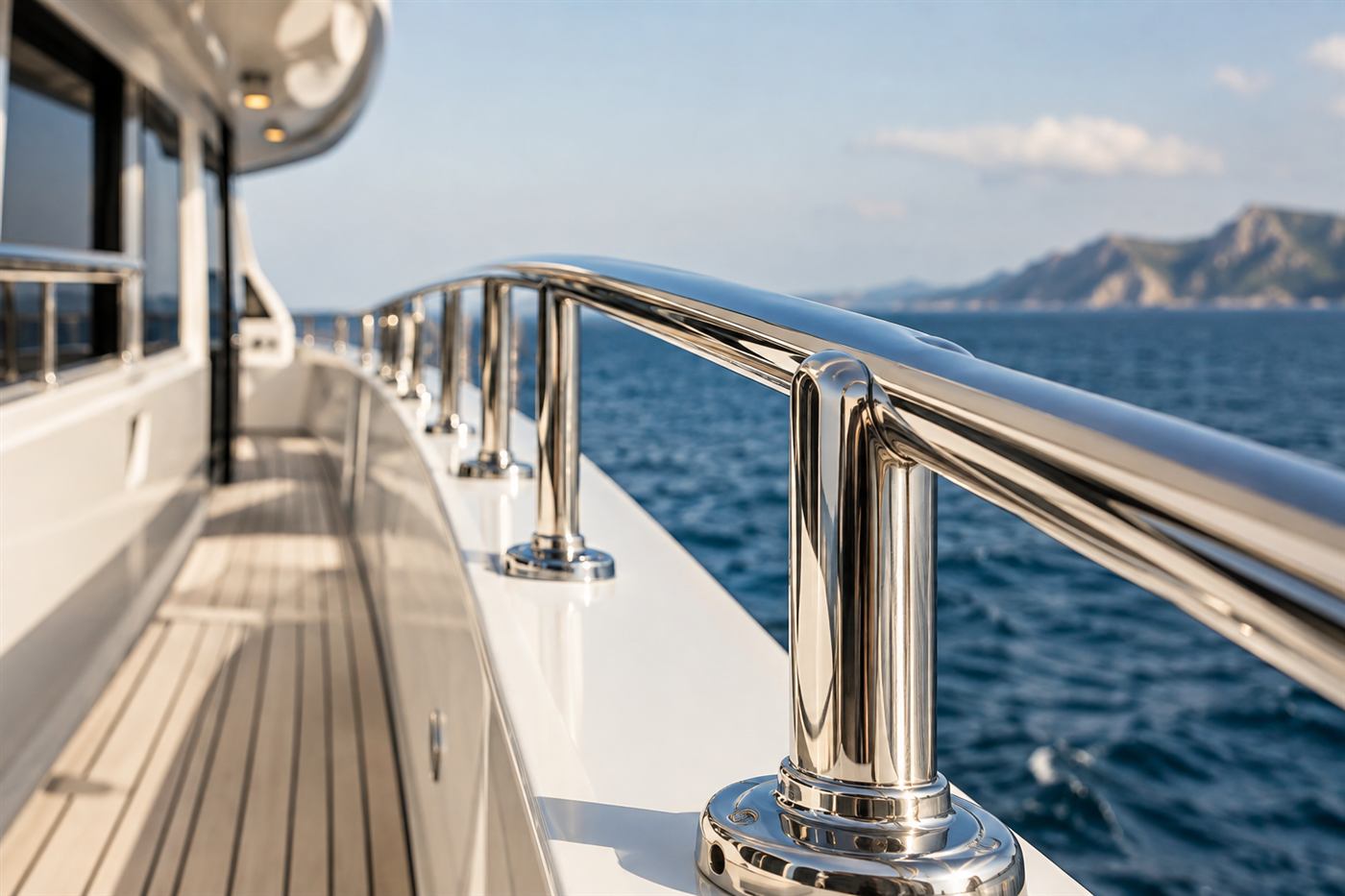
A boat that spends its time at a visible home dock often has substantial brightwork: polished stainless rails, bow pulpits, hardware and sometimes varnished or oiled teak. Owners care about these because they define the look of the boat, and they are also the parts that need steady attention. Tea-colored staining on stainless returns quickly in a salt-heavy setting, and teak can gray or blacken if it is left unprotected.
We clean and polish stainless using methods that suit the metal and its condition. We do not use harsh abrasives on thin fittings, and we do not polish through plating. For teak, we clean with the grain and explain the choices: leave it natural and clean it regularly, brighten it to restore color or seal it for a more uniform look. Each has maintenance consequences, and a good decision depends on how much time the owner or crew will spend on it.
Take a look at teak sealing, teak brightening and bright work metals for more information about what each involves.
Hull, topsides and waterline
The hull of a large yacht is a big surface, and it shows every imperfection in the right light. Waterline staining, oxidation, fine scratches and swirl marks all become visible on a dark or highly polished finish. We evaluate the hull in different light, test small areas to determine how much correction is safe, and select compounds and pads accordingly. Gelcoat and paint differ, and a surface that has been repainted needs gentler treatment than original gelcoat.
Waterline marks are common on boats that stay at a dock. Tannins and organic film settle into the first inches of the hull and darken over time. We treat these with marine cleaners and, where needed, light polishing, and we are careful near the boot stripe, decals and any painted stripe, which can be damaged by strong products. See waterline stain removal, hull wash and wax and hull numbers and decals.
After correction, the finish is protected with a product matched to the boat and the owner's care routine. We explain the options, including the tradeoffs between wax, sealant and ceramic, and what each one asks of the owner afterward.
Interior and below-deck care
The interior of a large yacht deserves the same attention as the exterior. Carpets, upholstery, headliners, cabinetry and bathrooms all collect dust, salt and moisture. In South Florida humidity, a closed boat develops mustiness quickly unless air circulates or a dehumidifier runs. We clean interior surfaces with products suited to each material, extract carpets, treat mildew on hard surfaces and sanitize the head and galley.
We take care around wood veneers, leather and delicate fabrics, and we test products in hidden spots first. Where we find signs of a leak, such as stained headliner panels or soft spots near hatches, we report them promptly because the repair is a job for a qualified marine technician and the damage grows if it is left. Our pages on interior detail, head and galley sanitizing and carpet and headliner cleaning explain what each step involves.
For owners who live aboard part of the year or host guests, interior freshness matters as much as exterior shine, and a regular schedule is more effective than occasional deep cleaning.
Tenders, toys and the smaller items that get forgotten
A yacht at a Harbor Beach dock often comes with a tender, jet skis, paddleboards, inflatables and a collection of fenders, lines and covers. These smaller items are easy to overlook, yet they are what guests see first when they step onto the dock, and they wear in their own ways. Inflatable tenders bake in the sun, and their fabric can chalk, fade and lose adhesive strength if cleaned with the wrong product. Jet skis collect salt in every crevice. Fenders yellow and pick up dirt that then transfers to the hull.
We clean tenders and toys with products suited to their materials, rinse salt from the places where it hides, and apply protection made for fabric, plastic or gelcoat as appropriate. We also look for early signs of wear: seams lifting on an inflatable, cracked plastic trim or a hull scuffed by dock contact. Our pages on tender and jet ski detailing and dinghy and inflatable cleaning explain what is involved.
Lines and fenders are worth a mention too. Dock lines that are green with growth or stiff with salt are not only unsightly but wear faster, and fender covers hold grit that scratches the hull. Cleaning or replacing them is a small job that protects a large finish.
Getting started
To plan a visit, we need the boat's length and type, what finish it has, where it is docked and what you want done. If a captain or property manager looks after the boat, include their contact. If the dock is in a gated community or an association, mention any vendor requirements. A short description of what bothers you most, whether it is oxidation, waterline marks, stainless staining or the smell below deck, helps us prepare.
Quotes are given only by phone. We do not post prices or send figures by message. A large or complicated job needs an on-site visit before a quote, and if a service call charge applies, we explain it before anyone is dispatched. We will also be straightforward if a job is not worth doing or would be better handled by an expert.
When you are ready to talk, call the number on this page. We will work out a schedule that suits the dock, the weather and your plans for the boat.
Questions people ask
Do you work at private docks in Harbor Beach?
Yes. Many of our visits are at residential docks. We ask about the entry route, parking, water and power access and any house or association rules. We keep equipment staged neatly, hoses and cords off walkways and wash water out of the waterway where we can, and we clean up before we leave.
Why does my hull have marks from the fenders?
Fenders rub against the hull as wake moves the boat, and dirt or vinyl in contact with gelcoat leaves marks. Cleaning the fenders, treating the marks with a suitable cleaner and polishing when necessary clears most of them. A protective layer on the hull makes future marks easier to remove.
How do you clean a multi-deck yacht?
Top down. The flybridge and upper decks are washed first, then the main deck, topsides, swim platform and waterline, with glass done in sequence so streaks do not form. Metal is polished after washing and protection goes on last. Large jobs may take several visits, planned around your schedule and the weather.
Can you restore gray teak?
Often, yes. We clean gray, weathered teak gently with the grain, and brighten it to restore its color. We explain the choice between leaving it natural, brightening and sealing, because each has maintenance consequences. Teak that is rotted or badly worn needs a different repair, and we will say so.
Do you coordinate with captains and managers?
Yes. We routinely work with captains, crew, property managers and yacht management companies. We agree on scope and sequence, tell them which products we use and which areas must stay clear, and send photographs and notes after the visit so they have a record of the work.
How are quotes handled?
By phone only. We ask about the boat, its location and the work you want and give a quote from that call. Larger or more complicated jobs need an on-site visit first. If a service call charge applies, we explain it before dispatching anyone. We do not list prices on the website.
Describe the situation by phone and we will tell you what the job involves. Quotes are given by phone. Jobs that cannot be quoted without seeing them need a technician on site, and the service call charge is explained on the phone before anyone is dispatched.
(954) 719-3572Related pages
A walk-through of a large-yacht wash day
On a bigger boat the day starts before any water moves. The crew lead walks the vessel from bow to stern with the captain or manager, noting what is open, what is covered, and which hatches and vents must stay closed. Electronics, exposed teak oil, and anything freshly coated get marked so nobody sprays at them. Then the order is set: high work first, so runoff from the flybridge and arch drips onto decks that have not been cleaned yet. Hoses, brushes, ladders and buckets are staged on the dock so nothing has to be carried across finished surfaces. The scope and any quote are explained before work begins, and changes are talked through rather than assumed.
Working top down also keeps the team honest about water use and dock space. Rinse water comes off the upper decks first, carrying loose salt and dust with it, and the lower decks get washed once the heavy runoff is done. Windows and glass are handled near the end, after the grit has been rinsed away, because wiping glass while sand is still around leaves fine scratches. On show boats in a busy harbor, the crew also watches how spray drifts toward neighboring vessels and moves hoses or angles to keep it off other people's paint and cushions.
The last pass is a walk-around with the person in charge. Every deck level is checked from standing height and from a crouch, because a surface can look clean from above and still show streaks at a low angle. Scuppers and drains are confirmed to be running clear, fenders and lines are put back as found, and anything that needed a decision, such as a stubborn stain or a worn seal, is described plainly. That conversation is what lets an owner or captain decide what to schedule next without guessing.
What the owner or captain can do to make a visit smoother
A few small preparations make a large difference. Clear loose cushions, towels, toys and personal items from the decks so they are not wetted or moved around, and let us know which lockers and compartments are off limits. If the boat has an alarm system, tell the crew how it behaves when hatches open. Mention any surfaces that have been recently repaired, painted or oiled, since fresh finishes often need gentler products or a delay before washing. If a marina or building has rules about contractors, hose use or hours, passing those along ahead of time keeps the day from stalling at the gate.
Water and power are the next practical question. Some docks have a dedicated spigot and shore power for contractors, while others expect the crew to bring what they need or to use the boat's own supply. Knowing that in advance lets the team load the right gear. If you would rather the boat's tanks not be used, say so, and the plan is adjusted. The same goes for parking and loading, which can be tight near a beachside neighborhood on a weekend. Asking questions at any point is welcome, and the crew would rather explain a step than have an owner wonder about it.
Finally, think about what you want the end result to look like. Some owners want a thorough wash and shine for guests arriving that weekend, while others want a deep correction of a few worn spots. Those are different jobs with different tradeoffs in effort and results, and it helps to name the priority. A clear picture of the goal lets the crew spend their attention where it counts rather than spreading it evenly over everything. If anything about the plan feels unclear, a quick call before the visit settles it in a few minutes.