The south end of Miami Beach
Miami Beach Marina sits at the southern end of Miami Beach, on the bay side, close to South Pointe and the entrance to Government Cut. Government Cut is the main shipping channel into PortMiami, and the marina's position near it puts boats at an exceptionally busy crossroads. Cruise ships, cargo vessels, tugs, charter boats and private yachts all pass through the same stretch of water.
The area around the marina is urban and dense, with high-rise residential towers, restaurants and a lot of foot traffic. The marina itself is large, with a wide variety of vessels, from sportfish boats and charter boats to large motor yachts. Bay views stretch toward downtown Miami, and the setting is part of why owners choose to keep boats here.
For a detailer, the setting has practical implications. Parking and unloading near the docks may be limited. Dock access is controlled. Neighbors include boats with crews who are working at the same time. A visit to Miami Beach Marina is more like a visit to a busy commercial site than a quiet residential dock, and a plan that fits the environment is more likely to go smoothly.
A mix of megayachts and sportfish boats
One of the things that defines this marina is the range of vessels. Some boats are large yachts with professional crews. Some are sportfish boats running charters and tournaments. Some are private cruisers used for weekends and holidays. Each category has different needs, and a detailer who treats them all alike does none of them well.
Large yachts have extensive exterior surfaces, high topsides that require staging or lifts, teak decks, brightwork, glass and interiors that may include delicate finishes. The work is often done with a crew present, and the schedule has to fit the vessel's use and any charter calendar. Our page on motor yacht detailing explains how larger boats are approached, and superyacht detailing support describes how we support crews on the biggest vessels.
Sportfish boats need a different kind of attention: cockpit cleaning, fish boxes, non-skid, towers and outriggers, and fast turnarounds between charters. See sportfish boat detailing for the routine. Whatever the vessel, we start by asking what the boat does and what the captain or owner needs.
Contractor access and what marinas commonly require
Large marinas with many boats and many contractors usually have formal policies for outside vendors. They may require advance notice, a vendor registration, proof of insurance, a gate pass or a check-in at the dockmaster's office. They may restrict certain activities such as sanding, spraying or heavy machine work, and they may limit working hours.
We do not claim detailed knowledge of any marina's current rules, because they change and only the marina office can speak for them. The captain, owner or yacht management company is best placed to confirm what is required and to arrange access. Our guide on dockside detailing and marina rules describes the kinds of requirements to ask about.
A good habit is to confirm the rules before booking and tell us what you learn. If the marina needs certain paperwork, we will tell you what we can provide. If a particular job is not permitted at the dock, we will plan an alternative, such as a yard visit or a lighter scope at the slip. We would rather find out in advance than be turned away at the gate.
Working with captains, crews and managers
On larger boats, the people we work with are often not the owner. A captain, a mate, a deckhand or a yacht management company controls access, schedules and the details of what is done. That is how it should be, because they know the boat and are responsible for it. We work with them as partners, not as outsiders.
A good working relationship rests on clear communication. We ask the captain what needs to be done, what areas are sensitive, which products the manufacturer or crew recommend and what the schedule allows. We respect the crew's routines and the boat's rules, and we report back with photographs and a plain summary. Our page on captain and crew support explains how that works, and yacht management company detailing covers the arrangements for managed vessels.
Crews often do daily cleaning themselves, and a professional detail supports that work rather than replacing it. The crew keeps the boat tidy day to day, and a detailer handles the tasks that need machines, products and techniques beyond a daily wash. That division of labor works well when both sides know what the other is doing.
Wakes, traffic and a working harbor
Because of its position near Government Cut, the marina sees constant boat and ship traffic. Wakes from passing vessels rock boats at the dock, and fenders and lines work against hulls all day. The result is a particular kind of mark: scuffs, black streaks and rub lines on the sides of hulls, and wear on dock lines and fenders. Our pages on dock line and fender marks and black streaks on hull explain what causes them and how they are cleaned.
The water here is busy and salty. Spray from passing boats, wind off the bay and the open Atlantic nearby all deposit salt on hardware, glass and decks. Even boats that rarely leave the dock collect a haze that dulls glass and starts rust on stainless. Our page on exterior wash-down describes the routine that keeps ahead of it.
Traffic also affects the working day. A large vessel moving through the channel can make a dock sway, which matters when someone is working on a ladder or a platform. Technicians stay aware of conditions, and if the situation is not safe, work waits. Safety on a working dock comes ahead of any schedule.
Exhaust soot, generators and city air
Large yachts often run generators for air conditioning and power, even at the dock, and many boats at a busy marina idle engines before departure. Exhaust residue shows up as dark streaks and soot near exhaust outlets, on the transom, on the swim platform and on the stern sides. In an urban setting, city dust and grime add to the film.
Soot and grime respond to the right cleaner, applied with care. Strong products can damage gelcoat, paint or aluminum, and the wrong approach can leave a dull patch that is worse than the stain. Our page on exhaust soot stains explains what causes them and how they are cleaned safely, and why household cleaners damage boats explains what to avoid.
Regular washing and a protective layer on the surface make soot easier to remove, and the boat stays cleaner longer between visits. Whether a wax, sealant or ceramic coating makes sense depends on the boat and its use. Our comparison on wax, sealant and ceramic compared gives a balanced view, and we do not promise a lifespan for any of them.
Brightwork, teak and glass on larger boats
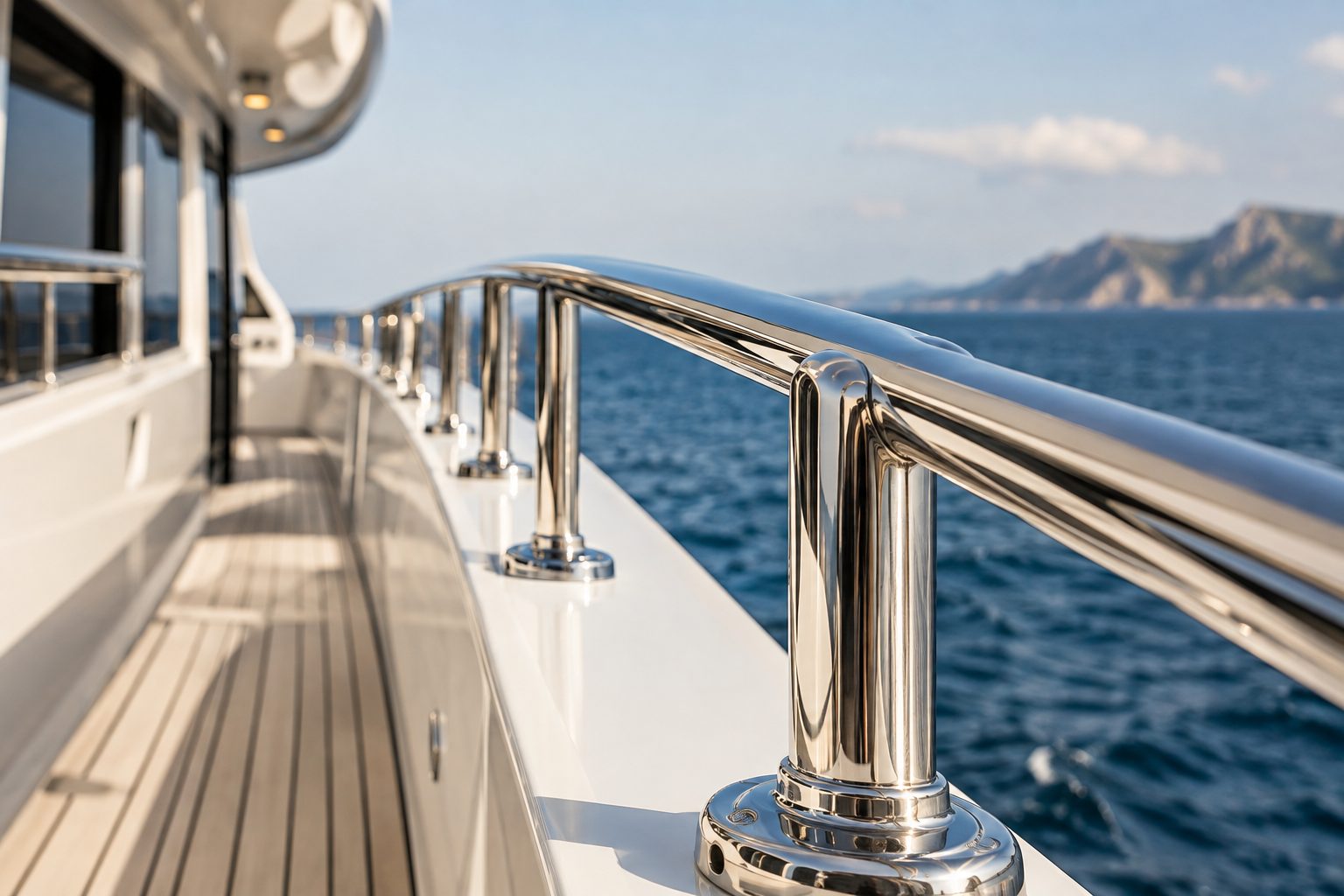
Large yachts carry a lot of surfaces that show neglect. Polished stainless rails, aluminum window frames, chrome fittings, varnished brightwork, teak decks and large areas of glass all need regular attention in a salt environment. Spotting, tea staining, pitting and haze build up faster than owners expect.
Each material needs its own method. Stainless and chrome respond to metal cleaners and polishes, with protective layers to slow the return of corrosion. Teak needs a gentle approach and the right product, because aggressive scrubbing wears away the soft grain. Glass needs a method that avoids scratching and leaves no residue. Our pages on stainless metal polishing, teak deck care and marine window glass cleaning describe the work.
On bigger vessels, access is part of the job. High topsides and flybridges may need staging, ladders or a lift, and the work is planned with the captain so that it is safe and does not interfere with other crew activities. We do not rush the high work, because a mistake at height is a safety matter.
Charter turnovers and quick resets
Some boats at Miami Beach Marina run charters, and a charter boat has to be turned around quickly between guests. A turnover is not a full detail. It is a focused reset that makes the boat feel clean and fresh for the next group: wiped surfaces, clean glass, tidy cockpit, sanitized head and galley and a quick wash of the decks.
The pressure of a turnover is time. The boat has a set window between one group leaving and another arriving, and the work has to fit inside it. We plan turnovers with the captain in advance, agree on a checklist and focus on what guests will see and touch. Our page on yacht charter turnover cleaning and the one on charter yacht detailing explain how this works.
We do not promise arrival windows, and we cannot fit a full detail into a short gap. We can offer a realistic plan and an honest assessment of what can be done in the time. For a boat with a heavy charter calendar, a regular schedule of turnovers with a larger detail during slow weeks is usually the best approach.
Interiors, humidity and delicate finishes
Interiors on larger boats often include fine wood, leather, stone, fabrics and carpet that are expensive and easy to damage. The wrong cleaner can stain, strip or dull a finish in a moment. A technician needs to know what the surfaces are before choosing a product, and when in doubt, the right step is to ask the crew or owner.
Humidity is the constant problem. A closed salon with air conditioning off holds moisture, and mildew can start on soft goods and in hidden places. Even on a boat with full-time crew, damp corners and lockers can hide growth. Our pages on interior detail and carpet and headliner cleaning explain what is cleaned and how.
If staining or damp suggests a leak, we will say so, because a leak is a repair and not a cleaning matter. Owners and crews can help by running air conditioning and dehumidifiers when possible and wiping up spills the day they happen. Our guide to yacht interior humidity control has more ideas.
How quotes work and how to start
Quotes are given only by phone. The right answer depends on the size and type of the vessel, its condition, the work you want, the access at the marina and the schedule. A website cannot answer those questions honestly. For complicated jobs, especially on larger vessels, we may suggest an on-site visit first. That visit has a service call charge, and we explain it on the phone before anyone is dispatched.
To make the call efficient, have the boat's length and type, the slip, what you want done, any problem areas, a few photographs and the name of the captain or manager who will arrange access. Tell us what you learned from the marina about vendor rules and whether there is a deadline, such as a charter, a survey or a sale.
If you are comparing detailers, our guides on how to choose a yacht detailer and what to ask before hiring one will help you ask the right questions of anyone, including us. When you are ready, call and tell us about your boat at Miami Beach Marina, and we will plan the visit with you and your crew.
Questions people ask
Do you work on large yachts and sportfish boats at Miami Beach Marina?
Yes. The marina has a wide mix of vessels, from sportfish boats and charter boats to large motor yachts. Each needs a different approach, so we begin by asking about the boat, its use and its crew. Larger vessels may need staging or lifts for high work, and we plan that with the captain.
Who arranges dock access for outside detailers?
Usually the captain, owner or yacht management company, who can confirm the marina's current rules and arrange any paperwork or gate access. We do not claim detailed knowledge of a marina's policies, because they change. We ask for what you learn from the marina office and plan the visit around it.
Can you turn a charter boat around between trips?
We can plan a focused turnover that resets the visible areas: surfaces, glass, cockpit, head, galley and decks. A turnover is not a full detail, and the time between groups limits what can be done. We agree on a checklist with the captain in advance and give an honest view of what fits.
Can you remove exhaust soot from the stern?
Usually we can improve it with the right cleaner and a careful approach. Strong products can damage gelcoat, paint or aluminum, so the method matters. If the soot has stained porous or oxidized surfaces, cleaning may lighten it without erasing it fully, and we will tell you what to expect.
How are quotes given?
Quotes are given only by phone, because the right answer depends on the vessel, its condition, the work you want and the access at the marina. Complicated jobs may need an on-site visit first. That visit carries a service call charge, which we explain on the phone before anyone is dispatched.
Do you promise a specific arrival time?
No. Marina traffic, weather, channel activity and earlier jobs all affect the day, so we do not promise arrival windows. We confirm the plan with you and the captain in advance, explain what to expect and tell you quickly if something changes. Calling early gives you the best chance of the day you want.
Describe the situation by phone and we will tell you what the job involves. Quotes are given by phone. Jobs that cannot be quoted without seeing them need a technician on site, and the service call charge is explained on the phone before anyone is dispatched.
(954) 719-3572Related pages
Preparing a larger vessel for a detailing visit
On a vessel of this size, preparation is half the work. A week or so ahead, the captain or manager can share a simple plan: which decks need attention, which finishes are delicate, and when the boat has no guests or owners aboard. The crew then brings the right number of people and the right gear. Items like fresh teak oil or new sealant should be flagged, since they need gentler handling. Anything that is already scheduled with another contractor, such as an engineer or electrician, should be noted so the teams do not get in each other's way.
Marina rules shape the day. Many facilities ask contractors to register, share documents, or follow specific procedures for water use and runoff. We ask the captain or marina office what is expected and follow it. We do not claim any credentials we do not have, and the captain should confirm directly with the marina what they require. Parking, loading and gangway access are worked out beforehand so equipment arrives where it should. A few calls ahead save a lot of waiting on the dock. Photos taken before and after, where the owner wants them, make it easy to see exactly what changed.
On the day, the crew checks in with the captain, walks the boat together, and confirms the scope again. Any area to avoid is marked, and any special products to use or not use are agreed. Throughout the work, the crew keeps decks tidy and stays out of crew quarters unless invited. At the end, a final walk with the captain points out what was done and anything noted, such as worn finishes or small defects. That record helps the crew plan the next visit and gives the owner useful facts.
Keeping guest-ready standards between charters and trips
When a boat is used often by guests, the difference between a good and an average impression is in the small things: clear glass, a spotless head, fresh cushions, and no sticky patches on the deck. A reset between trips focuses on exactly those. The crew works through a checklist suited to the vessel, adapting it to what the captain wants. Because every boat has its own quirks, the list is built with the person who knows it best, and refined after each visit as we learn which areas need more attention.
Timing between trips can be tight, so we plan with the captain and do not promise specific windows. What we can do is discuss what is realistic, prioritize the work that matters most to guests, and be honest if something cannot be done well in the time available. Rushing a polish or a deep clean often leaves marks or missed spots, and it is better to do a smaller set of tasks properly. Larger jobs can wait for a quieter stretch when the boat is empty.
Communication with the crew matters. A captain who tells us about spills, stains or complaints from the last trip helps us aim our effort. Notes about pet hair, sand, food spills or a smoker's cabin shape the products and tools used. After each visit, we leave a short summary so the next crew or the owner can see what was done. Over time, this record shows patterns, such as which areas wear fastest, and helps owners plan for deeper work during off-seasons. Asking questions at any point is welcome, and the crew would rather explain a step than have an owner wonder about it.