Why this stretch of the waterfront is different
The area around Haulover Marine Center sits close to the cut that connects the Intracoastal Waterway to the open Atlantic. That single fact shapes almost everything about the boats kept nearby. Owners here are often a few minutes from blue water, so boats are used more spontaneously than at a marina deep inside the bay. An open Saturday morning becomes an offshore trip, and the boat comes back with a coat of dried salt that nobody had time to rinse properly.
The second thing that sets this area apart is how much of it is a working boating facility rather than a purely residential marina. Boat yards, service shops, fuel docks and storage buildings sit side by side with slips. Boats come and go for repairs, bottom work, engine service, upholstery jobs and haul-outs. A vessel that spends part of the month in a yard collects a different kind of dirt from one that sits in a calm slip: sanding dust from neighboring jobs, grime from lift straps and trailers, grease from handling equipment, and the film that settles on anything stored near busy machinery.
A good detailing plan for a boat in this area has to account for both patterns. The first is the fast, salty, frequently used boat. The second is the boat that is moved around, stored, serviced and put back in the water. This page explains how we think about each one and what you can expect when you ask for a visit.
The owner rhythm: use, rinse, repeat
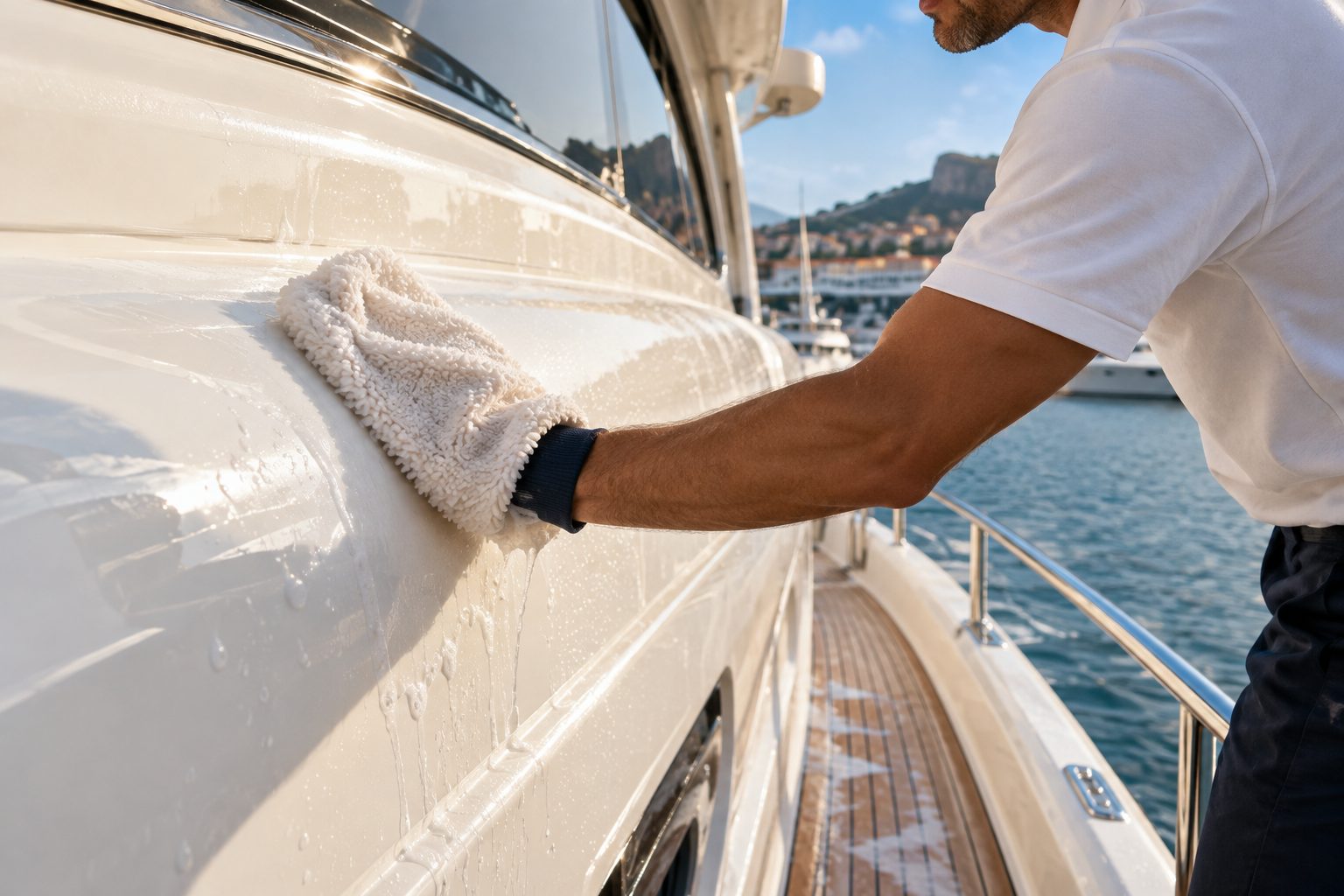
Most owners near the inlet fall into a pattern. The boat goes out, it comes back, and there is a quick fresh-water rinse at the dock or the wash rack if the day allows. Many owners are careful about this, and it helps a lot. But a quick rinse and a proper wash are different jobs. A rinse moves loose salt off horizontal surfaces. It does not lift the thin film that bonds to gelcoat, it does not clean the track of every sliding window, and it does not reach the underside of rails, the backs of cleats or the seams around hatches.
Over several weeks, that film builds. It dulls the surface, holds moisture against metal, and gives algae and mildew a foothold in the textured areas. Owners often describe the result in the same words: the boat looks fine from the dock, but up close it has lost its depth.
Our approach with owners in this area is to match the service to the rhythm. For a boat used every weekend, a regular wash-down with attention to the places a rinse misses usually does more good than occasional heavy correction. For a boat used a few times a season, the work leans toward a thorough restoration visit followed by protection that makes the owner's own rinsing more effective. We talk this through on the phone and shape the plan around how you actually use the vessel, not around a fixed menu.
Boats that come out of the yard
A boat returning from yard work is one of the most common reasons owners near Haulover call for detailing. The work might have been bottom paint, a prop and shaft job, an engine repair, new canvas, or simply a haul-out for inspection. Whatever the reason, the vessel often comes back looking worse above the waterline than it did before it left.
The reasons are practical. Sanding on neighboring boats puts fine dust into the air, and that dust settles into non-skid, canvas seams and the tracks of windows and hatches. Lift straps can leave marks along the hull. Rubber fenders and chocks leave dark scuffs. Pressure washing of bottoms throws a mist of growth and old paint residue onto topsides that are sitting nearby. Overspray from paint work can travel farther than people expect, and it bonds to gelcoat if it is left to cure.
A post-haul-out detail starts with an honest inspection. We look at what has landed on the surface and what is simply dirt. Dust and grime come off with the right wash and the right pads. Residue that has bonded may need a careful clay step before polishing. If something looks like damage rather than dirt, we say so and leave it for a yard or a repair specialist rather than rubbing at it. You can read more about this kind of visit on our post haul-out detailing page.
Dry stack and rack storage nearby
Dry stack storage is common around this part of the coast, and it changes how a boat gets dirty. A boat on a rack is out of the water, which keeps the bottom clean, but it sits in a covered or semi-open building where airborne salt, dust and exhaust from forklifts and neighboring boats settle on the hull. It is launched on request, used, and returned. The cycle of being lifted, set down and stacked brings its own marks: strap lines, contact points where cradles meet the hull, and scuffs from tight handling.
Detailing a boat that lives on a rack takes coordination. Many facilities have rules about when and where outside vendors can work. Some will lower the boat to a wash area. Some prefer work to happen after a trip, when the boat is in the water or on a dock. Some limit chemicals, water use or noise. We ask these questions up front and follow whatever the facility requires.
If your boat is stored this way, tell us on the call which facility and which rack arrangement you use. We will talk through how to schedule around the launch process. For a broader look at how this works across several marinas, see our page on dry stack marinas.
Salt air, metal and the places rinsing misses
Saltier air near the inlet means more work for anything made of metal. Stainless steel is not rust-proof, and in a marine environment it develops surface staining, often called tea staining, when salt sits on it. Aluminum pits and turns chalky. Chrome-plated parts can blister if the plating is breached. Hardware near the water, such as cleats, rails, stanchion bases, hinges and latches, takes the brunt of it.
A detail focused on metals starts with cleaning, because polish applied over salt scratches rather than shines. Once the surface is clean, we decide whether it needs light polishing, a more thorough restoration, or just a protective layer. Heavy pitting cannot be polished away, and we will tell you when a part is past the point where detailing can help. Where it can help, the improvement is often the most visible change on the boat.
You can see how we approach this on our bright work and metals page. The key message for boats near open water is that metals reward regular attention. A short maintenance visit every so often protects the finish far better than waiting until staining has set in.
Hull, topsides and gelcoat in a high-use setting
Gelcoat is a hard but porous surface. Over years of sun and salt it oxidizes, which shows up as a chalky, faded look, particularly on darker colors and on surfaces facing the sky. Boats that are used heavily and exposed to strong sun may show this sooner than boats that are covered most of the time. Boats kept under cover or inside a building may look better overall but can collect streaks where moisture and grime run down from the same spots.
A typical plan for a high-use boat begins with a thorough wash, followed by an assessment of the finish. If the surface is only lightly oxidized, a polish and a protective layer may bring back depth. If the oxidation is heavy, compounding comes first. Our gelcoat oxidation removal page explains what that step involves and when it makes sense.
After correction, the protection layer matters as much as the polish. A wax, a sealant or a ceramic coating each behave differently. Wax is easy to apply and does not last as long. Ceramic coatings form a harder layer that resists staining and makes washing easier, but they still need proper maintenance. We explain the differences in plain terms on the phone so you can choose what suits how you use the boat.
Canvas, upholstery and the cockpit
Boats that spend a lot of time in the sun and salt wear out their soft goods quickly. Vinyl seats fade and crack. Stitching weakens. Canvas picks up mildew in the folds, and isinglass clouds and scratches if it is wiped with the wrong cloth. Sunscreen and fuel stains show up on cushions after a day offshore, and dirty hands leave marks on white upholstery.
Cleaning soft goods is a delicate job. Harsh cleaners can strip protective coatings or damage stitching. Brushing too hard can raise the nap on fabrics and scratch clear vinyl. We use gentler approaches first and step up only when needed. Stains that have been sitting for months may lighten but not vanish, and we tell you what is realistic before we begin.
The cockpit also collects fish residue, bait, drink spills and the general mess of a day offshore. Residue left to dry attracts insects and breeds odors. A cockpit-focused visit after a weekend of heavy use is a practical way to keep the boat pleasant. See cockpit and flybridge detailing for what that includes.
Interiors on boats that are used hard
A boat that is closed up between trips can develop a stale smell, especially in humid weather. Air conditioning that is switched off, a damp towel left in a locker, a wet bilge or a small leak can all lead to mildew. Once mildew starts in carpet, headliners or cushions, it spreads in the dark and moves slowly into the areas where air does not circulate.
Interior detailing starts with finding the source. Cleaning a surface without fixing the moisture that feeds the problem only buys time. We look at the bilge, the lockers, the hatches, the drains and the air flow, and we report what we see. Where the cause is plumbing, a leak or a mechanical fault, we point you to the right trade. Where it is a cleaning matter, we handle it.
For owners who want to keep the interior in good shape between visits, simple habits help: run the air conditioning or a dehumidifier when you can, leave lockers cracked open, take wet items home, and wipe down the head after use. Our interior mildew treatment page covers the process in more detail.
What to arrange before we arrive
A little preparation makes a visit smoother. Tell us which dock, slip, rack or yard bay the boat is in, and whether there is a gate access procedure or a sign-in requirement. Many facilities ask outside vendors to register or show proof of insurance, and it is easier to sort that out before the day than at the gate. If the boat is in a yard, ask the office whether outside work is permitted on the premises.
Let us know about power and fresh water. Some work needs a hookup, and some slips or yard bays do not have convenient access. Tell us if the boat will be occupied, if there is a captain or crew on board, and whether any areas are off limits. If you want particular items left alone, such as a freshly sealed surface or items stowed on deck, say so in advance.
Clear the decks of loose personal items where you can, and leave keys or access arrangements with someone who can let us on board. If the weather is likely to interfere, we discuss rescheduling rather than rushing the work. We do not promise arrival windows because tides, traffic and facility schedules vary, but we keep you informed as the day develops.
How the call works and what to expect
Pricing is given only by phone. We do not post rates, because the right answer depends on the size of the boat, its condition, where it is kept and what you want done. On the call we ask a few questions: the length and type of vessel, the facility, what you are seeing on the surface, and how the boat is used. Straightforward jobs can often be discussed in a single conversation.
Complicated jobs need an on-site visit so we can look at the finish in person. There is a service call charge for that visit, and it is explained on the phone before anyone is dispatched. We prefer that you know the terms before you commit to anything.
If your boat is near Haulover Marine Center and you are not sure where to start, call and describe what you see. Whether it is salt that will not rinse off, a boat back from the yard, or a plan for the season ahead, we will talk it through and suggest a sensible next step. Call whenever you are ready.
Questions people ask
Do you detail boats stored at yards or on dry stack racks near Haulover?
Yes, as long as the facility allows outside vendors. Rules differ by location, so tell us which facility and which storage arrangement your boat uses when you call. We ask about sign-in, insurance requirements, water access and permitted working hours, and we schedule around the launch process wherever we can.
My boat just came back from the yard. What should I check first?
Look at the topsides, canvas seams and window tracks for sanding dust, grime and overspray. Check for scuffs from straps and fenders. Do not rub at anything that looks bonded, because that can scratch the gelcoat. Describe what you see on the phone and we will suggest whether it is dirt that washes off or residue that needs a careful approach.
How often should a boat used near the inlet be washed?
There is no single schedule. A boat used often in salt water benefits from regular fresh-water rinsing after each trip and a deeper wash at intervals that match your use. We talk through how you use the boat and suggest a rhythm that fits, rather than a fixed interval, because condition and exposure vary widely.
Can you remove stains from stainless steel and aluminum?
Often, yes. Surface tea staining and light chalking usually clean and polish well. Deep pitting is different, because it is damage in the metal rather than dirt on top of it. We examine the part, tell you what detailing can realistically achieve, and say so if it is beyond what polishing can fix.
Do I need to be on the boat while you work?
Not always. Many owners arrange access with the marina, a captain or a crew member and leave us to it. We do ask for clear instructions about where to work, what to leave alone and how to reach you if a question comes up. For a first visit, some owners prefer to be present for a short walk-through.
How do I get a quote?
By phone. We do not publish rates because they depend on the vessel, the condition and the facility. Describe your boat and what you want done, and we will talk it through. Larger or more complicated jobs need an on-site visit, and the service call charge for that is explained on the phone before dispatch.
Describe the situation by phone and we will tell you what the job involves. Quotes are given by phone. Jobs that cannot be quoted without seeing them need a technician on site, and the service call charge is explained on the phone before anyone is dispatched.
(954) 719-3572