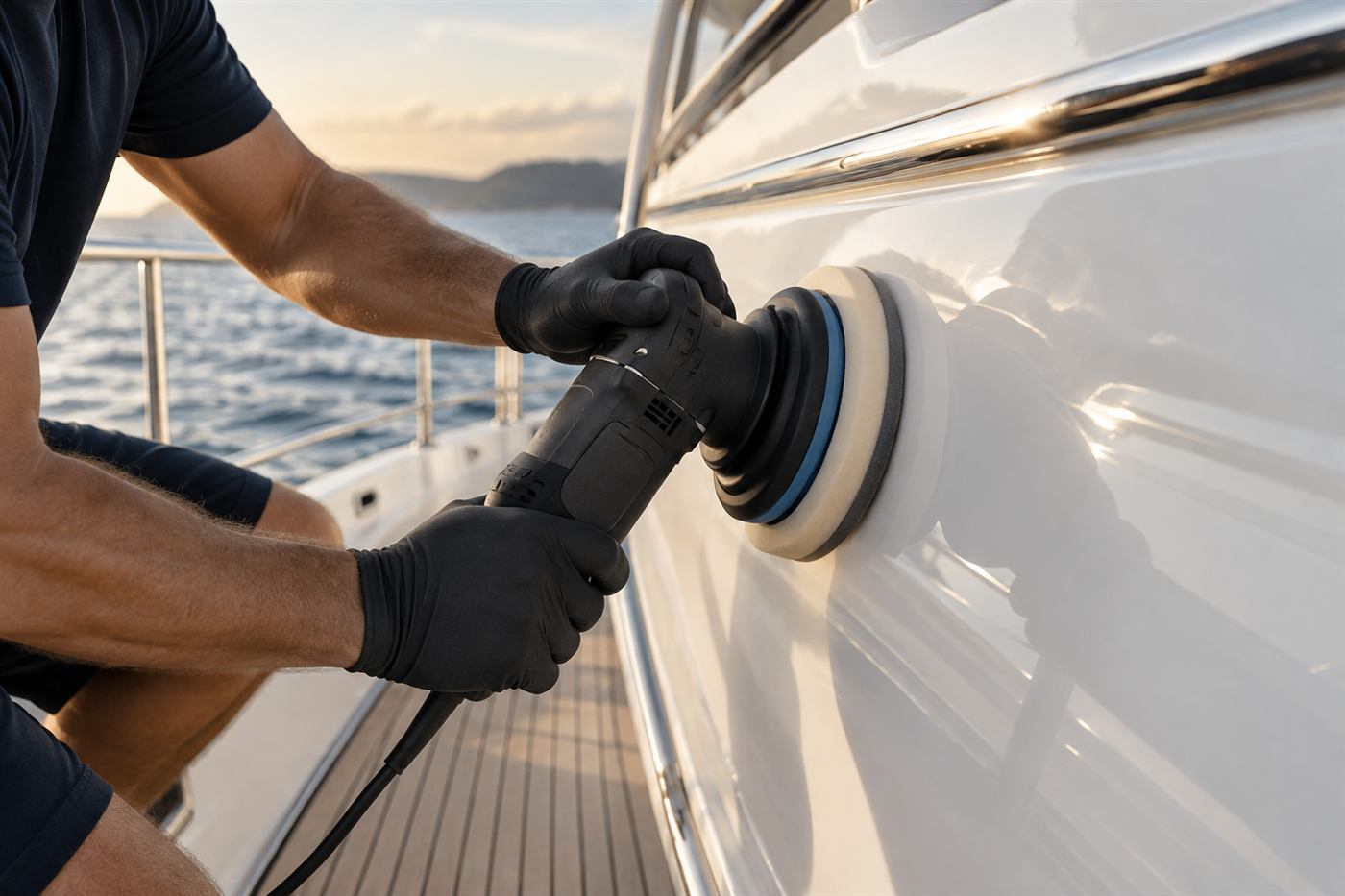
What detailing does and does not do for storm readiness
Start with the most important point. A storm plan is about safety and seamanship: where the vessel will be kept, how it will be secured, who will handle it and when decisions will be made. Those decisions belong to the owner, the captain, the marina or yard and, in the case of mandatory evacuations, the authorities. Cleaning and waxing do not change any of this, and a detailer who implied otherwise would be misleading you.
What detailing does is prepare the vessel's surfaces for a long, harsh season. The months from June through November bring intense sun, daily humidity, frequent rain and, at times, salt-laden winds. A vessel that begins the season clean and protected resists staining, mildew and oxidation better than one that begins it neglected. Hull sides, glass, stainless, canvas, teak and the interior all benefit from a pre-season reset.
Detailing also helps with inspection. A clean boat reveals its condition. Cracked caulk, weeping fittings, loose hardware, worn canvas and early corrosion are easier to spot when surfaces are clean, and catching them before the season gives you time to have them repaired. In this sense, pre-season detailing is a companion to a proper storm plan, not a substitute for one. Our guide on hurricane season yacht preparation goes into the planning side.
The South Florida season in plain terms
The Atlantic hurricane season runs from the start of June through the end of November, with the most active period typically late summer into early fall. For a vessel in Fort Lauderdale, Miami or Palm Beach, it also coincides with the hottest, wettest and most humid months of the year. Even in a year with no named storm affecting the area, the season is hard on boats.
Heat and UV accelerate oxidation of gelcoat and the breakdown of vinyl, canvas and sealants. Humidity feeds mildew inside the cabin, especially on boats that are closed up. Frequent rain washes dust and airborne pollutants onto the hull, leaving streaks and spots. Afternoon storms bring wind and rain that can force water through weak seals. Seasonal residents often leave their vessels for the summer, which means the boat sits closed in the heat for months.
Understanding this pattern helps you decide what to do before the season begins. A detail in late spring that cleans, protects and sets up airflow addresses the most predictable problems. Our guide on summer heat and UV on boats explains the sun side in more depth, and the South Florida boating season calendar shows how the year breaks down.
Cleaning and protecting the exterior before the season
A thorough exterior wash removes the winter's accumulation of salt, dust and grime, and prepares the surfaces for protection. Hull sides should be washed, and if oxidation is present, compounded and polished to restore the finish. Our page on compound and polish explains this. Once the gelcoat is clean, a wax, sealant or ceramic coating gives it a barrier against UV and staining. The guide to wax, sealant and ceramic compared helps with the choice.
Stainless steel and other metals benefit from cleaning and protection before the humid months, which are the most aggressive for tea staining and pitting. Glass should be cleaned and treated so that rain sheets off instead of leaving spots. Non-skid decks should be cleaned thoroughly, since algae grows quickly in summer wet and makes decks slippery. Teak should be cleaned and, if you use a sealer, refreshed.
Canvas, isinglass and vinyl deserve attention too. They should be cleaned and dried completely before any protectant is applied. Check stitching, zippers and snaps while you are there. If a canvas enclosure is worn, address it before the season, because torn canvas can flap in wind and cause damage. Our guide on protecting canvas and enclosures has more.
Interior preparation: humidity and mildew control
For many yachts, the interior is where summer does the most harm. A closed cabin in humid heat will grow mildew within weeks unless air is moving and moisture is controlled. Pre-season interior detailing should include a thorough cleaning of all surfaces, cushions, carpet and headliners, followed by steps to keep the cabin dry.
Clean and dry lockers, remove perishable items, empty and prop open the ice box and refrigerator, and clean the head and galley. Remove any damp gear. Set up airflow: if the vessel will be on shore power, an air conditioning unit with a humidistat or a dehumidifier running on a schedule is among the best defenses. If the vessel will be without power, solar vents or battery fans can help. Prop cushions on end, crack open lockers and keep louvers clear.
Our pages on interior mildew treatment and odor removal explain what happens when these steps are skipped, and our guide on yacht interior humidity control covers equipment and routines. Be aware that a dehumidifier or air conditioner depends on power, and a storm can interrupt it. Plan for what happens if the power fails, and do not rely on any single measure.
What owners and captains handle: the storm plan
The real work of storm preparation is done by owners, captains and marina or yard staff, and it follows the vessel's insurance requirements, the marina's rules and the vessel's circumstances. A detailer is not the right person to design or perform it. It is useful, though, to understand how detailing fits around it, so here is a short outline of what a storm plan usually considers. Please follow your insurer, marina and local authorities, and consult a qualified professional.
Typical questions an owner or captain addresses include where the vessel will be kept during a named storm, whether it will be hauled, moved to a protected location or left in the water, how it will be secured, who is responsible for it and when decisions must be made. Other items are removing canvas and loose equipment from the deck and flybridge, checking and doubling dock lines and chafe protection, arranging fuel and batteries, closing seacocks that should be closed, checking bilge pumps and arranging for someone to look at the vessel after the storm.
These are safety and seamanship decisions, and they should be made well before a storm is in the forecast. Many marinas require owners to submit a storm plan, and insurers may have conditions. If you do not have a plan, ask your captain, marina or insurance agent. Do not rely on a detailer for this advice. When the weather is a threat, follow official guidance and put people's safety first.
Taking photos and notes before the season
A pre-season detail is a good time to document the vessel's condition. Clean surfaces photograph clearly, and a set of photos taken before the season creates a record of how the boat looked. If a storm or any other event causes damage, photos from before help show what changed. Insurers and surveyors often ask for this sort of evidence.
Photograph the hull from all sides, the deck, the cockpit, the helm, the interior spaces, the engine room and any existing damage or repairs. Take close-ups of fittings, stainless, canvas, electronics and anything of value. Record the date and keep the files somewhere you can reach even if you cannot reach the boat, such as cloud storage. Note the serial numbers of major equipment.
A detailer can provide photos of what was found and what was done as part of a visit, which adds to your record. It is the owner's responsibility to keep the documentation and share it with an insurer if needed. We make no claims about what any insurer will accept, but good records can only help. Our page on protecting yacht resale value also touches on record keeping.
Laying up or leaving for the summer
Many South Florida yachts are left unattended for part or all of the summer because their owners are away. A closed boat in heat and humidity needs a deliberate plan. Before leaving, give the vessel a complete clean, with attention to the interior, the bilge, the head and the galley. Remove food, trash and anything that can rot or ferment. Empty and clean the ice box and refrigerator, and leave doors ajar.
Arrange for someone to check the boat regularly, such as a captain, a manager or a trusted service. Regular visits allow air to move, catch leaks and keep the pumps and power systems under watch. Our page on recurring yacht detailing programs describes how periodic visits can be arranged, and the guide to boat storage and cover care explains covers and storage methods.
Think about cleaning the hull and deck at intervals, since dust, bird droppings and rain residue accumulate. A boat that returns in autumn with deposits baked on by months of sun is harder to restore than one that was washed along the way. A modest, regular schedule is nearly always better than one big clean at the end.
After a storm: what cleaning looks like
If a storm does pass through, the first priority is safety. Do not approach a vessel until officials say it is safe, and expect to find hazards: debris, damaged fittings, sunken or displaced vessels, fuel in the water and downed power. Inspection and any damage assessment belong to the owner, captain, marina and insurer, and any serious damage should be documented and reported before cleaning.
Once it is safe, cleaning follows. Salt spray, windblown debris, leaves, mud and sometimes oily residue may cover the hull and deck. Interiors may need attention if water got in. Our guide on after-a-storm yacht cleaning explains the process. An important point is not to clean away evidence of damage before it is photographed and reported.
Water intrusion needs extra attention because wet carpet, cushions and panels can grow mildew quickly in the heat. Air movement and drying come first, and a technician can help with cleaning once things are drying. Structural, mechanical and electrical damage is for marine professionals. A detailer's role is to restore the surfaces once the vessel is safe and assessed.
How the call goes and what to have ready
Pricing for pre-season detailing is given only by phone, after a few questions about the vessel and your goals. Larger or more complicated jobs may need an on-site visit first. A service call charge applies for that visit and is explained on the phone before anyone is dispatched. Do not wait until a storm is in the forecast to call, since demand rises and conditions limit what can be done safely.
Have these details ready: the vessel type and approximate length, where it is kept, whether you plan to leave for the summer, what condition the surfaces are in, whether there is shore power for the cabin, and whether you already have a storm plan. If you are leaving the boat, tell us who will be checking on it.
We cannot promise arrival times, particularly when weather is a factor, but we can plan ahead. When you are ready to set up your pre-season preparation, call the number on this page.
Questions people ask
Can detailing protect my yacht from a hurricane?
No. Storm protection depends on where the vessel is kept, how it is secured and decisions made by the owner, captain, marina and insurer. Detailing cleans and protects surfaces for the harsh season and makes inspection easier, but it does not make a yacht storm-proof.
When is the best time to do pre-season detailing?
Late spring, before the heat and humidity build and before storm activity picks up. Doing it early gives you time to fix anything it reveals. Leaving it until a storm is forecast is not wise, because conditions can make work unsafe and schedules get crowded.
Will a coating or wax stop mildew inside the cabin?
Not by itself. Exterior protection helps the outside surfaces. Mildew inside depends on moisture and airflow, so cleaning, a dehumidifier or air conditioning on a schedule, propped cushions and open lockers matter more. Power can fail in a storm, so do not rely on a single measure.
Should I clean the boat before leaving for the summer?
Yes, a thorough clean before you leave helps. Remove food and damp items, clean the ice box and head, and set up airflow. Arrange for someone to check the boat regularly. A periodic wash during the summer is usually better than one large clean on your return.
Do you help with storm plans or securing the boat?
No. Storm plans and securing a vessel are safety and seamanship matters for the owner, captain, marina or yard, and insurer. We can clean and protect the surfaces, provide photos for your records and help restore the vessel after a storm once it is safe and assessed.
How do I book pre-season detailing?
Call the number on this page. Quotes are given only by phone, after questions about the vessel, its location and your plans. Larger jobs may need an on-site visit, with a service call charge explained before anyone is dispatched. Please call well before a storm is forecast.
Describe the situation by phone and we will tell you what the job involves. Quotes are given by phone. Jobs that cannot be quoted without seeing them need a technician on site, and the service call charge is explained on the phone before anyone is dispatched.
(954) 719-3572Related pages
A wash before the season is also a walk-around
A pre-season washdown has a second purpose that is easy to miss: it forces someone to put hands and eyes on every part of the boat. While the crew is working along the rails, around the hatches and over the canvas, they see things a casual glance misses, such as chafed lines, frayed cover edges, a loose stanchion base, dried-out sealant or a hatch gasket that no longer seats. None of these are detailing jobs, but they are exactly the items you would want to know about before a named storm is on the forecast.
We make notes of what we see and pass them along in plain terms, without turning it into an inspection or claiming expertise we do not hold. A list might read: canvas stitching looks worn at the corner, one cleat bolt head shows rust staining, the lazarette latch is stiff. You can then forward the relevant items to a rigger, canvas maker or mechanic while there is still time. A clean boat also makes it easier for those tradespeople to see what they are dealing with, which tends to speed up their work.
Timing matters because everyone wants the same services in the same few weeks. Boat yards, riggers and detailers all get busy when a storm approaches, and the best time to do preparation is long before anyone is watching the forecast. A routine that starts early in the season, with a sensible gap between steps, avoids the scramble. If you wait until a storm is close, cleaning becomes a lower priority than securing the vessel, and that is exactly as it should be. If anything looks different once the work starts, we stop and talk it through first.
Loose items, covers and the things that become projectiles
In strong wind, anything that is not fastened down becomes a hazard to your boat and to the ones around it. Cushions, cockpit cushions, fenders, boat hooks, cleaning gear, chairs and loose canvas should all be gathered and stored below or ashore well before the weather turns. A cleaning crew can help with this during the pre-season visit by identifying what is typically left outside, but the decisions about what comes off, where it goes and who secures it belong to the owner or captain and their storm plan.
Covers deserve special thought. Fitted covers that have been left on all summer collect dirt, mildew and bird droppings and may trap moisture against the finish. Cleaning and drying them, then checking that they close properly, is useful. Whether a cover stays on during a storm, however, is a call for you and the marina, because a loose or flapping cover can cause more harm than good. We will not make that judgment for you, but we can clean and fold them so they are ready if you need them.
After you have decided what moves and what stays, a short written list on board helps anyone who steps in later. Include where the cushions are stored, which lockers hold the extra lines and who has the keys. If the boat is in a condo marina or a shared dock, share the same list with the dockmaster. Clear information reduces the number of hurried decisions, and it means that cleaning, storage and securing can each be done properly without stepping on each other. If anything looks different once the work starts, we stop and talk it through first.