Why a lived-in trawler is a different job
A weekend cruiser sits closed and dry for most of the week. A liveaboard trawler is the opposite. Cooking steam, showers, damp towels, wet shoes and the simple fact of several people breathing in a sealed cabin push moisture into the air all day long. In South Florida, where outdoor humidity is already high for much of the year, that moisture has nowhere easy to go. It settles on cold surfaces, collects behind cabinetry and in the bilge, and feeds mildew in the corners you do not look at every day.
Trawlers also tend to be built with a lot of interior volume. Full-displacement hulls and wide beams give a salon, a galley, one or more staterooms, heads and often a pilothouse with its own seating and electronics. All of that is living space, and all of it collects the residue of daily life: cooking grease on the galley overhead, skin oil on cushions, salt tracked in on shoes, pet hair in the carpet. A detailer working on a liveaboard is closer to a house cleaner with marine training than to a person who simply polishes gelcoat.
- People are present, so noise, chemical smell and access all have to be planned.
- Belongings are everywhere, so a technician cannot simply move and wipe.
- Moisture is constant, so cleaning without moisture control gives only short relief.
- The boat is often the owner's only home, so mistakes are felt immediately.
Working around the household
The first conversation with a liveaboard owner is about logistics, not products. Who is aboard on the day of the visit? Are there pets? Is anyone working from the salon? Does the owner want the technician to work while they are out, or stay and answer questions? Some owners prefer to have the boat to themselves for a few hours, others want to be nearby in case a decision comes up about moving a personal item. Either way works, but it needs to be settled before anyone steps aboard.
Pets deserve a mention. Cats and dogs are common on trawlers, and some products are not appropriate to use while an animal is in a small space. Tell the person on the phone about any animals, any allergies in the household, and any sensitivity to fragrance. A good detailer can choose lower-odor products, ventilate between steps and sequence the work so the animals can stay in a part of the boat that is not being treated.
Finally, think about the power and water situation. Many liveaboards are on shore power and dock water, but some are at anchor or on a mooring and come in only occasionally. Say which one applies. It affects what equipment a technician can bring, how the job is laid out and whether it is practical to do interior and exterior work on the same visit.
The galley: grease, odor and surfaces
The galley is where a lived-in boat shows its age fastest. Cooking grease travels as a fine mist and lands on the overhead, the cabinet faces, the hood and the backs of handles. It then attracts dust and salt, and the combination turns into a tacky film that is hard to see until you wipe a clean spot beside it. Standard spray cleaners often smear this film rather than lifting it, and aggressive degreasers can dull laminate, stain teak veneer or attack the finish on varnished trim.
A careful galley cleaning works from the top down. Overhead and cabinet faces are treated first with a product matched to the surface, then countertops, sinks, the stove and the refrigerator or ice box are cleaned. The refrigerator deserves extra attention on a boat because door gaskets and drain troughs collect moisture and growth. Odor that seems to come from the galley often starts in the drain, the sink trap or the area behind the fridge, not on a visible surface.
Owners can help by emptying the refrigerator and clearing countertops before the visit if they can. Anything they would rather the technician not touch, such as spice racks, fragile dishes or personal papers, should be set aside or pointed out up front.
- Clear counters and the refrigerator if you are comfortable doing so.
- Point out surfaces with unknown finishes, such as old varnish or painted laminate.
- Tell the technician about any past water leaks near the galley.
- Ask what will be used on food-contact surfaces and how it is rinsed.
Heads, showers and sanitizing
Marine heads on a liveaboard are in constant use, and they combine moisture, soap residue, hair and sometimes a closed door that keeps air from moving. Pink and black growth appears on shower pans, caulk lines and the seals around hatches. Odor from a head is more complicated than a dirty bowl. It can come from the hose run, from sump areas, from a worn gasket or from damp material nearby, and a thorough cleaning looks at all of those.
A detailer can sanitize fixtures, scrub and treat caulk and grout lines, clean the sole and the door tracks and wipe down surrounding cabinetry. Anything that involves removing hoses, servicing the head pump or addressing a holding tank belongs to a marine mechanic or plumber, not to a cleaning visit. A good technician will tell you plainly when a smell points to a mechanical cause rather than a cleaning one, and will not mask it with fragrance.
If you have been living aboard for a while and the head smell returns within days of cleaning, that pattern is useful information. Mention it on the phone. See the guide on head and galley sanitizing for more on how that service is handled.
Long-term mildew control
Cleaning mildew away is the easy part. Keeping it away on a boat people live on is the real project. The same dampness that created the problem is still there after the visit, so a good plan combines cleaning with simple habits and some equipment choices. Dehumidifiers, small air movers, opened lockers, louvered doors and cushions stood on edge all help air reach surfaces that otherwise stay damp. Gentle ventilation matters more than any product.
Technicians look for the places where mildew reliably returns: under mattresses against the hull, behind cushions on the outboard side of a settee, inside hanging lockers, along the inside of hull ports, and in the bilge access areas. These are all cool surfaces where warm moist air condenses. A mattress with no airflow underneath can grow mildew on its underside in a matter of weeks in humid conditions.
A detailer can clean and treat these areas, but cannot change how air moves on your boat. The most helpful thing an owner can do is to pick a routine, such as running a dehumidifier while the boat is closed and lifting mattresses weekly, and to keep it going. For more on the science of this, read about interior humidity control.
- Lift mattresses and cushions regularly so the hull side can dry.
- Leave lockers and drawers slightly open when you are away from the boat.
- Run a dehumidifier or air conditioning with a good drain whenever the boat is closed.
- Wipe condensation from hull ports and windows instead of letting it sit.
- Report any fresh leak right away, because a damp headliner will bloom quickly.
Carpet, headliner and soft furnishings
Soft goods hold the story of a boat. Salon carpet takes in tracked-in salt, spilled food and pet dander. Headliners collect cooking steam and, in older boats, can sag or stain around leaky fittings. Cushions carry skin oil, sunscreen and moisture. Fabric and foam that stays damp is the quickest path to a stubborn musty smell.
Cleaning method matters. Heavy soaking of carpet or upholstery on a boat is rarely wise because it can take days to dry in a closed cabin and may create the very problem the cleaning was meant to solve. Technicians use controlled extraction and low-moisture methods, and they will tell you if a particular item, such as an old foam cushion that has absorbed moisture for years, is better replaced than cleaned. A headliner needs gentle handling because the backing and adhesive can fail if overwetted.
Read more about how this work is approached in the pages on carpet and headliner cleaning and interior mildew treatment.
Exterior work on a trawler
Trawlers are often tall, with a wide boat deck, a bridge deck, a pilothouse and sometimes a Portuguese bridge or wing stations. The topsides can be gelcoat or paint, and many older trawlers have a mix of finishes, such as painted wood, varnished rails, aluminum window frames and stainless hardware. The sheer variety means the exterior package needs to be written down surface by surface so that nothing is treated with a product that does not suit it.
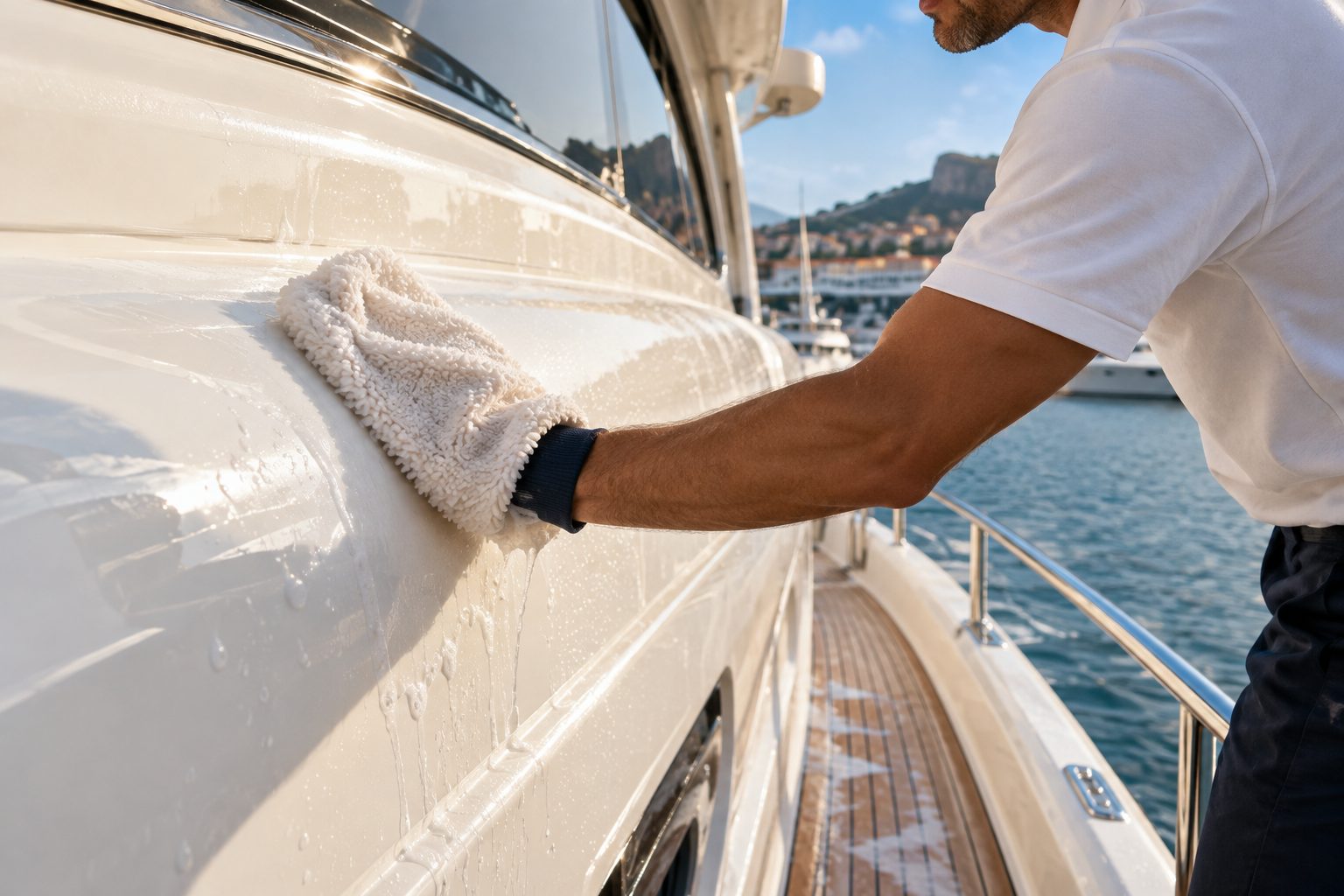
Because trawlers move slowly and may sit for long periods, they collect waterline growth, rust runs from deck hardware and black streaks from the stack and the exhaust. Salt and dirt build up on flat decks. Many owners schedule the exterior on a recurring basis and the interior on a separate plan, because the tasks and the rhythm are different. A regular exterior wash-down keeps salt from working into the finish, while periodic compounding and polishing restores the gelcoat when it has dulled.
If your trawler has teak, canvas or isinglass, say so. Those materials need their own approach and are not touched by a general wash. See teak deck care if your boat has a teak cockpit or aft deck.
Scheduling and recurring service for liveaboards
Because a liveaboard does not have a quiet season, scheduling works best as a rhythm, not a rescue. Some owners book a thorough deep detail to reset the boat, then move to a lighter recurring visit. Others split the work: exteriors every so often, interiors on a different cycle, galley and heads more frequently. A recurring maintenance plan is explained by phone, and the schedule depends on how the boat is used, how many people live aboard and how close you are to open water.
Plan around the marina as well. Many marinas have rules about what can be done at the dock, how water is used and where runoff goes. Technicians who work in South Florida marinas are used to these rules, but your own marina may have its own. Read about dockside detailing and marina rules before the visit and share any specific notice from your dockmaster.
Hurricane season changes the calendar. Liveaboards face real decisions about whether to stay, move or haul out. Detailing is not a part of storm decisions, but cleaning after a storm often is. See the guide on cleaning after a storm.
What to have ready and how the call goes
When you call, expect a few simple questions. What kind of boat is it, and roughly how long? Where is it docked? Do people live aboard, and are there pets? What are the main concerns, whether that is odor, mildew, a worn exterior or all of the above? Is there shore power and water at the slip? Quotes are given only by phone. A simple job can be quoted from the conversation. A larger or more complicated trawler job may need an on-site visit first, and there is a service call charge that is explained on the phone before anyone is dispatched.
Have a rough list ready of the areas you care about most, and mention anything delicate: antique fixtures, unsealed wood, items of sentimental value, electronics at the helm. Keep personal papers and valuables put away. If you have a marina requirement, such as proof of insurance for outside contractors, mention it so that it can be handled in advance.
A liveaboard owner often knows their boat better than anyone. Share what you have noticed: the spot that always grows mildew, the cabinet that smells after rain, the hatch that seeps. That knowledge saves time and leads to a more accurate plan. When you are ready, call and describe your trawler and how you use it.
Questions people ask
Can the work be done while I am living aboard?
Usually yes, with planning. Interior work is easiest when you can leave for part of the visit, but many owners stay on board, particularly for exterior work. Tell the person on the phone who and what will be aboard, including pets, and the sequence can be arranged so you are not displaced from the whole boat at once.
Why does mildew keep coming back after cleaning?
Because the moisture source is still there. Cleaning removes the growth but not the damp air. Ventilation, a dehumidifier, lifting mattresses and fixing leaks are what keep it away. A detailer can clean and treat the usual trouble spots, but ongoing airflow in a lived-in boat is the long-term answer.
Will you move or handle my personal belongings?
Technicians generally avoid moving personal items beyond what is needed to clean around them. For a thorough interior job it helps if you clear counters, lockers you want cleaned and anything fragile or valuable ahead of time. Point out anything you would rather not be touched.
Do you clean the holding tank or repair the head?
No. Detailing covers cleaning and sanitizing surfaces, fixtures and surrounding areas. Pumping, hose replacement and repairs to head or tank systems belong to a marine mechanic or plumber. A technician can tell you when an odor seems mechanical so you know whom to call next.
Is a trawler detail priced differently from a smaller boat?
Quotes are given only by phone and depend on the size of the vessel, the scope of work and the condition. Simple jobs can be quoted on the call. Larger or more complicated work may need an on-site visit, and the service call charge is explained before anyone is dispatched.
Should I schedule interior and exterior work together?
It depends on how you live. Some owners prefer one longer visit to reset the boat, others split interior and exterior onto different dates to keep disruption low. Describe your routine on the phone and the visits can be arranged to fit around work, pets and your marina's rules.
Describe the situation by phone and we will tell you what the job involves. Quotes are given by phone. Jobs that cannot be quoted without seeing them need a technician on site, and the service call charge is explained on the phone before anyone is dispatched.
(954) 719-3572Related pages
Condensation, ventilation and the air inside a sealed hull
A trawler or liveaboard that is lived in all year has a particular relationship with moisture. Cooking, showering, breathing and drying clothes all add water to the air, and a tightly closed hull holds it in. In South Florida, outside humidity makes the problem worse. Windows can fog, cold surfaces can drip, and corners behind cushions can stay damp. Mildew grows in those spots, which is why cleaning alone is not enough without some thought about airflow. Honest notes at the end of the day matter as much as the cleaning itself.
We look at how air moves through the boat. Open hatches, working fans, vents and dehumidifiers can all help, and the best choice depends on how the boat is used and whether it sits at the dock with shore power. We do not install equipment, but we can point out spots where air does not circulate and suggest simple habits such as opening lockers, lifting mattresses or leaving doors ajar. These are small changes, and they often make the biggest difference to how the cabin smells and feels.
During cleaning, we focus on the places where moisture and mildew meet: behind seating, under bunks, inside lockers, around windows and along hull sides. We use methods that remove growth without soaking fabrics or wood, and we avoid products that would leave strong odors in a space where people sleep. We explain what we plan to use before we begin, and we ask about allergies or sensitivities. A cabin that feels fresh is usually the result of both cleaning and steady airflow. Nothing is rushed past, and we stop to ask whenever something looks unusual.