Where Stuart sits and why that matters to a boat
Stuart is on the Treasure Coast, in Martin County, a stretch of Florida that feels a little quieter than the big South Florida marina cities to the south. The town sits on the St. Lucie River, which flows out toward the St. Lucie Inlet and the Atlantic, and it connects to the Indian River Lagoon and the Intracoastal Waterway. The Okeechobee Waterway also reaches the coast near here, which brings boaters who are crossing the state or heading for the Gulf.
Stuart has long called itself a sailfishing town, and the fishing culture is part of the local identity. At the same time it is a real cruising and sailing town, with anchorages, boatyards and a steady flow of visiting vessels. That mix means a detailer in Stuart sees a wider range of boats than the name might suggest: classic cruising sailboats next to modern center consoles, trawlers beside weekend runabouts.
For owners, the value of a local detailing plan is that it fits the actual place. A boat on the river faces different water, different shade and different growth than a boat at an open ocean dock. We start every call by asking where the boat is kept and how it is used, because those two answers decide most of what follows.
The St. Lucie Inlet, salt and open-water runs
The St. Lucie Inlet is the route to the Atlantic for Stuart boats. Like most inlets on this coast, it can be tricky when wind opposes the tide, and boats that run through it come back with salt on every surface. Because the run from the river to open water is short, many owners go out for a morning and return to wash up in the afternoon, which is exactly the right habit.
The salt that dries on a boat after an ocean run is the same wherever you are on the coast, but its effect depends on how quickly it is removed. Metal fittings, window tracks, hinges and railings are the first to show damage. A rinse with fresh water soon after the boat returns helps enormously, and a professional wash-down handles what the rinse leaves behind. The details are on our exterior wash-down page.
Boats that spend most of their time on the river and lagoon see less salt spray, but they are never clear of salt in any practical sense, because the water is brackish and the air carries moisture. The honest answer is that every boat in Stuart needs regular care. The difference is only in the rhythm, which a conversation about use will settle.
River water, brackish conditions and waterline growth
The St. Lucie River and the Indian River Lagoon are estuaries, meaning fresh and salt water mix. That mixing makes brackish water, and the salinity changes with tide, rainfall and what is released from upstream. Boats kept in brackish water pick up different kinds of marks than boats in clean ocean water: brown tannin staining, a slimy film at the waterline and, in some seasons, growth that attaches quickly to anything that sits still.
When the lagoon or river is carrying more nutrients or freshwater than usual, algae and slime can build faster on hulls, lines and fenders. This is a local water-quality matter that changes from year to year, and we do not make claims about it. What we can say is that a boat that sits in these conditions benefits from regular attention at the waterline, and that heavy growth below the water belongs to a bottom-cleaning professional, not a detailer.
Above the waterline, we can clean bands of staining and film. Our page on hull cleaning above the waterline explains what is in scope. If you are not sure whether a mark is above or below the line, send a photograph on the phone call and we will sort it out.
Sailboats, rigging and canvas
Stuart has a strong sailing tradition, and many of its boats are cruising sailboats, some of them lived on and some used for weekends. A sailboat asks for different attention than a power boat. The deck is smaller and cluttered with hardware. There is rigging overhead, lines underfoot and canvas everywhere: a dodger, a bimini, sail covers, cockpit cushions and sometimes a full enclosure.
Canvas and sail covers in this climate fight mildew and sun. Pink and black spotting appears in folds and seams, especially where the material stays damp. Cleaning must be gentle enough to protect the stitching and any water-repellent finish. Our pages on sailboat detailing and mildew on sails and sail covers explain the approach and the limits.
Hull care on a sailboat also has its own quirks. White hulls on older sailboats often carry heavy oxidation and a brown waterline stain, and stainless on a boat that lives at anchor can collect rust from the constant damp. A detailer can bring much of that back, but we will not promise a mirror finish on a thirty-year-old hull. We tell you what the surface can reasonably do.
Sportfish and center consoles in a sailfishing town
The sportfish and center console crowd in Stuart wants what fishing owners everywhere want: a boat that is clean enough to enjoy and quick to turn around after a day on the water. Fish blood, bait and slime need prompt attention, and fish boxes and live wells need washing out so that odors do not build. White non-skid collects stains, and rod holders and outriggers gather salt.
These boats are also run hard. Hardtops and towers see the most sun, and the metalwork up there is often anodized aluminum or polished stainless that does not look its best with dried salt on it. Our pages on sportfish boat detailing and center console detailing describe how we handle the full boat, including the tower and the cockpit.
For owners who fish in tournaments or charter their boats, appearance matters on short notice. A recurring plan keeps the boat close to presentable at all times, so that a last-minute event does not mean a scramble. We are happy to talk through a schedule that matches your fishing calendar, with the understanding that weather and tides will sometimes change the plan.
Sun, shade and the finish on a Treasure Coast boat
Treasure Coast sun is as strong as anywhere in South Florida, and boats kept on open docks or lifts take the full dose. The effects are familiar: faded gelcoat, chalky oxidation, cloudy plastic, dried teak and cracked vinyl. A boat kept under a roof or cover fares better, but even covered boats collect salt, humidity and dust.
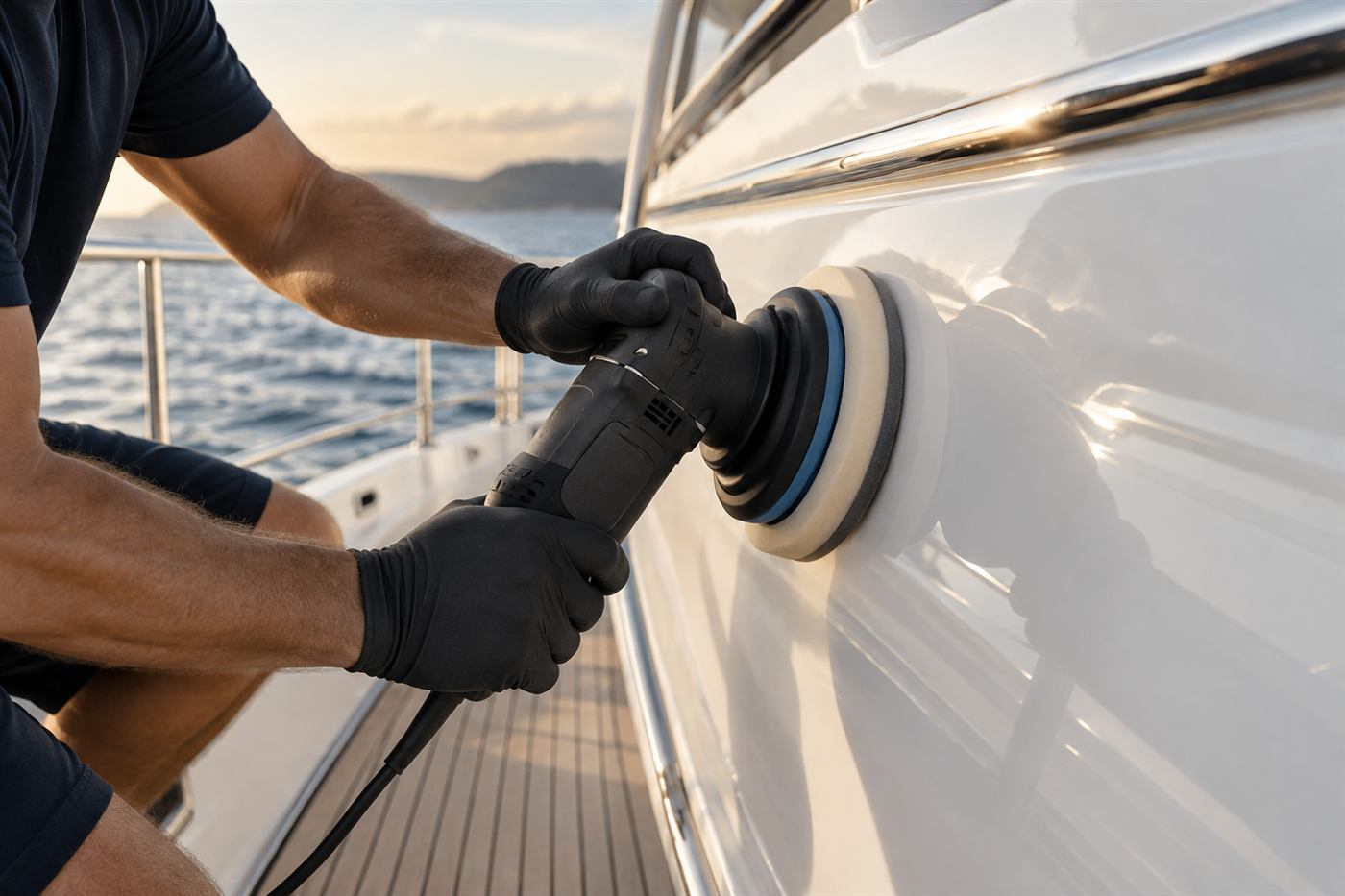
Compounding and polishing remove oxidation from gelcoat and restore its color and depth, within the limits of how much gelcoat is left. Painted hulls need a more careful approach, since paint is thinner and not meant to be cut the way gelcoat can be. If your hull is painted, tell us at the start, and read about it on our painted hull care page.
Protection after correction is a choice between wax, sealant and ceramic coating, and each has its place. Wax is simple and easy to reapply. Sealants last longer. Ceramic coatings form a harder layer. We compare them plainly in wax, sealant and ceramic compared. We do not promise years of performance, since washing habits and storage conditions change the outcome.
Teak, brightwork and interiors
Many Stuart boats, particularly older cruisers and trawlers, carry teak and varnished brightwork. Teak grays in the sun, takes up stains and can turn sticky or black in damp spots. Cleaning it well is a matter of the right products and a light hand, because aggressive scrubbing wears away the soft grain and shortens the life of the wood.
Our page on teak deck care describes what we do, and the guide on protecting teak between details offers simple habits for owners. If teak is cracked, lifting or leaking at the seams, that is a repair, and cleaning will only make the problem more visible.
Inside the boat, humidity is the constant adversary. Cabins that stay shut collect mildew on vinyl, carpet and headliner, and bilge odors can drift upward. Interior detailing cleans and sanitizes the surfaces you touch and notes any signs of moisture, but a recurring leak needs a repair. Ventilation and a dehumidifier on shore power help owners keep a cabin fresh between visits.
Trees, shade and debris along the river
Much of the Stuart waterfront is green. Mangroves line parts of the river and lagoon, oaks and palms overhang private docks and the town has a lot of established shoreline landscaping. That greenery is part of the charm, and it is also a source of cleaning work. Leaves, blossoms, seed pods and sap land on decks and covers, and under a tree the surfaces below stay damp longer than they would in open sun.
Damp organic matter is where black spotting and green film begin. It shows up first on canvas, on the north-facing side of cabin tops and in the seams of non-skid. Tree sap leaves tacky spots that attract dirt, and some blossoms leave stains that look like rust or tea. Most of these respond to a gentle wash with the right cleaner, but they are easier to remove when they are fresh and not baked on by the sun.
Shade is not all bad. A boat that sits partly shaded takes less ultraviolet damage than one in full sun. The trade-off is moisture and growth, so the best habit is to rinse off debris regularly and let the boat dry. A technician will point out where growth is starting and suggest a routine to keep it from coming back. Our page on green algae on deck explains what that growth is and how it is cleaned safely.
Hurricane season on the Treasure Coast
Stuart, like the rest of Florida, lives with hurricane season each year, and owners here take storm preparation seriously. Preparation decisions, such as whether to haul the boat, move it to a protected spot or double up the lines, belong to the owner, the marina and the people who know the boat. A detailer does not decide that, and we do not give safety advice about riding out a storm aboard. Follow official guidance and local marina instructions.
What detailing can contribute is the cleaning side of the cycle. Before a storm, a wash-down and the removal of loose gear is part of getting the boat ready. After a storm, once it is safe to go aboard and the boat has been assessed and documented, salt, debris and mildew risk are the main cleaning concerns. Our guides on hurricane season yacht preparation and cleaning and after a storm yacht cleaning cover those steps in plain terms.
If a storm has damaged your boat, photographs and a written record come first, and any repair belongs to the appropriate professionals. Cleaning comes afterward. We would rather tell you to wait than wash away evidence your insurer may want to see.
Working around boatyards, docks and access in Stuart
Boats in Stuart are kept in many different ways: at marinas, at boatyards, on private docks along the river, on lifts behind waterfront homes and on moorings or at anchor. Each arrangement changes how a detailer works. A boat on a lift can be cleaned from a ladder or platform. A boat at a boatyard may be subject to the yard's rules about outside vendors. A boat on a mooring needs a tender and a plan.
When you call, tell us how the boat is kept, whether water and power are available at the dock and whether any rules apply to outside contractors. Many marinas and yards have clear policies, and our guide to dockside detailing and marina rules explains what to expect. If a post-haul-out detail is in order, our page on post haul-out detailing describes that service.
Quotes are given only by phone, because the right price depends on the boat, its condition, the work and the access. For complicated jobs we may suggest an on-site visit first, which carries a service call charge explained on the phone before dispatch. We do not promise arrival windows. When you are ready, call, and we will talk through your boat in Stuart.
Questions people ask
Do you detail liveaboard and cruising sailboats in Stuart?
Yes. Sailboats have their own concerns: canvas and sail covers prone to mildew, rigging overhead, stainless that collects rust and decks full of hardware. We plan the visit around the boat and around the people living aboard, so the work is done with minimal disruption. Tell us on the phone how the boat is kept and whether anyone will be aboard.
Why does my hull get brown stains on the St. Lucie River?
River and lagoon water here is brackish and often tinted by natural tannins, which leave brown marks at the waterline. Slime and light growth can add to it. Above the waterline we can usually clean the staining. Heavy growth below the water belongs to a bottom-cleaning professional rather than a detailer.
Can you restore an older, oxidized fiberglass hull?
Often we can improve it considerably through compounding and polishing, but results depend on how much gelcoat is left and how deep the oxidation goes. We check the surface first and tell you honestly what is realistic. We do not promise a mirror finish on a hull that has been neglected for a long time.
What is the difference between detailing and bottom cleaning?
Detailing covers everything at and above the waterline: washing, polishing, protecting, teak, canvas, glass, hardware and interiors. Bottom cleaning removes growth from the underwater hull, running gear and props, and is done by a diver or a haul-out. If you are not sure where a problem sits, send a photo when you call.
Is there a price list I can look at?
No. We give quotes only by phone, because boat size, condition, access and the work you want all change the answer. For complicated jobs we may suggest an on-site visit first. A service call charge applies to that visit, and we explain it before anyone is dispatched.
Do you work at boatyards and on private docks?
Yes, where access allows. Many yards and marinas have rules for outside vendors, and private docks may have gates or community requirements. Tell us where the boat is kept and what water and power are available when you call, and we will plan the visit around it. If something is missing, we will tell you ahead of time.
Describe the situation by phone and we will tell you what the job involves. Quotes are given by phone. Jobs that cannot be quoted without seeing them need a technician on site, and the service call charge is explained on the phone before anyone is dispatched.
(954) 719-3572