Where the crust comes from
Seawater is mostly water with a heavy load of dissolved salts. When spray or a wave lands on a deck and the water evaporates, the water leaves and the salt stays. Repeat that through a day on the water and the surface builds up a thin, often invisible layer. Give it a few days in the sun and a boat can look like it has been dusted with powdered sugar.
South Florida conditions speed this up. Warm air and strong sun dry the spray quickly, so the salt crystallizes on the surface before there is any chance for it to run off. Onshore wind carries a fine salt mist even to boats that never leave the slip, especially those on the Intracoastal and near inlets such as those along the Atlantic coast. A boat that sits in a marina close to open water collects salt without going anywhere.
Salt is also hygroscopic, which means it attracts moisture from the air. A salty deck does not truly dry out overnight. It pulls humidity back in and stays damp, which keeps corrosive conditions alive on metal and encourages mildew on fabrics and non-skid. That is why a salt coated boat can look dry in the afternoon and feel tacky or damp in the morning.
What salt does to the different parts of a boat
On gelcoat and paint, salt is abrasive. Crystals are hard little grains, and wiping a dry, salty hull spreads them across the surface like fine sandpaper. That is a major source of swirl marks and haze. Washing with plenty of fresh water before touching the surface is the key step. See our page on scratches and swirl marks for the details.
On stainless steel and aluminum, salt is a corrosion driver. Even marine grade stainless is not rust proof, and it relies on a thin oxide layer that salt deposits and trapped moisture can break down. The brown spotting called tea staining is a common result. Aluminum shows white powdery pitting. Both are much easier to prevent than to remove.
On glass and clear plastic, dried salt etches and scratches, and sea spray left in the sun can leave permanent spotting. Isinglass and acrylic panels cloud when wiped dry.
On canvas, upholstery and non-skid, salt traps dirt, holds moisture and feeds mildew. It also stiffens and wears stitching over time. Fabrics that are repeatedly soaked with salt and left to dry deteriorate faster than those that are rinsed.
Salt and electrical gear
Electrical corrosion is the most expensive consequence of neglected salt, and the one owners are most surprised by. Salt in the presence of moisture is conductive. On connectors, terminal blocks, switches, lights and exposed wiring, it creates paths where current does not belong, and it corrodes copper and fittings from the inside out.
The usual signs are green or white crusty growth on terminals, flickering lights, gauges that misbehave, connectors that run warm, and breakers or switches that start to stick. Often the problem begins slowly and the first complaint is something minor, such as a light that works only when wiggled.
Rinsing is still the right habit, but electrical equipment needs care. Do not aim a hose or pressure washer at helm electronics, open panels, connector plugs or anything that is not rated for direct spray. Wipe those areas with a barely damp cloth, and have a qualified marine electrician inspect connections that look corroded. We do not do electrical repairs, and we do not recommend owners take apart live circuits to clean them.
What we can do is keep the surrounding areas clean, remove salt from fixtures and the helm console exterior, and flag signs of corrosion we notice so you can have a marine electrician look at it.
The fresh water rinse routine
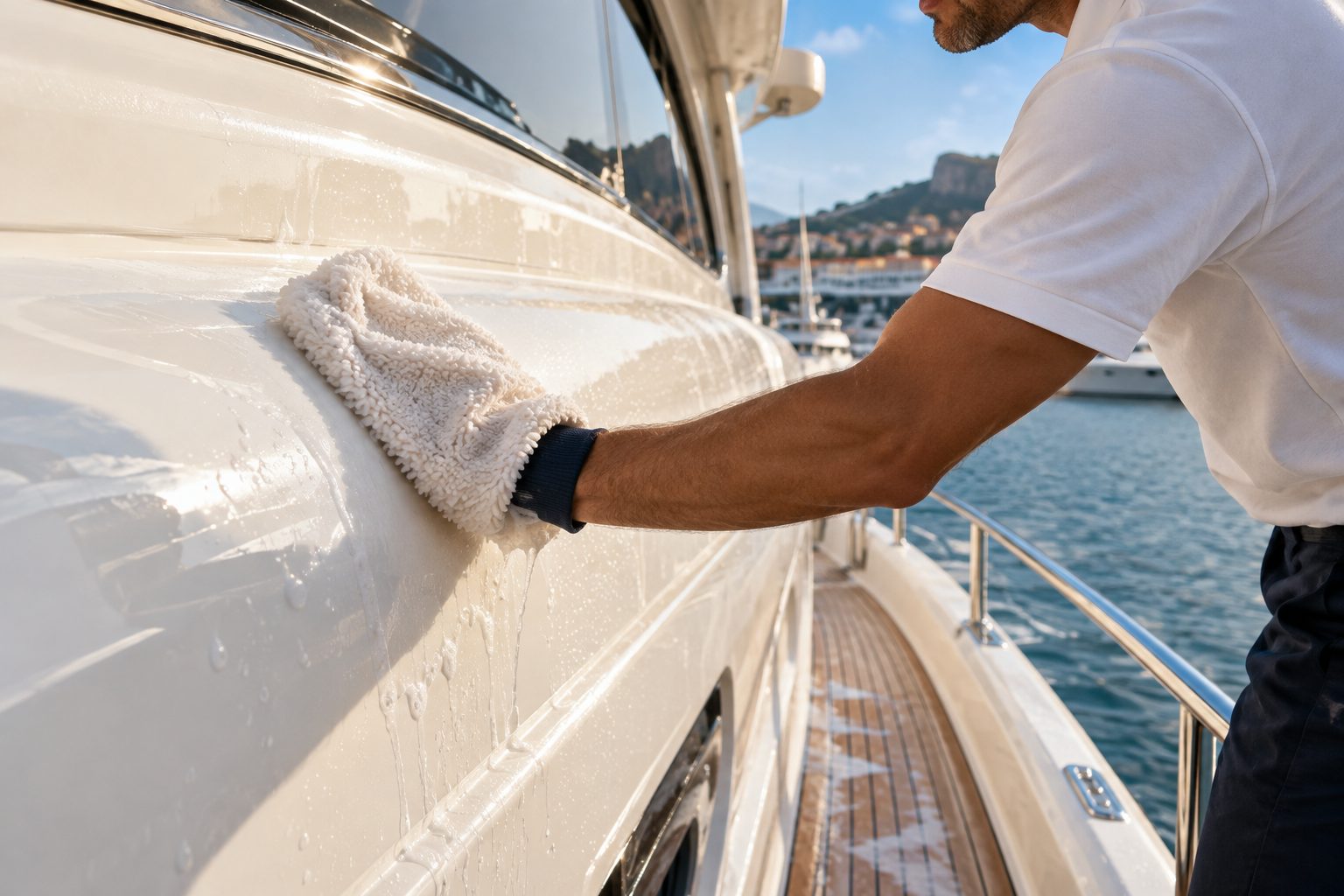
The best fix for salt is not a product. It is fresh water, used soon and used often. A rinse after each outing keeps salt from sitting and drying. It takes a few minutes and prevents much of what a detailer later has to undo.
Begin from the top and work down so that runoff and rinse water do not re-salt the areas already done. Start with the flybridge or hardtop, then windows and the cabin top, then the sides, then decks and the cockpit, and finally the swim platform. Rinse the hull sides and the rail caps. Give hardware its own attention.
Use a gentle flow, not a hard jet. A regular garden hose with a nozzle on a soft setting does most of the work. If a hose is not available at the dock, a pump sprayer or a bucket of fresh water used from the top down is better than nothing.
Rinse thoroughly rather than quickly. Pay attention to cleats, stanchion bases, hinges, latches, rod holders, windlass areas, and the spots where water pools or hides. Open hatches and lockers briefly and rinse the sills and gaskets, then dry them.
After the rinse, let the boat drain and, where it makes sense, wipe the glass and stainless dry with a clean microfiber towel. Drying prevents the spotting that happens when water evaporates and leaves minerals behind, which is especially a concern where the dock water is hard.
Rinse checklist for after a run
- Rinse the hull sides and transom from the top down with a soft flow of fresh water.
- Rinse windows and clear panels thoroughly before wiping, so no salt is dragged across the surface.
- Rinse all stainless and aluminum hardware, including cleats, rails, stanchion bases and hinges.
- Flush the cockpit and deck, and rinse scuppers so drains stay clear.
- Rinse canvas and upholstery where spray reached them, and let them air dry fully before covering.
- Rinse the swim platform, ladder and any dinghy or tender gear that was wet.
- Wipe, do not spray, electronics and connectors, and check that nothing is dripping into panels.
- Dry the glass and bright metal with a clean microfiber towel to avoid water spotting.
What not to do
Do not wipe a salty surface dry. Dry wiping drags crystals across paint, gelcoat and glass. Always float the salt off with water first.
Do not use a high pressure jet at close range. A pressure washer can drive water behind hatch seals and into electrical fittings, lift sealant and canvas stitching, and damage paint edges. Our guide on avoiding pressure washer damage explains the safe approach.
Do not rely on dock water that is not clean. Some marinas supply water that is fine for rinsing, while others have hard water with minerals that leave spotting on glass. Dry glass and polished metal after rinsing to avoid it.
Do not reach for household descalers and acidic cleaners on stainless, aluminum or gelcoat. They can etch and strip protective finishes. See our guide on why household cleaners damage boats.
Do not leave a boat salted for weeks and assume a single hard wash will catch up. Some of the damage, such as pitting, is permanent by the time it shows.
Salt in the marina versus salt offshore
A boat that runs offshore in a swell collects the heaviest salt loads, with spray reaching the flybridge and sometimes the cabin top. Sportfish and center consoles that run in a chop often come back with white tracks down the hull sides and heavy crystals on rails and windshields.
A boat that rarely leaves the slip still gets a steady supply. The mist off the water, the spray from passing boat wakes and the salty air carry a thin film that builds over weeks. Owners of docked boats in Fort Lauderdale, Miami and the Keys sometimes assume their boat is safe because it never moves, and they find that the hardware has still spotted.
Rain helps a little but does not solve the problem. A light shower can dissolve part of the salt and move it around, and then leave it as streaks and spots when it dries. Heavy rain rinses more thoroughly, but not underneath canvas, in sheltered corners or under rails.
Hurricane season adds another source. Storm spray and surge can coat everything. Our guide on cleaning a yacht after a storm covers that case.
Hardware and stainless care
Stainless steel hardware is where salt does its slow, expensive work. Cleats, rail fittings, hinges, windlass parts, rod holders and stanchion bases are exposed to splash and spray, and many sit in crevices where moisture lingers. Rust colored stains that appear on these parts are usually surface corrosion, and they bleed onto gelcoat and teak below.
A regular rinse, a periodic cleaning with a gentle metal cleaner, and a protective layer of a marine metal sealant or polish keeps stainless bright and slows staining. Fresh water and a soft cloth remove most light deposits. Heavier staining needs a dedicated metal cleaner and careful polishing. See our stainless polishing service.
Pitting is a different matter. If the metal surface is already deeply pitted, cleaning will not restore it, and the metal may need replacement or professional refinishing. We tell owners plainly when metal is past the point where polishing helps.
Fasteners and screws in teak, canvas snaps and zippers also need attention. Salt in zippers makes them stiff and eventually breaks them. A rinse and a drop of a suitable lubricant keeps them working.
Decks, non-skid and teak
Non-skid surfaces trap salt in their texture. A soft brush and plenty of fresh water lifts it out. If salt and dirt are left to build up, the texture clogs, grip drops, and mildew finds a home. Our page on non-skid deck cleaning covers the deeper clean.
Teak weathers faster with salt. The salt holds moisture in the grain, and teak that stays damp is more likely to blacken and grow mildew. Rinse teak after use, and avoid scrubbing across the grain with harsh brushes. If you want the wood to last, see our teak deck care service and the guide on protecting teak between details.
Vinyl and fabric surfaces should be rinsed gently, with attention to seams where salt gathers. Letting cushions dry in the air before storing them below prevents musty smells.
Scuppers and drains deserve a look too. A scupper clogged with salt, dirt and debris will hold water on the deck, which keeps everything wet longer and makes the salt problem worse.
When a detailer is the right call
Most owners and crews can handle the routine rinse. A detailer is useful when salt has been allowed to build up, when hardware has begun to stain or pit, when glass has been scratched or spotted, or when the boat is simply too large or too busy to keep up with.
A good detailing visit starts with a thorough fresh water wash to float off the salt, then a proper cleaning of the hull and deck. After that come targeted steps such as metal cleaning, glass care and a protective layer to make the next rinse easier. The aim is a boat that is easier to maintain, not just one that looks clean on the day.
We can also set up a recurring plan so that a technician handles the washdown on a schedule. See our recurring maintenance plans and the exterior wash down service.
Quotes are by phone only. If a boat has hardware damage, heavy buildup or unknown conditions, an on-site visit comes first. There is a service call charge, explained on the phone before anyone is dispatched. When you call, tell us how often the boat runs, where it is kept, and what you are seeing, and we will say what a sensible plan looks like. Call when you are ready to talk it through.
Questions people ask
How soon after a run should I rinse the boat?
As soon as is practical, ideally the same day. Salt dries within hours in warm sun and starts attracting moisture and attacking metal right away. A quick rinse from top to bottom with fresh water, followed by drying glass and bright metal, prevents much of the damage that appears later. A rinse a day or two later still helps.
Is it fine to rinse electronics and helm panels with a hose?
No. Keep hose spray and pressure washers away from helm electronics, open panels, connector plugs and anything not rated for direct spray. Wipe those areas with a barely damp cloth. If you see green or white crust on terminals or connectors, have a qualified marine electrician inspect them rather than cleaning live circuits yourself.
Does rain wash the salt off for me?
Only partly. Rain can dissolve some salt and move it around, then leave streaks and spots as it dries. It rarely reaches under canvas, rails and sheltered corners. A proper fresh water rinse by hand is still needed, especially around hardware and in areas the rain does not hit.
Why does my boat feel damp or sticky the morning after it dried?
Salt attracts moisture from the air, so a surface that looked dry in the afternoon can pull humidity back overnight. That tacky film means salt is still on the surface. A thorough fresh water rinse removes it, and drying with a clean microfiber towel keeps it from returning quickly.
Can salt damage be reversed once metal is pitted?
Surface staining and light corrosion can often be cleaned and polished. Deep pitting cannot, because the metal itself has been eaten away. Polishing may improve the look but not the surface. We tell owners plainly when hardware is past the point where cleaning helps and replacement or refinishing is the better route.
Can you set up regular washdowns for my boat?
Yes, recurring service can be arranged for many boats and marinas. Details, scope and quotes are handled by phone. Tell us the marina, vessel type and how often it runs, and we will talk through a schedule that fits. Larger or unusual jobs may need an on-site visit first, with the service call charge explained on the phone.
Describe the situation by phone and we will tell you what the job involves. Quotes are given by phone. Jobs that cannot be quoted without seeing them need a technician on site, and the service call charge is explained on the phone before anyone is dispatched.
(954) 719-3572Related pages
Seeing where salt hides after the obvious rinse
A good rinse removes the visible crust, but salt hides in places a hose does not reach well. A technician looks under cockpit cushions, behind hardware, inside winch bases, along hinge lines, and in the grooves of non-skid. Salt also settles in the threads of fasteners and in the gaps around windows and hatches. Running a finger along these areas often picks up a gritty film that looks clean from a distance. Finding these pockets is the first step to keeping salt from slowly working into places where it can cause trouble.
The second place to look is where water cannot drain. Corners of cockpit sole, recesses around lockers, and low spots on the deck hold salty water that evaporates and leaves a crust. Over time that crust attracts moisture from the air and keeps things damp. Canvas seams and zipper tracks also trap salt, which can stiffen zippers and make fabric feel rough. We note which areas hold the most and plan to clean them with fresh water, soft brushes, and patience, rather than scraping or using harsh tools.
After cleaning, we wipe or dry the key areas so that new moisture does not pull salt back out of crevices. We tell the owner which spots need special attention in future rinses, such as a particular hinge or a corner that never drains well. We do not service electronics or mechanical parts, and we do not apply lubricants to moving equipment unless the owner agrees. The scope is explained before work begins, any quote is shared first, and no extra work starts without your agreement.