Why Juno Beach boats are different from big-harbor boats
Juno Beach sits in northern Palm Beach County, between Jupiter to the north and North Palm Beach to the south. The town is mostly a narrow strip between the Atlantic and the Intracoastal Waterway, and that geography shapes how people keep boats here. There is no single giant marina that defines the town. Instead, owners tend to use a mix of private residential docks, community slips behind waterfront condominiums and houses, and marinas in neighboring towns a short drive or a short run away.
For detailing, that mix matters. A detailer working at a big harbor can service a dozen boats on one visit, with one entry gate, one set of rules and one dock layout. A detailer working around Juno Beach often services one boat at a time, at an address that may be a private dock behind a gated community, with its own access arrangements. That makes scheduling more personal. It also means the owner or captain usually has to coordinate access ahead of time, which we cover further down this page.
None of this makes the boats any harder to clean in principle. A motor yacht, a center console or a sailboat at a Juno Beach dock gets the same careful process as anywhere else on this coast. What changes is logistics: how the detailer gets onto the property, where water and power come from, what the neighbors will tolerate, and how the work fits around the boat's actual use.
Salt, spray and the open ocean nearby
Juno Beach is close to the Atlantic, and it is close to an inlet route that boats use to get offshore. A boat that runs out through the nearest inlet and returns the same day arrives home covered in dried salt. That film is mostly sodium chloride, and it is the main reason boats in South Florida need regular washing. Left on gelcoat, painted surfaces, glass and metal, it holds moisture against the surface, dulls shine over time and speeds up corrosion on anything metallic.
Even a boat that never leaves the dock collects salt. Onshore breezes carry a fine mist inland, and a dock only a short distance from the beach can see a light salt haze settle on horizontal surfaces after a windy week. Stainless rails, cleats, window frames and hatches show it first, as a cloudy bloom or tiny rust-colored freckles. Our page on stainless hardware cleaning explains what that bloom is and how it is handled safely.
The practical takeaway for Juno Beach owners is simple. Fresh water rinsing after every outing does more than any product, and a periodic professional wash-down removes what a quick rinse misses: the salt in seams, under rub rails, behind hardware and in the textured surfaces of the deck. Read more about that routine in how to rinse after saltwater use.
Docks, access and what to arrange before a visit
Because so many boats near Juno Beach sit at private or community docks, access is the first thing we sort out on the phone. Questions that come up again and again include whether there is a gate and who controls it, whether the dock has fresh water and shore power available for the detailer, whether there is a place to park close to the dock, and whether the community has rules about outside vendors, noise or working hours.
Some condominium associations and waterfront communities require vendors to be on a list, to carry certain paperwork or to check in with a manager. Others have no formal process at all. The owner or captain is the right person to know, and a short message to the property manager before the visit usually clears everything up. A marina, by contrast, will often have a written policy on outside contractors, which is explained in our guide to dockside detailing and marina rules.
If water or power is not available at the slip, tell us when you call. Detailing can be planned around that, but the plan has to be made in advance, not discovered at the dock. We would rather ask more questions up front than arrive and find a locked gate.
- Gate or access instructions for the day of the visit
- Whether fresh water and shore power are on at the dock
- Where the detailer may park and unload
- Any community rules on vendors, hours and noise
- Who will be aboard, or who has the keys and the alarm code
What a typical wash-down covers on a Juno Beach boat
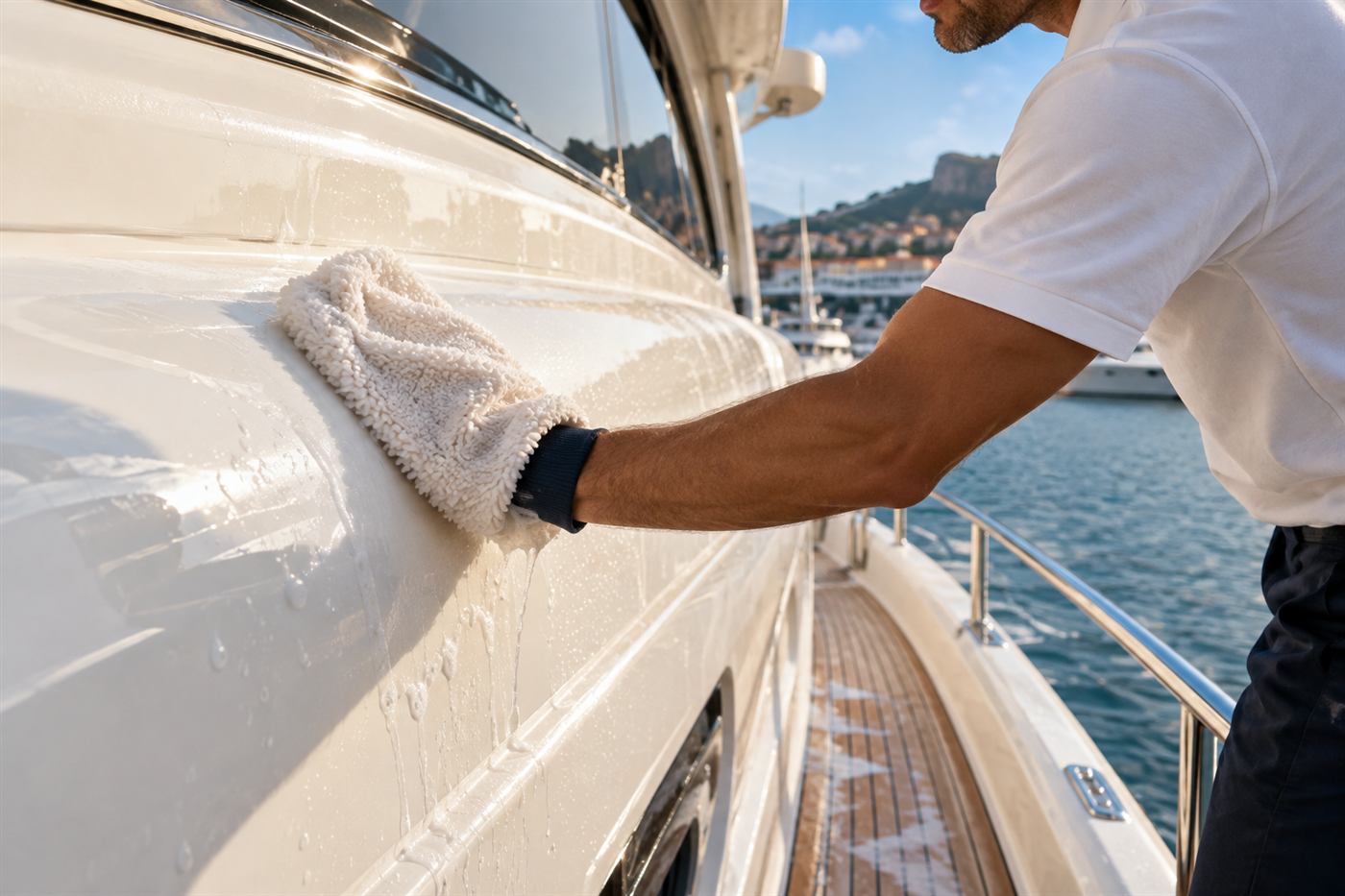
A full exterior wash-down starts with a fresh water rinse to lift loose salt and grit before any wash mitt touches the surface. Rubbing grit across gelcoat is how swirl marks are made, so the rinse is not a formality. After that comes a marine-safe wash with a mild soap, worked from the top down so that dirty water runs over unwashed areas rather than clean ones. Hardware, glass, canvas and non-skid are each handled with the method that suits them.
The detail that makes the biggest visible difference on boats near the inlet is the waterline. Dock lines, fenders and tide leave brown and gray bands that ordinary soap does not lift. They respond to a purpose-made cleaner and some patience, and our page on waterline stain removal describes how that works and when a stain is too deep for cleaning alone.
The full routine is described on exterior wash-down. For a boat that stays in the water and is used regularly, a wash-down is the foundation. Polishing, sealing and coating build on top of it, and none of them hold up well over a surface that was not properly cleaned first.
Oxidation and the sun on boats kept outdoors
Many Juno Beach boats are kept on open docks with no covered slip, which means long hours of direct sun every day of the year. Ultraviolet light and heat break down the surface layer of gelcoat over time. The result is oxidation: a chalky, faded look that starts on the surfaces facing the sky, such as the cabin top, the foredeck and the upper sides of the hull, and slowly spreads.
Light oxidation can often be corrected by machine compounding and polishing, which removes the thin dead layer and exposes fresh gelcoat underneath. Heavy oxidation may need more than one step, and gelcoat is not unlimited, so a good detailer will check how much surface remains before committing to an aggressive approach. The process is explained in compound and polish and in the guide on understanding oxidation.
After correction, a protective layer is what keeps the result. Wax, sealant and ceramic coatings all do that job differently, and the comparison page on wax, sealant and ceramic helps owners choose with the right expectations. We do not promise a particular lifespan for any of them, because sun exposure, washing habits and storage vary too much from boat to boat.
Teak, canvas and soft goods in a sunny, salty setting
Boats near the ocean show age on their softer materials first. Teak decks and trim silver and dry out when sun and salt strip the oils. Canvas and vinyl collect mildew in shaded folds and fade where the sun hits. Isinglass and clear vinyl windows cloud and scratch if they are wiped dry or cleaned with the wrong product.
Each of these materials has its own care routine, and each can be damaged by well-meant but wrong cleaning. Harsh brushes tear up teak grain. Household cleaners can strip the stitching coating on canvas. A pressure washer can drive water through seams and into cabins. Our guide to avoiding pressure washer damage and our page on teak deck care go into the reasoning.
If you are not sure whether a material on your boat is teak, synthetic teak, painted wood or something else, say so on the phone. The correct method depends on the material, and guessing is how surfaces get damaged. A photo of the area is helpful and usually settles the question quickly.
Sea turtle season, lighting and good neighbors
Juno Beach is well known for sea turtle nesting, and the town is home to a marine turtle center that visitors often know by reputation. Nesting season runs through the warm months, and communities along the beach are careful about lighting and disturbance. Boats on the Intracoastal side are not on the beach, but the general culture of the town is a respectful one, and owners should expect neighbors to care about noise, bright lights and chemical runoff.
That culture fits how detailing ought to be done anyway. Runoff from washing should be kept to marine-safe products, and harsh solvents should be controlled so they do not end up in the water. Work should be done at reasonable hours and with reasonable noise. Our guide to environmental practices in yacht detailing explains the approach.
If your dock or community has its own preferences, such as no machine polishing before a certain hour or limits on running a generator, tell us. A detailer who knows the rules in advance can plan the day around them, and the neighbors will have no reason to complain.
Interiors, humidity and boats that sit between trips
Many Juno Beach boats are weekend boats. They are used on Saturday and Sunday and then closed up for the week in warm, humid air. A closed cabin with no airflow is a good place for mildew to start, and it often starts out of sight: behind cushions, inside lockers, under mattresses and in the carpet near the bilge access.
An interior detail on a boat like this is part cleaning and part inspection. A technician will notice a musty smell, damp cushions, spotting on the headliner or dark growth on vinyl, and can tell you what is surface mildew and what might point to a leak. A leak is a repair job, not a cleaning job, and we will say so plainly rather than clean over a problem that will return. The page on interior mildew treatment covers the process.
Owners can help between visits by running air conditioning or a dehumidifier when the boat is on shore power, opening lockers and cushions to let air move, and wiping up spills right away. Our guide to yacht interior humidity control has practical ideas that do not require extra equipment.
Matching the service to the boat and how it is used
A fishing boat that runs offshore every weekend needs something different from a cruiser that mostly sits at the dock with a few sunset trips a month. The first needs frequent washing and attention to hardware and fishing-related stains. The second needs steady protection from sun and humidity, and attention to what accumulates when the boat is idle.
Vessel type matters as well. A center console has exposed electronics, a lot of non-skid and a big open cockpit. A motor yacht has more interior, more glass and more flybridge to look after. A sailboat has rigging, sail covers and a lot of lines. See our pages on center console detailing, motor yacht detailing and sailboat detailing for how each is approached.
Many owners find that a recurring schedule, rather than a rescue every few months, is easier on the boat and on the budget. How often is right depends on use, exposure and what you want the boat to look like. The guide on maintenance schedules by vessel use lays out the thinking, and we will talk it through on the phone.
How to book, what to have ready and how pricing works
Quotes are given by phone only. We do not publish prices, because the right answer depends on the size of the boat, its condition, the work you want done and the access at your dock. A short conversation lets us ask the right questions and give you a clear answer instead of a guess. If the job is complicated, we may suggest an on-site visit first. There is a service call charge, and it is explained on the phone before anyone is dispatched.
To make the call efficient, have a few things ready: the length and type of the boat, where it is kept, what you would like done, any problem areas you have noticed, and a couple of photographs if you can. If there is a deadline, such as a trip, a sale or a guest weekend, mention it. We will tell you honestly what is realistic.
If you are weighing options, read how to choose a yacht detailer and what to ask before hiring one. Those pages are written to help you compare anyone you are considering, including us. When you are ready, call and tell us about your boat near Juno Beach, and we will take it from there.
Questions people ask
Do you detail boats kept at private docks near Juno Beach?
Yes, access permitting. Many boats in this area sit at residential or community docks rather than at a large marina. When you call, tell us about the gate, parking, fresh water and shore power at the dock, and whether the community has vendor rules. With that information we can plan the visit properly, and if something is missing we will tell you before anyone is dispatched.
How often should a Juno Beach boat be washed?
It depends on use and exposure. A boat that runs offshore regularly collects salt quickly and benefits from a fresh water rinse after every outing and a professional wash on a regular schedule. A boat that mostly sits needs less frequent attention but still collects haze and growth. We will suggest a rhythm on the phone after hearing how you use the boat.
Can you remove the brown band at the waterline?
Often, yes. Those bands come from tide, dock lines and the water itself, and a purpose-made cleaner with careful work lifts most of them. If the stain has soaked into old or damaged gelcoat, cleaning may improve it without fully removing it, and polishing may be needed. We will explain what is realistic once we see photographs or the boat itself.
Will detailing fix a musty smell inside my boat?
Sometimes, but the smell is a clue, not just a nuisance. If the cause is surface mildew on cushions or vinyl, cleaning and drying can solve it. If the cause is a leak, wet carpet or a bilge issue, cleaning alone will not hold. A technician will check what they can and tell you plainly if the source needs a repair from someone else.
Can I get a price from the website?
No. Quotes are given only by phone, because the right answer depends on the boat, its condition, the work you want done and how we can get to it. For complicated jobs we may recommend an on-site visit first. A service call charge applies for that, and we explain it on the phone before anyone is sent.
Do you promise a certain arrival time?
We do not promise arrival windows, because dock access, weather and the length of the previous job all affect the day. What we do is confirm the plan with you in advance, tell you what to expect and keep you informed if something changes. Calling early in the week for a weekend visit is the best way to get the day you want.
Describe the situation by phone and we will tell you what the job involves. Quotes are given by phone. Jobs that cannot be quoted without seeing them need a technician on site, and the service call charge is explained on the phone before anyone is dispatched.
(954) 719-3572